Home
Class 11
PHYSICS
A particle movesin the X-Y plane with a ...

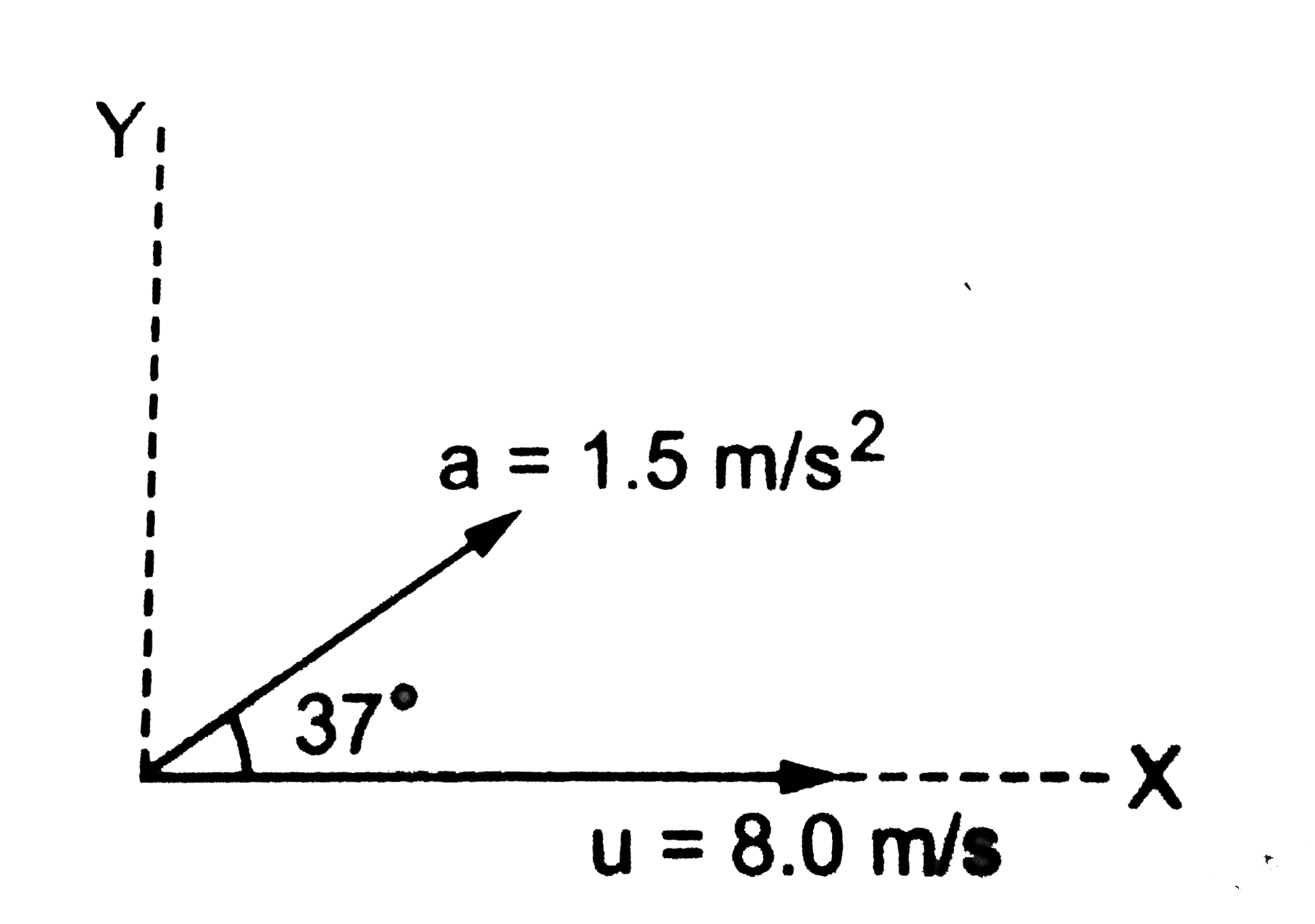
A particle movesin the X-Y plane with a constasnt acceleration of `1.5 m/s^2` in the direction making an angle of `37^0` with the X-axis.At t=0 the particle is at the orign and its velocity is 8.0 m/s along the X-axis. Find the velocity and the position of the particle at t=4.0 s.

Text Solution

Verified by Experts

`a_x=(1.5 m/s^2) (cos37^0)`
`=(1.5 m/s^2)xx4/5 = 1.2 m/s^2`
and a_y=(1.5 m/s^2)(sin37^0)`
`=(1.5 m/s^2) xx 3/5 = 0.90 m/s^2`. ltbr. The initial velocity has components
`u_x=8.0 m/s`
and `u_y=0`
`At t=0, x=0 and y=-0`
The x-component of the velocity at time t=4.0 s is given by
`v_x=u_x+a_xt`
`=8.0 m/s+(1.2 m/s^2)(4.0s)`
`=8.0 m/s+4.8 m/s=12.8 m/s`.
The y-componet of velocity at t=4.0 si given by
`v_y=u_y+a_y t`
`=0+(0.90 m/s^2)(4.0s)=3.6 m/s`
The velocity of the particle ast t=4.0 is
`v=sqrt(v_x^2+v_y^2)= sqrt(12.8 m/s)^2 +(3.6 m/s)^2`
`=13.3 m/s`.
The velocity makes an angle theta with the X-axis where
`tantheta= (v_y)/(v_x) = (3.6 m/s)/(12.8 m/s) = 9/32`
The x-coordiN/Ate at t=4.0 s is
` x= u_x t+1/2 a_x t^2`
`=(8.0 m/s)(4.0 s)+1/2 (1.2m/s^2)(4.0s)^2`
`=32m+9.6 m 41.6m.
The y=component at t=4.0 is
`y=u_y t+1/2 at^2`
`=1/2 (0.90 m/s^2)(4.0s)^2`
`=7.2m`
Thus, the particle is at (41.6 m, 7.2 m) at 4.0 s.
Promotional Banner

Similar Questions

Explore conceptually related problems

V_(x) is the velocity of a particle of a particle moving along the x- axis as shown. If x=2.0m at t=1.0s , what is the position of the particle at t=6.0s ?

If the velocity of a particle moving along x-axis is given as v=(3t^(2)-2t) and t=0, x=0 then calculate position of the particle at t=2sec.

Figure gives the x-t plot of a particle is one dimensional motion. Give the signs of position, velocity and acceleration of the particle at t = 0.3s

Acceleration of particle moving along the x-axis varies according to the law a=-2v , where a is in m//s^(2) and v is in m//s . At the instant t=0 , the particle passes the origin with a velocity of 2 m//s moving in the positive x-direction. (a) Find its velocity v as function of time t. (b) Find its position x as function of time t. (c) Find its velocity v as function of its position coordinates. (d) find the maximum distance it can go away from the origin. (e) Will it reach the above-mentioned maximum distance?

A particle moves along the X-axis as x=u(t-2s)+a(t-2s)^2 .

Acceleration of a particle moving along the x-axis is defined by the law a=-4x , where a is in m//s^(2) and x is in meters. At the instant t=0 , the particle passes the origin with a velocity of 2 m//s moving in the positive x-direction. (a) Find its velocity v as function of its position coordinates. (b) find its position x as function of time t. (c) Find the maximum distance it can go away from the origin.

The position of a particle moving along a straight line is given by x =2 - 5t + t ^(3). Find the acceleration of the particle at t =2 s. (x is metere).

The velocity of a particle moving in the positive direction of the x axis varies as v=alphasqrtx , where alpha is a positive constant. Assuming that at the moment t=0 the particle was located at the point x=0 , find: (a) the time dependence of the velocity and the acceleration of the particle, (b) the mean velocity of the particle averaged over the time that the particle takes to cover the first s metres of the path.

A particle stars from origin at t=0 with a velocity 5.0hatim//s and moves in x-y plane under action of a force which produces a constant acceleration of (3.0hati+2.0hatj) m//s^(2) . (a) What is the y- coordinate of the particle at the instant its x - coordinate is 84 m ? (b) What is the speed of the particle at this time ?

A particle moving with uniform acceleration passes the point x=2m with velocity 20 m//s at the instant t=0 . Some time later it is observed at the point x=32 m moving with velocity 10 m//s .What is its acceleration ?What is its velocity at 8 sec?
