Home
Class 11
PHYSICS
Three particles A, B and C are situated ...

Three particles A, B and C are situated at the vertices of an equilateral triangle ABC of side d at time `t=0.` Each of the particles moves with constant speed v. A always has its velocity along AB, B along BC and C along CA. At what time will the particles meet each other?

Text Solution

Verified by Experts
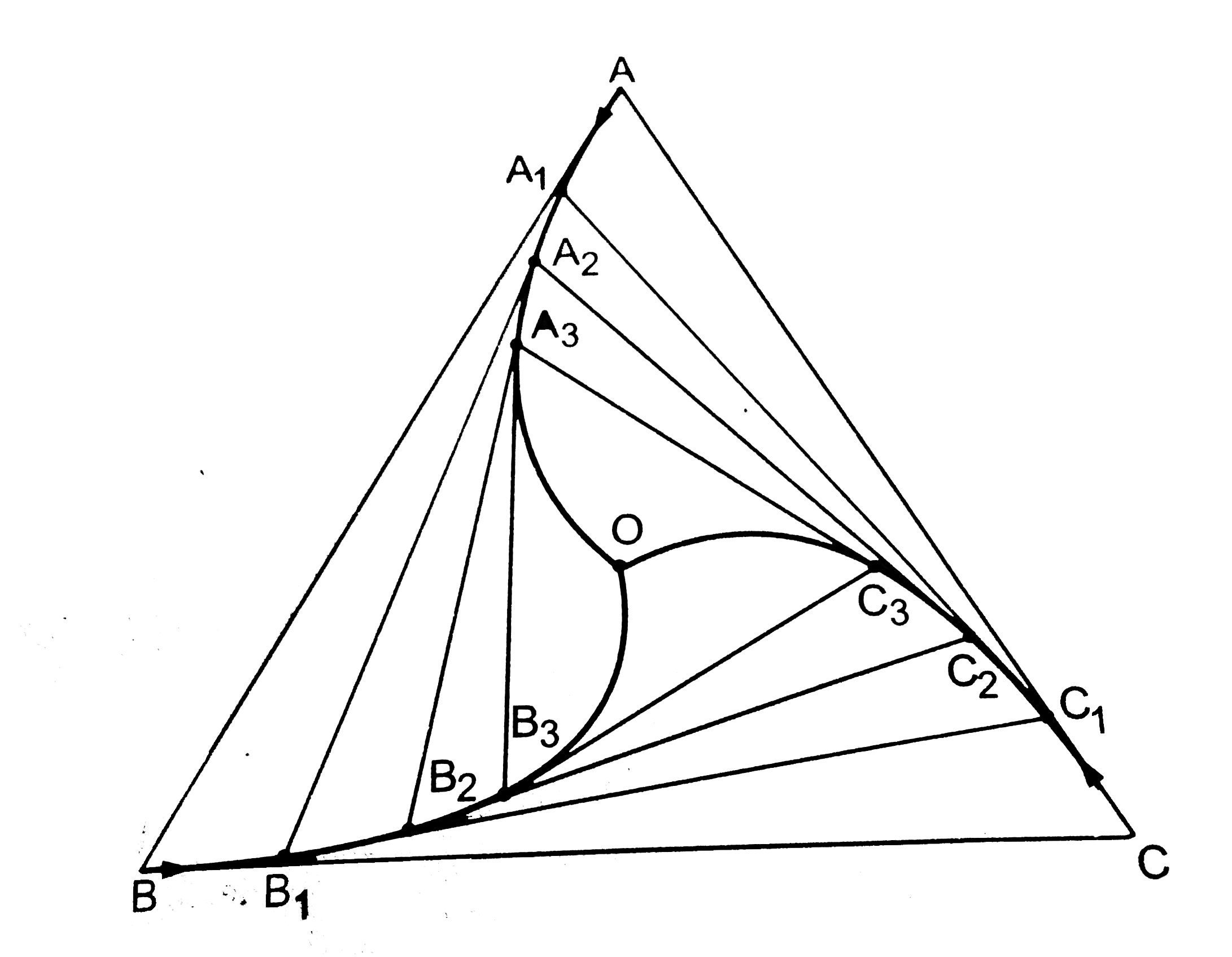
The motion of the particles is roughly sketched in ure. By symmetry they will meet at the centroid O of the triangle. At any instnt the particles will form an equilatgeral triangel ABC with the same centroid O. Concentrate on the motion of any one particle say A. At any instant its velocity makes angle `30^0` with AO.

The component of this velocity along AO is v cos 30^0`. This component is the rate of decrease of the distasnce AO.
Initially,
`AO=2/3 sqrt(d^2-(d/2)^2)=d/sqrt3`
There the time taken for AO to become zero
`=(dsqrt(3))/(v cos 30^0)=(2d)/(sqrt(3 vxxsqrt3)=(2d)/(3v)`
AlterN/Atively : Velocity of A is v along AB. The velocity of B is along BC. Its component along BA is`v cos 60^0 =v/2`. Thus, the speration AB decreases at the rate
`v+v/2=(3v)/2`
Since this rate is constant, the time taken in reducing the separation AB from d to zero is
t= d/(3v)/2 = (2d)/(3v)`.
Promotional Banner

Similar Questions

Explore conceptually related problems

Three boys A,B and C are situated at the vertices of an equilateral triangle of side d at t=0. Each of the boys moves with constant speed v. A always moves towards C and C towards A, At what time and where they meet each other?

Three particles A, B, Care located at the comers of an equilateral triangle as shown in figure. Each of the particle is moving with velocity v. Then at the instant shown, the relative angular velocity of

Three particles, each of the mass m are situated at the vertices of an equilateral triangle of side a . The only forces acting on the particles are their mutual gravitational forces. It is desired that each particle moves in a circle while maintaining the original mutual separation a . Find the initial velocity that should be given to each particle and also the time period of the circular motion. (F=(Gm_(1)m_(2))/(r^(2)))

Find the centre of mass of three particles at the vertices of an equilateral triangle. The masses of the particles are 100g, 150g, and 200g respectively. Each side of the equilateral triangle is 0.5m long.

n' number of particles are located at the verticles of a regular polygon of n sides having the edge length 'a'. They all start moving simultaneously with equal constant speed 'v' heading towards each other all the time. How long will the particles take to collide?

Three particles of masses 1 kg, 2 kg and 3 kg are situated at the corners of an equilateral triangle move at speed 6ms^(-1), 3ms^(-1) and 2ms^(-1) respectively. Each particle maintains a direction towards the particles at the next corners symmetrically. Find velocity of CM of the system at this instant

A particle moves with constant speed v along a regular hexagon ABCDEF in the same order. Then the magnitude of the avergae velocity for its motion form A to

Three point particle A, B and C are projected from same point with same speed at t=0 as shown in figure. For this situation select correct statement(s).

Three particles P, Q and R are situated at point A on the circular path of radius 10m. All three particles move along different path and reach at point B shown in figure. Then the ratio of distance traversed by particle P and Q is:-
