Home
Class 11
PHYSICS
What is the total capacitance when three...

What is the total capacitance when three capacitors, C1, C2 and C3 are connected in parallel?
a) C1/(C2+C3)
b) C1+C2+C3
c) C2/(C1+C3)
d) 1/C1+1/C2+1/C3

Text Solution

Verified by Experts
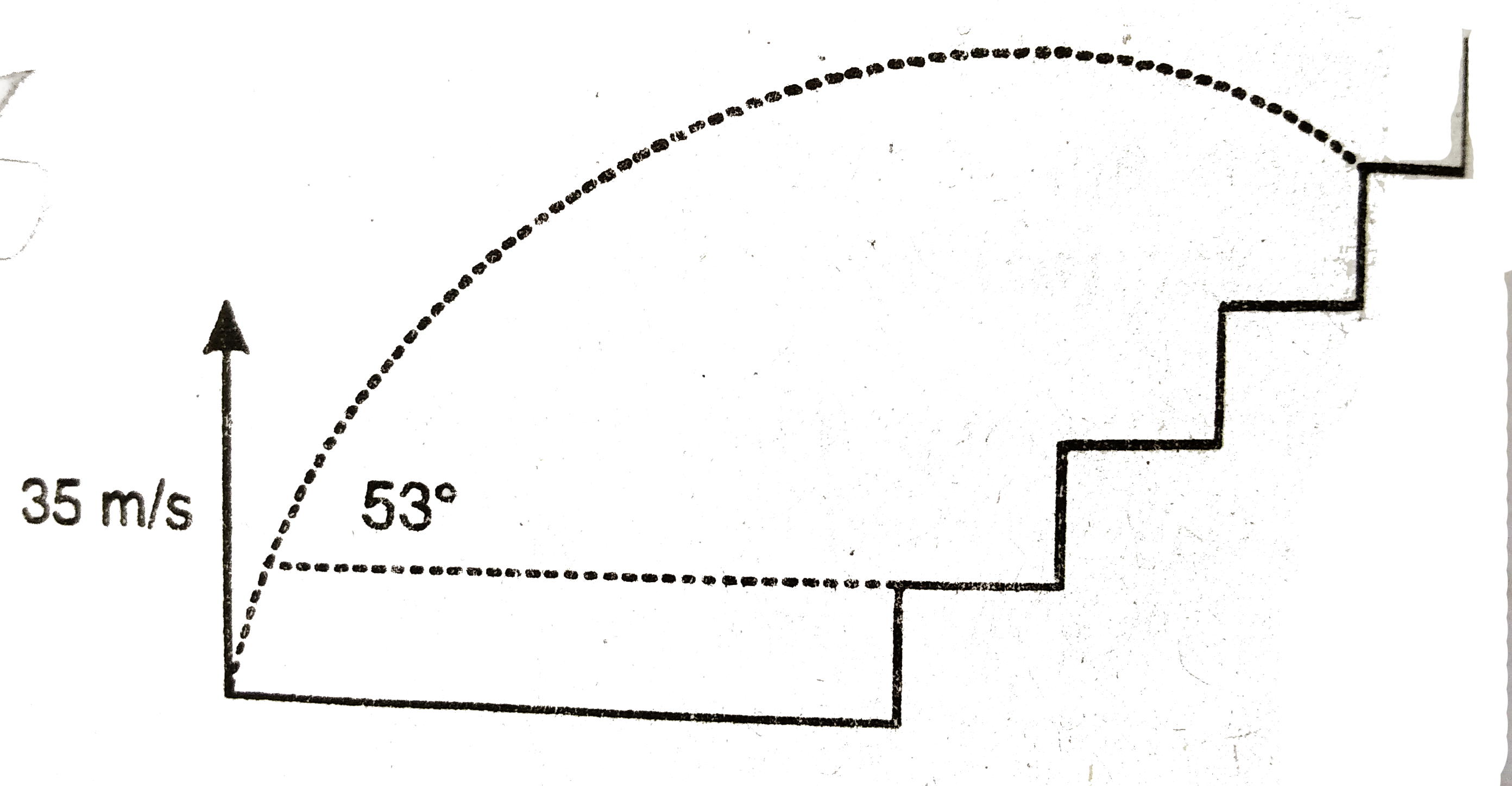
Given, `theta = 53^0
Therefore, `cos 53^0 = 3/5
`sec^2 theta = 25/9`
and ` tan theta = 4/3`
Suppose the ball lands on ninth bench
`:. y=(n-1)1……….i.`
[ ball starting point 1 m above ground ]

Again ` y= x tan theta = ((gx^2 sec^2 theta)/(2u^2)) `
`rarr y= (110+y) (4/3) - (10(110+y)^2(25/9))/(2xx(35)^2)`
`x= 100+n-1=100+y[Using i. ]`
`=440/3+4/3 y (250(100+y)^2)/(18xx(35)^2)`
`440/3+4/3 y (250*110+y)^2)/(18xx35^2)`
From the equation, y cane calculatd as
y=5 ltbr. `rarr n-1 = 5`
`rarr n=6` ltbr. The ball will drop in sixth bench.
Promotional Banner

Similar Questions

Explore conceptually related problems

A : Three capacitors having C_(1) lt C_(2) lt C_(3) are connected in parallel its effective capacitance will be C_(p) gt C_(3) . R : (1)/(C_(P))=(1)/(C_(1))+(1)/(C_(2))+(1)/(C_(3))

If two capacitors C_(1) and C_(2) are connected in a parallel combination then the equivalent capacitance is 10 mu F . If both the capacitors are connected across a l V battery, then energy stored in C_(2) is 4 times of that in C_(1) . The equivalent capacitance if they are connected in series is

If the points A(-1, -4) , B(b,c) and C(5,-1) are collinear and 2b + c = 4 , find the values of b and c.

Consider the curves on the Argand plane as " "{:(C_(1):arg(z)=pi/4","),(C_(2):arg(z)=(3pi)/(4)):} and C_(3):arg(z-5-5i)=pi," where " i=sqrt(-1). bb"Statement-1" Area of the region bounded by the curves C_(1),C_(2) " and " C_(3) " is " 25/2 bb"Statement-2" The boundaries of C_(1),C_(2) " and " C_(3) constitute a right isosceles triangle.

10 C_(1)+10 C_(3) +10 C_(5) +10 C_(7) +10 C_(9) = …….

Match the column A with column B and choose the correct option. (A) (a - 2), (b - 3), (C-5), (d - 4), (e - 1) (B) (a - 2), (b-5), (C-3), (d - 4), (e - 1) (C) (a - 1), (b - 3), (C-5), (d - 4), (e - 2) (D) (a - 1), (b - 5), (C-3), (d - 4), (e - 2)

Match the following list of animals with their level of organisation. (A) (a - 2), (b - 3), (C-4), (d - 1) (B) (a - 2), (b - 4), (C-3), (d - 1) (C) (a - 4), (b - 1), (C-2), (d - 3) (D) (a - 1), (b - 4), (C-3), (d - 2)

The potential at point D is = ....... as shown In below figure. (a) (1)/(2) (V_(1)+V_(2)) (b) (C_(1)V_(2)+C_(2)V_(1))/(C_(1)+C_(2)) (c) (C_(1)V_(1)+C_(2)V_(2))/(C_(1)+C_(2)) (d) (C_(2)V_(1)-C_(1)V_(2))/(C_(1)+C_(2))

