Home
Class 11
PHYSICS
A river 400m wide is flowing at a rate o...

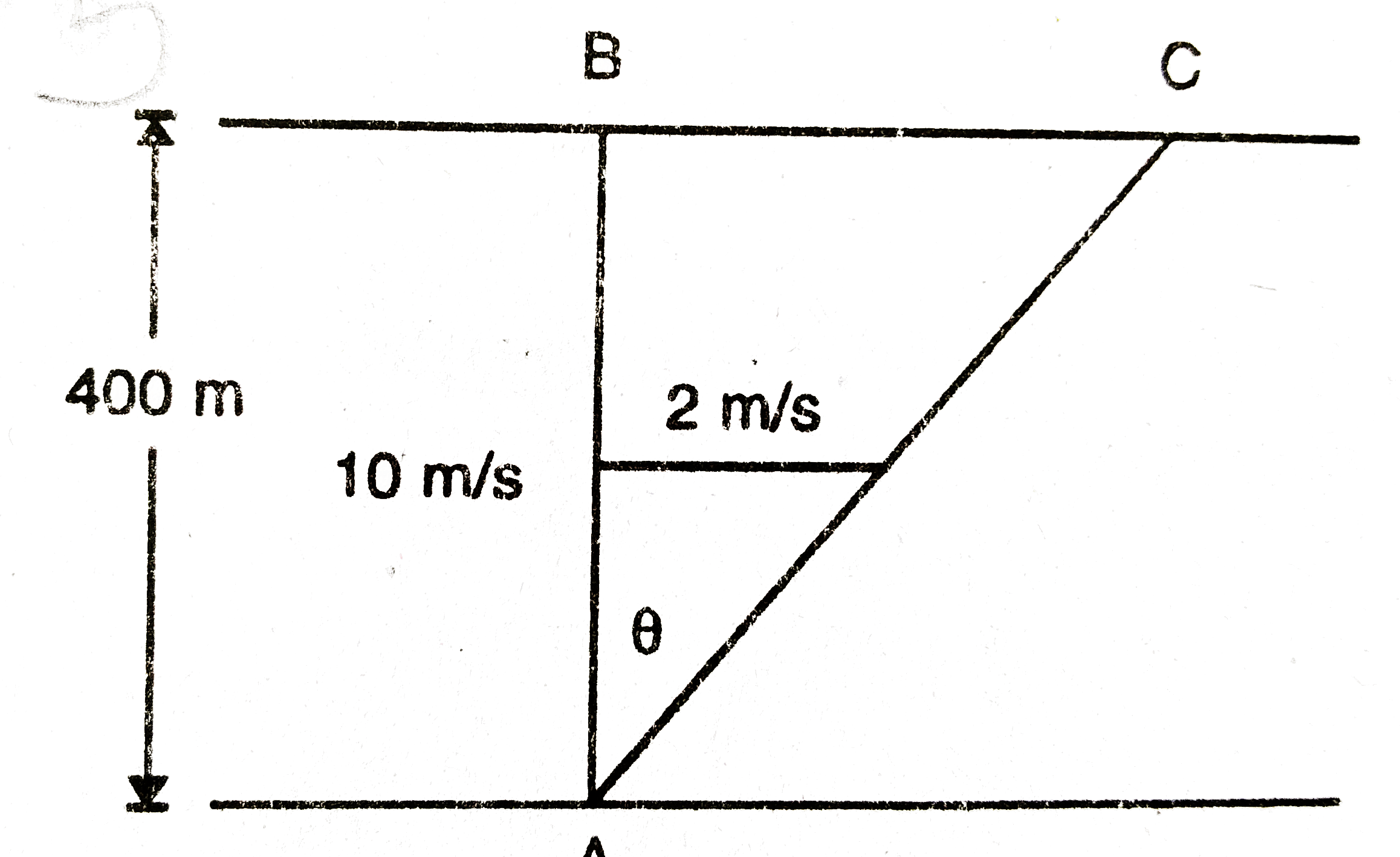
A river 400m wide is flowing at a rate of 2.0 `ms^(-1)`. A boat is salling at a speed of `10 ms^(-1)` w.r.t. water, in a direction perpendiuclar to the river.
(a) Find the time taken by the boat to reach the oppposite bank.
(b) How far from the point directly opposite to the starting point does the boat reach the opposite bank.

Text Solution

Verified by Experts

The correct Answer is:
A, B, D

Here the boat moves with the resultant velocity r, but the vertical component 10 m/s takes him to the opposite shore.
`tan theta = 2/10 = 1/5`
` Velocity = 10 m/s`
`Distance = 400 m`
`Time = 4008/10 = 40 sec`

b. The boat will reach the point C.
In `/_\ABC, tan theta = (BC)/(AB)= (BC)/400= 1/5`
`rarrBC= 400/5=80 m`
Promotional Banner

Similar Questions

Explore conceptually related problems

A river 400 m wide is flowing at a rate of 2.0 m//s. A boat is sailing at a velocity of 10.0 m//s with respect to the water In a direction perpendicular to the river. (a) Find the time taken by the boat to reach the opposite bank. (b) How far from the point directly opposite to the starting point does the boat reach the opposite bank?

A river 2 km wide is flowing at the rate of 2km/hr. A boatman, can row the boat at a speed of 4 km/hr in still water, goes a distance of 2 km upstream and them comes back. The time taken by him to complete his journey is

Velocity of the boat with respect to river is 10m/s. From point A it is steered in the direction shown. Where will it reach on the opposite bank ?

A boatman moves his boat with a velocity 'v' (relative to water) in river and finds to his surprise that velocity of river 'u' (with respect to ground) is more than 'v'. He has to reach a point directly opposite to the starting point on another bank by travelling minimum possible distance. Then

A man can swim at the rate of 5 kmh^(-1) in still water A. One km wide river flows at the rate of 3 kmh^(-1) . The man wishes to swim across the river directly opposite to the starting point. How much time will be take to cross the river

A river 4.0 miles wide is following at the rate of 2 miles/hr. The minimum time taken by a boat to cross the river with a speed v=4 miles/hr (in still water) is approximately

A man wishes to swim across a river 0.5km. wide if he can swim at the rate of 2 km/h. in still water and the river flows at the rate of 1km/h. The angle (w.r.t. the flow of the river) along which he should swin so as to reach a point exactly oppposite his starting point, should be:-

A man can swim with a speed of 4.0 km/h in still water . How long does he take to cross a river 1.0 km wide if the river flows steadily at 3.0 km/h and he makes his strokes normal to the river current ? How far down the river does he go when he reaches the other bank ?

Starting from rest, A lift moves up with an acceleration of 2 ms^(-2) . In this lift , a ball is dropped from a height of 1.5m (with respect to floor of lift). The time taken by the ball to reach the floor of the lift is ( g=10 ms^(-2) )

A river of width 'd' with straight parallel banks flows due North with speed u. A boat, whose speed is v relative to water, starts from A and crosses the river. If the boat is steered due West and u varies with y as u=(y(d-y)v)/d^(2) then answer the following questions. Absolute velocity of boat when it reaches the opposite bank is

