

Home
Class 11
PHYSICS
Suppose the magnitude of Nuclear force b...

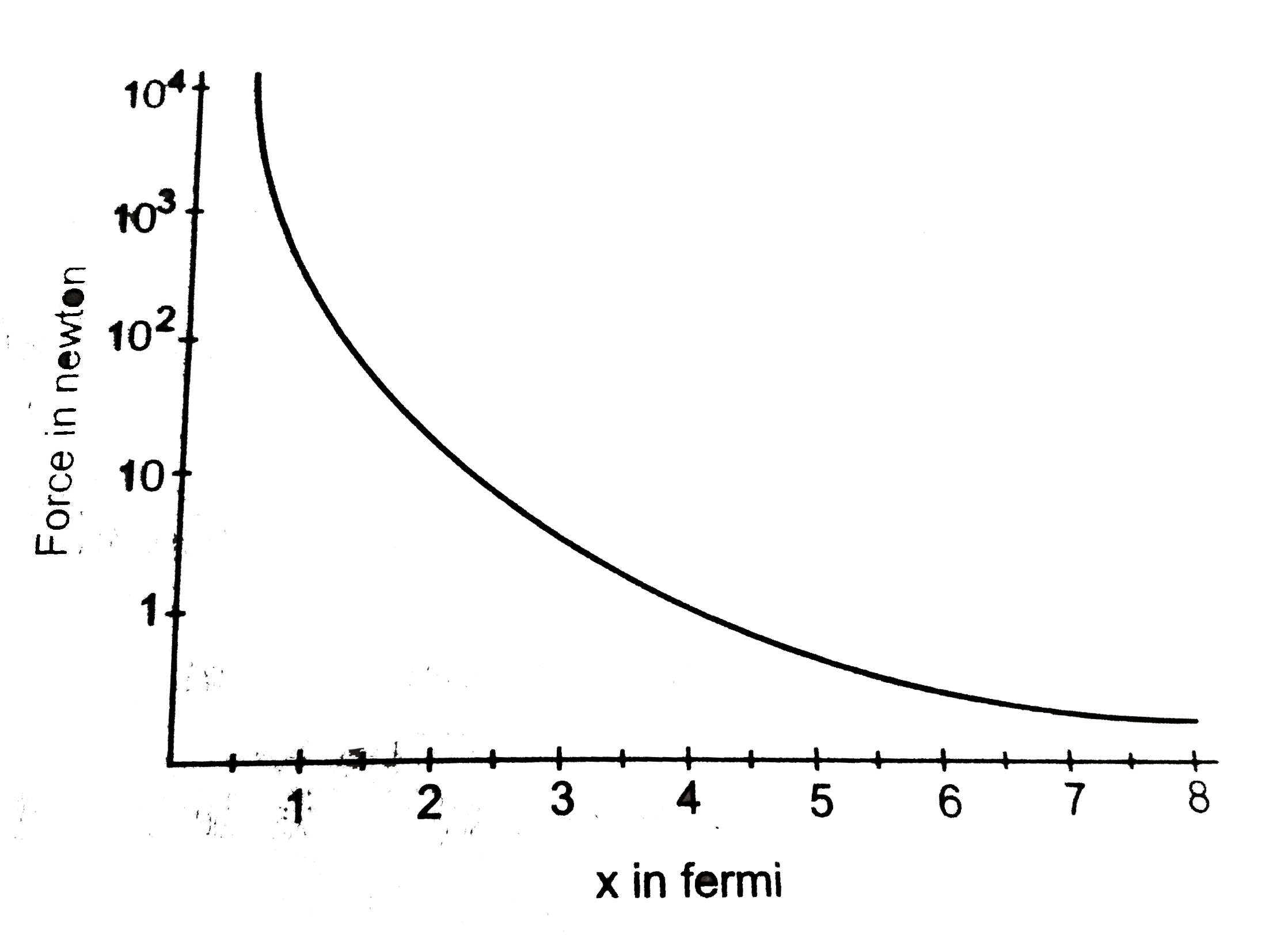
Suppose the magnitude of Nuclear force between two protons varies withethe distasnce between them as shown in figure. Estimate the ratio Nuclear force/Coulomb force for a. x=8 fm b. x=4 fm, c. x=2 fm and d. x=1 fm (1fm`=10^-15m)`.

Promotional Banner

Similar Questions

Explore conceptually related problems

Force F on the particle of mass 0.1 kg varies with distance x as shown in figure . If particle with distance x as shown in figure .If particle move from rest x = 0 , that at x = 12 cm , what will be its velocity ?

Columb law for electrostatic force between two point charges and newton law for gravitational force between two the distance between the charges and masses respectively (a) compare the strength of these forces by determining the ratio of their magnitudes (i) for an electron and a proton and (ii) for two protons (b) estimate the acceleratons of electron and proton due to the electrical force oftheir mutual attarction when they are 1A (=10^(-10) m) a part (m_(p)=1.67xx10^(27) kg m_(e )=9.11xx10^(-31) kg)

The sum of the magnitudes of two forces acting at a point is 16 N. The resultant of these forces is perpendicular to the smaller force has a magnitude of 8 N. If the smaller force is magnitude x, then the value of x is (A) 2N (B) 4N (C) 6N (D) 7N

If distance between two objects m_1=m_2=1kg 1 mm, then gravitational force between them is …... [ G=6.67xx10^-11 SI unit]

Two spheres of copper, having mass 1 g each, are kept 1 m apart. The number of electrons in them are 1 % less than the number of protons. The electrical force between them is Atomic wt. of copper is 63.54 g/mol, atomic number is 29, Avogadro's number N_A = 6.023 xx 10^23 mol^(-1) and k = 9 xx 10^9 SI

Coulomb's law for electrostatic force between two point charges and Newton's law for gravitational force between two stationary point masses, both have inverse-square dependence on the distance between the charges and masses respectively, (a) Compare the strength of these forces by determining the ratio of their magnitudes (i) for an electron and a proton and (ii) for two protons. (b) Estimate the accelerations of electron an proton due to the electrical force of the mutual attraction when they are =10^(-10)m apart? (m_(p) = 1.67 xx 10^(-27) kg, m_(e) = 9.11 xx 10^(-31) kg)

The equation of second degree x^2+2sqrt2x+2y^2+4x+4sqrt2y+1=0 represents a pair of straight lines.The distance between them is a. 4 b. 4/sqrt3 c. 2 d. 2sqrt3

In the figure masses m_(1),m_(2) and M are kg. 5 kg and 50 kg respectively. The co-efficient of friction between M and ground is zero. The co-efficient of friction between m_(1) and M and that between m_(2) and ground is 0.3. The pulleys and the string are massless. The string is perfectly horizontal between P_(1) and m_(1) and also between P_(2) and m_(2). The string is perfectly verticle between P_(1) and P_(2). An externam horizontal force F is applied to the mass M. Take g=10m//s^(2). (i) Drew a free-body diagram for mass M, clearly showing all the forces. (ii) Let the magnitude of the force of friction between m_(1) and M be f_(1) and that between m,_(2) and ground be f_(2). For a particular F it is found that f_(1)=2f_(2). Find f_(1) and f_(2). Write down equations of motion of all the masses. Find F, tension in the string and accelerations of the masses.

The elastic collision between two bodies, A and B, can be cosidered using the following model. A and B are free to move along a common line without friction. When their distance is greater than d = 1 m , the interacting force is zero , when their distance is less d, a constant repulsive force F = 6 N is present. The mass of body A is m_(A) = 1 kg and it is initially at rest, the mass of body B is m_(B) = 3 kg and it is approaching body A head-on with a speed v_(0) = 2 m//s . Find th eminimum distance between A and B :-

If the angle between the two lines represented by 2x^2+5xy+3y^2+2y+4=0 is tan ^(-1) (m) , then m is equal to