Home
Class 11
PHYSICS
A heavy particle of mass 0.50 kg is hang...

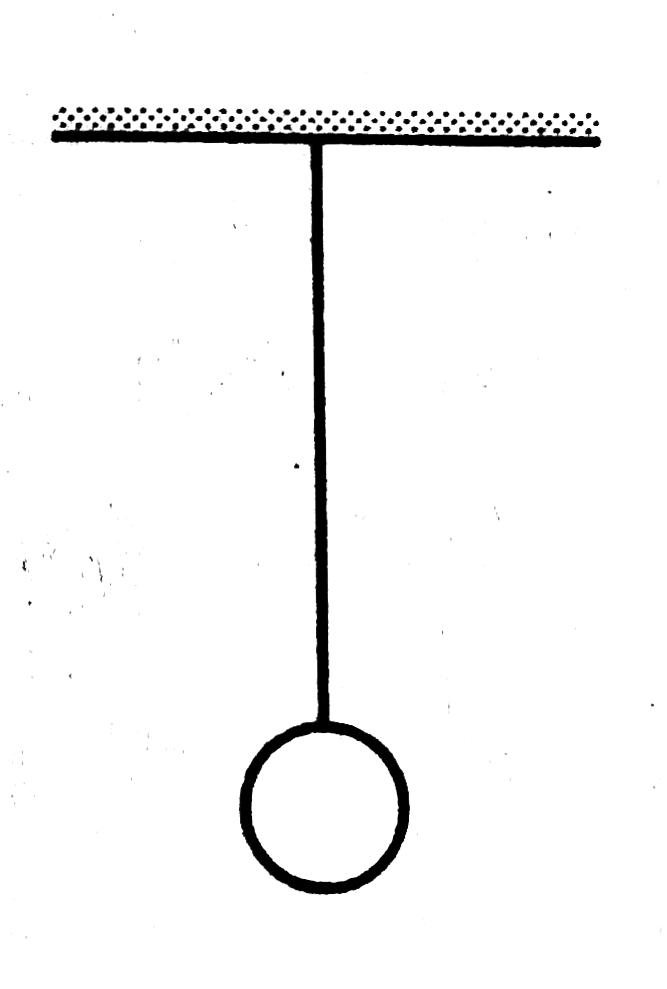
A heavy particle of mass 0.50 kg is hanging from a string fixed with the roof. Find the force exerted by the string on the particle. `Take g=9.8 m/s^2`
.

Text Solution

Verified by Experts

The correct Answer is:

B

The forces acting on the particle are a. pull of the earth `0.50 kg xx 9.8 m/s^2=4.9N` vertically downward
b. pull of the string . T vertically upward.
the particle is at rest with respect to the earth (which we assume to be an inertial frame). Hence, the sum of the forces should be zero. Therefore, T is 4.9 N acting vertically upward.
Promotional Banner

Similar Questions

Explore conceptually related problems

As shown in Fig.7.40, the two sides of a step ladder BA and CA are 1.6 m long and hinged at A. A rope DE, 0.5 m is tied half way up. A weight 40 kg is suspended from a point F, 1.2 m from B along the ladder BA. Assuming the floor to be frictionless and neglecting the weight of the ladder, find the tension in the rope and forces exerted by the floor on the ladder. (Take g = 9.8 m//s^(2) )

A ladder is hanging from ceiling as shownin figure. Three men A, B and C of masses 40 kg, 60 kg, and 50 kg are climbing the ladder. Man A is going up with retardation 2m//s^(2), C is going up with an acceleration of 1m//s^(2) and man B is going up with a constantg speed of 0.5 m/s. Find the tension in the string supporting the ledder. [g=9.8m//s^(2)]

The bob of a simple pendulum of length 1 m has mass 100g and a speed of 1.4 m/ s at the lowest point in its path. Find the tension in the string at this moment. Take g=9.8 m//sec^(2) (AS_(1))

The motion of a particle of mass m is described by y = ut + 1/2 "gt"^2 . Find the force acting on the particle.

A block A of mass 2 kg is placed over another block B of mass 8 kg and supported by a ledge L fixed on block B on its smooth surface as its extended part. If a force F=100 N is applied on block B , it starts moving on rough horizontal surface. Find the force exerted by block B on block A . (Take g=10m//s^(2) )

Two particles of masses 1.0 kg and 2.0 kg are placed at a separation of 50 cm. Assuming that the only forces acting on the particles are their mutual gravitation find the initial acceleration of the two particles.

(x, t), (y, t) diagram of a particle moving in 2-dimensions If the particle has a mass of 500 g, find the force (direction and magnitude) acting on the particle.

A particle of mass m is placed at each vertices of equilateral triangle. If the particle of 5 kg is placed at the centroid of triangle, then find the gravitational force on it. The distance between centroid to vertice is 2 m.

A particle of mass 2kg is moving on a straight line under the action of force F = (8-2x) N . The particle is released at rest from x = 6 m . For the subsequnent motion(All the value in the right column are in their S.I. units)

A particle of mass m id driven by a machine that delivers a constant power k watts . If the particle starts from at rest the force on the particle at time t is :
