Home
Class 11
PHYSICS
A block of mass M is pulled on a smooth ...

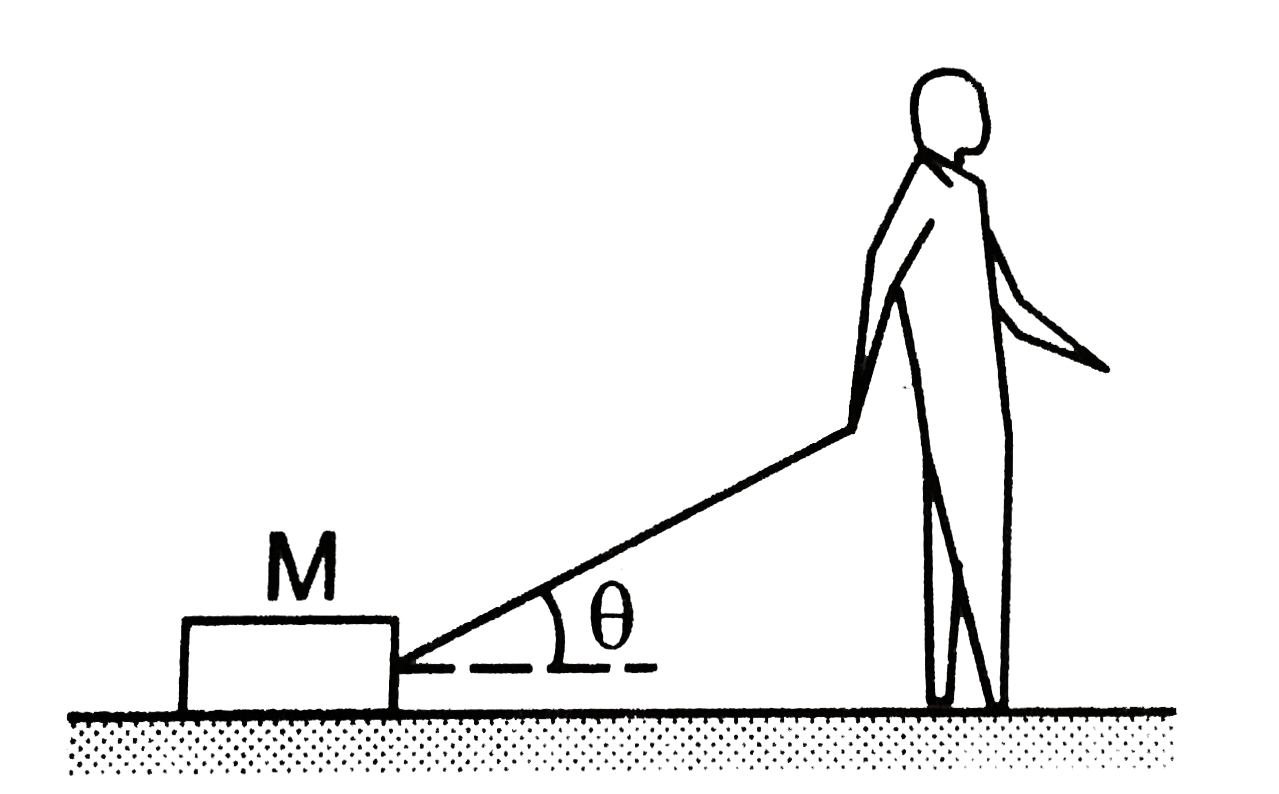
A block of mass M is pulled on a smooth horizontal table by a string making an angle `theta` with the horizontal as shown in figure. If the acceleration of the block is a find the force applied by the string and by the table N on the block.

A

`T=(Ma)/(tantheta)` , `N=(Mg-Ma tan theta)`

B

`T=(Mg)/(costheta)` , `N=(Mg-Ma tan theta)`

C

`T=(Ma)/(costheta)` , `N=(Mg-Ma cos theta)`

D

`T=(Ma)/(costheta)` , `N=(Mg-Ma tan theta)`

Text Solution

Verified by Experts

The correct Answer is:
D

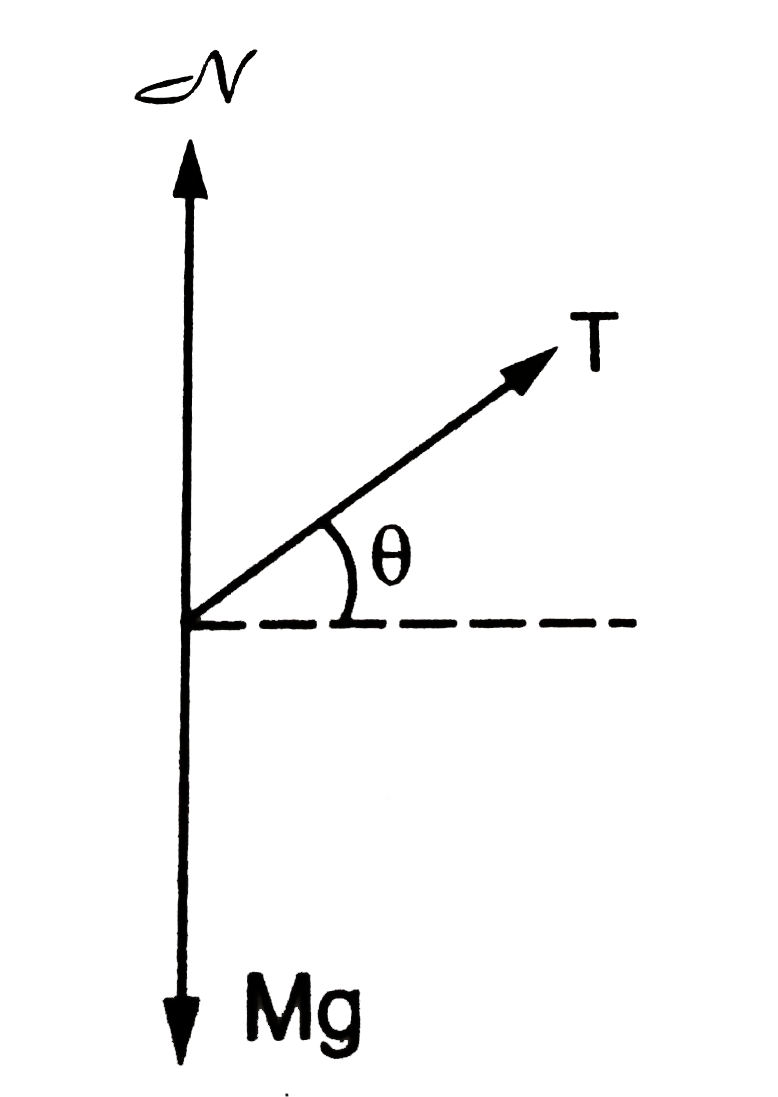
Let us consider the block as the system.
The forces on the block are
a. pull of the earth, Mg, vertically downward,
contact force by the table , vertically upward,
pull of the string T, along the string.
The free body diagram for the block is shownin ure.
The acceleration of the block is horizontal and towards the right. Take this direction as the X-axis and vertically upward direction as the Y-axis. We have,


component of Mg along the X-axis =0
component of N along the X-axis =0
component of LT along the X-axis = T `costheta`
Hence the total force along the X-axis = `T cos theta`
Using Newton's law, `T costheta=Ma`
Component of Mg along the Y-axis =-Mg
component of `N along the Y-axis =N`
Component of T along the Y-axis `=T sin theta`
Total force along the Y-axis `= N+T sin theta-Mg`
Using Newton's law `N+T sintheta- Mg=0` ...........ii
From equation i. `T=(Ma)/(costheta)`. Putting this in equation ii. `N=(Mg-Ma tan theta)`
Promotional Banner

Similar Questions

Explore conceptually related problems

A block of mass M is pulled along a horizontal frictionless surface by a rope of mass m as shown in A horizontal force F is applied to one end of the rope. Find (a) the acceleration of the rope and block (b) the force that the rope exerts on the block (c) the tension in the rope at its mid point

A block of mass M is pulled along a horizontal frictionless surface by a rope of mass m . Force P is applied at one end of rope. The force which the rope exerts on the block is:

A block is placed on a rough horizontal plane. Three horizontalforces are applied on the block as shown in the figure. If the block is in equilibrium, find the friction force acting on the block.

A block is dragged on a smooth plane with the help of a rope which moves with a velocity v as shown in figure. The horizontal velocity of the block is :

A block rests on a rough inclined plane making an angle of 30° with the horizontal. The coefficient of static friction between the block and the plane is 0.8. If the frictional force on the block is 10 N, the mass of the block ((in kg) is .......... (Take g = 10 m//s^(2) )

A block of mass 4 kg is placed on another block of mass 5 kg and the block B rests on a smooth horizontal table. If the maximum force that can be applied on A so that both the blocks move together is 12N, find the maximum force that can be applied on B for the blocks to move together.

A block of mass m is placed on a smooth wedge of inclination theta . The whole system is accelerated horizontally, so that the block does not slip on the wedge. The force exerted by the wedge on the block (g is acceleration due to gravity) will be

A block of 50 kg on a smooth plane inclined at 60^(@) and another block of 30 kg on a smooth plane inclined at 30^(@) with horizontal are connected by a light string passing over a frictionless pully as shown in the figure. Take g = 10 ms^(-2) , sqrt(3) =1.7 . The acceleration of the blocks and tension in the string are.

A block of mass m is placed on a smooth slope of angle theta . The whole system (slope + block) is moved horizontally with acceleration a in such a way that the block does not slip on the slope. Hence, a =………..

A block of mass 2 kg is kept on a rough horizontal floor an pulled with a force F. If the coefficient of friction is 0.5. then the minimum force required to move the block is :-

