Home
Class 11
PHYSICS
The mass of the part of the string below...

The mass of the part of the string below A in figure is m. Find the tension of the string at the lowere end and at A.

Text Solution

Verified by Experts
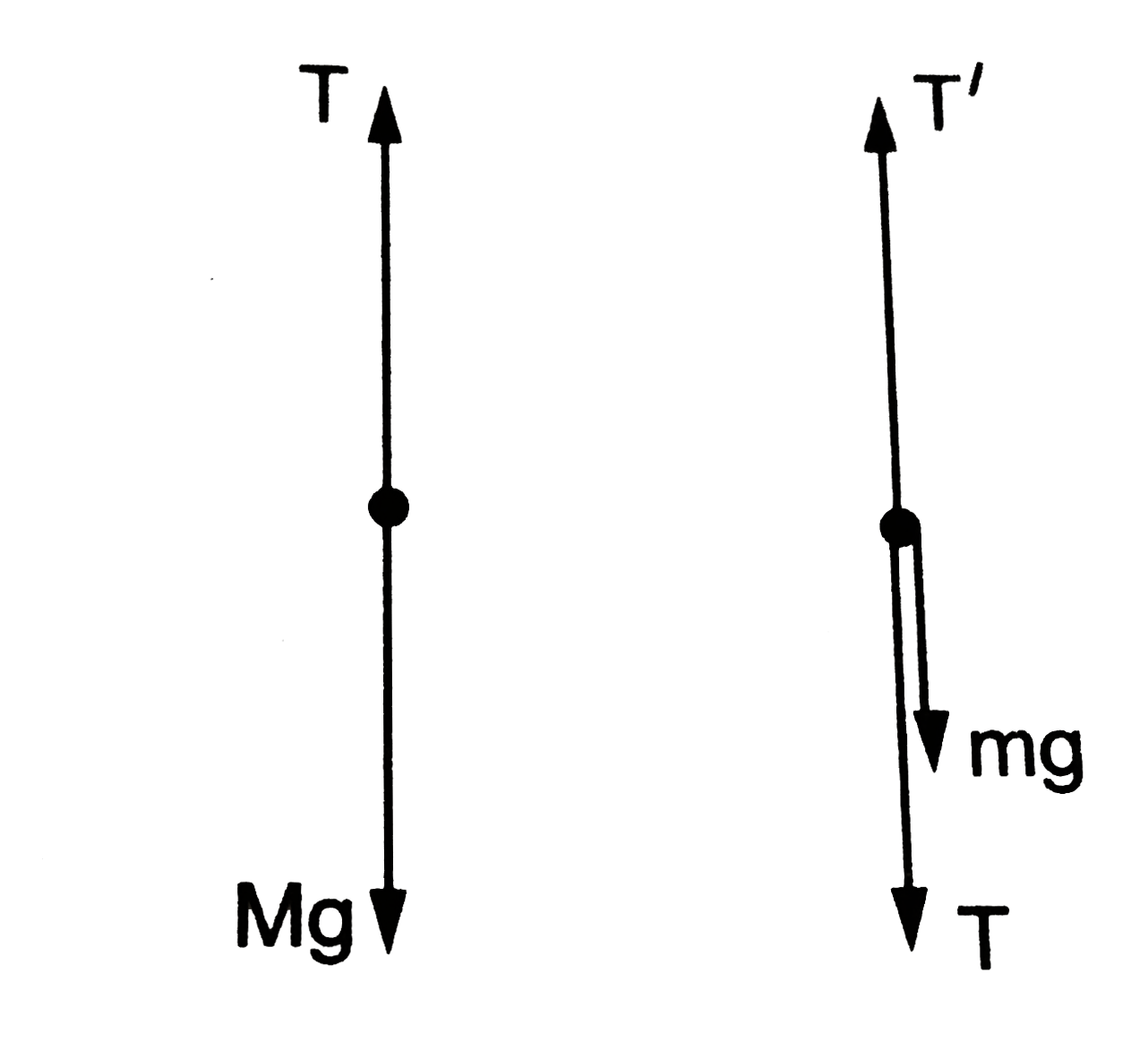
To get the tension at the lower end we need the force exerted by the string on the block.
Take block as the system. The forces on it are
a. pull of the string T, upward
b. pull of the earth Mg, downward,
The free body diagram for the block is shown in ure. s the acceleration of theblocfk is zero, these forces should add to zero. Hence the tension at the lower end is T=Mg.

To get the tension T at A we need the force exerted by the upper part of the string on the lower part of the string. For this we many write the equation of motion for the lower part of the string. So take the string below A as the system. The forces acting on this part of the string
a. T', upward by the upper pasrt of the string
b. mg, downward by the block.
c. T, downward by the block
Note that c we have written T for by the block on the string. We have already used the symbol T Newton's third law here. Teh force exerted by the block on the string is equal in magnitude to the force exerted by the string on the block.
The free body diagram for this part is hsown in ure part of the string) is an equilibrium, Newton's first law gives
`T'T+mg`
` But T=Mg hence, T'=(M+m)g`
Promotional Banner

Similar Questions

Explore conceptually related problems

The bob of a simple pendulum of length 1 m has mass 100g and a speed of 1.4 m/ s at the lowest point in its path. Find the tension in the string at this moment. Take g=9.8 m//sec^(2) (AS_(1))

A kite is flying at a height of 60m above the ground. The string attached to the kite is temporarily tied to a point on the ground. The inclination of the string with the ground is 60^(@) . Find the length of the string, assuming that there is no slack in the string.

A string of mass per unit length mu is clamped at both ends such that one end of the string is at x = 0 and the other is at x =l . When string vibrates in fundamental mode, amplitude of the midpoint O of the string is a, tension in a, tension in the string is T and amplitude of vibration is A. Find the total oscillation energy stored in the string.

(a) A box of weight 10sqrt(3) N is held n equilibrium with the help of two strings OA and OB as shown in figure-1. the string OA is horizontal. Find the tensions in both the stings. (b) If you can change location of the point A on the wall and hence the orientation of the string OA without altering the orientation of the string OB as shown in figure-II. what angle should the string OA make with the wall so that a minimum tension is developed in it?

A 2 kg block A is attached to one end of a light string that passes over an an ideal pulley and a 1 kg sleeve B slides down the other part of the string with an acceleration of 5m//s^(2) with respect to the string. Find the acceleration of the block, acceleration of sleeve and tension in the steing. [g=10m//s^(2)]

One end of a taut string of length 3m along the x-axis is fixed at x = 0 . The speed of the waves in the string is 100ms^(-1) . The other end of the string is vibrating in the y-direction so that stationary waves are set up in the string. The possible wavelength (s) of these sationary waves is (are)

Two particles each of mass m are connected by a light inextensible string and a particle of mass M is attached to the midpoint of the string. The system is at rest on a smooth horizontal table with string just taut and in a straight line. The particle M is given a velocity v along the table perpendicular to the string. Prove that when the two particles are about to collide : (i) The velocity of M is (Mv)/((M + 2m)) (ii) The speed of each of the other particles is ((sqrt2M (M + m))/((M + 2m)))v .

One end of a string of length L is tied to the celling of lift accelerating upwards with an accelerating 2g The other end of the string is free. The linear mass density of the string varies linearly from 0 of lamda from bottom to top :-

Two masses 8 kg and 12 kg are connected at the two ends of a light inextensible string that goes over a frictionless pulley. Find the acceleration of the masses, and the tension in the string when the masses are released.

