Home
Class 11
PHYSICS
The block shown in figure has a mass M a...

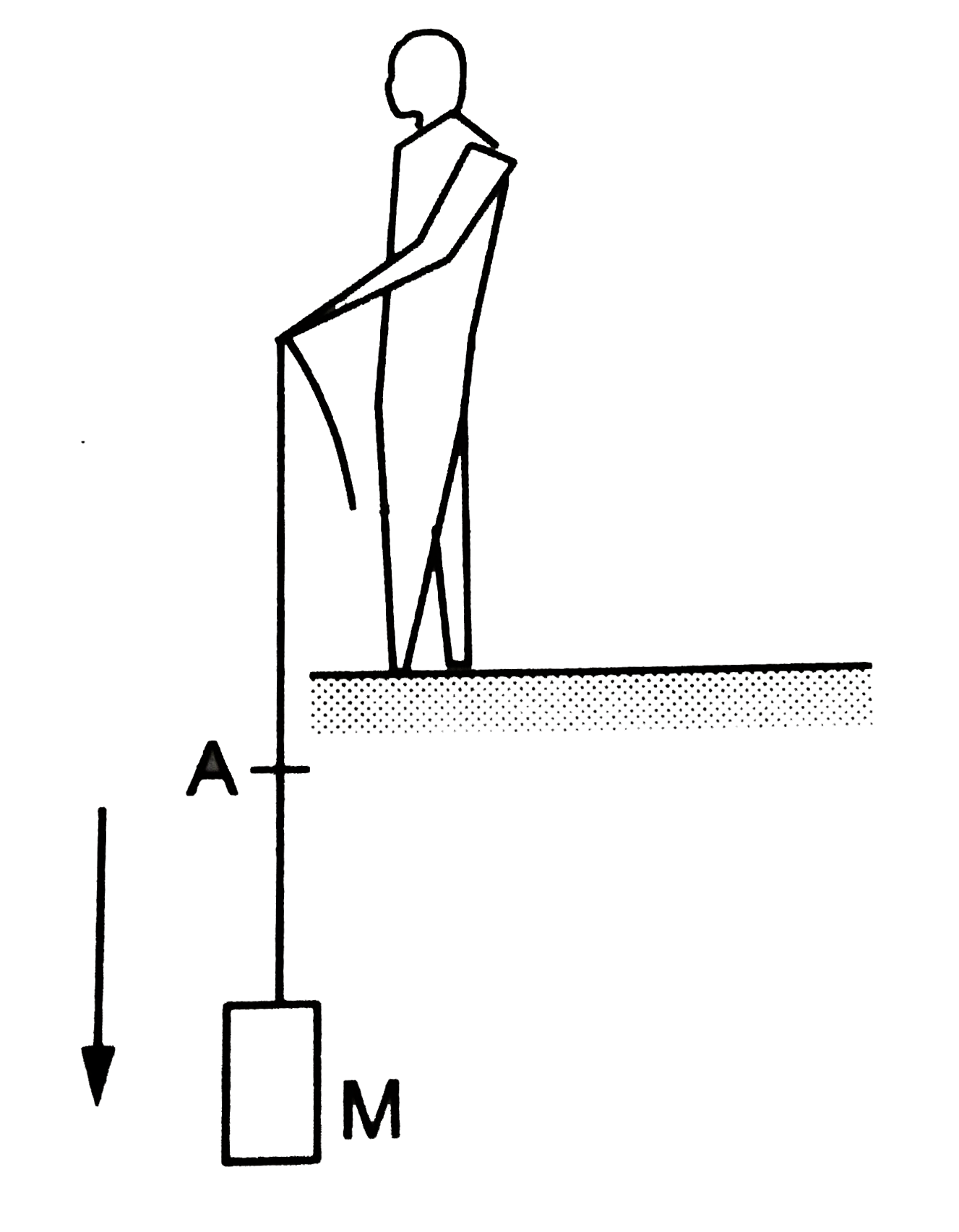
The block shown in figure has a mass M and descends with an acceleration a. the mass of the string below the point A is m. Find the tension of the string at the point A and at the lower end.

Text Solution

Verified by Experts

Consider the block +the part of the string below A'' as the system . Let the tension at A be T. The forces acting on this system are
a. (M+mg)g, downward, by the earth
T, upward, by the upper part of the string.
The first is gravitatioN/Al and the second is electromagnetic. We do not have to write the force by the string on the block. This electromagnetic force is by one part of the system on the other part. Only the forces acting on the system by the objects other than the system are to be included.
The system is descending with an acceleration a. Taking the downward direction as the X-axis, the total force along the X-axis is `(M+m)g-T.` Using Newton's law along the X-axis is ` (M+mg)g-T=(M+m)a`.
or `T=(M+m)(g-a)`
we have omitted the free body diagram. This you can do if you can draw the free body diagram in your mind and write the equations correctly.
To get the tension T' at the lower end we can put `m=0 in i.`
Effectively we take the point A at the lower end. Thus, we get `T'=M(g-a)`.
Promotional Banner

Similar Questions

Explore conceptually related problems

The elevator shown in fig. is descending with an acceleration of 2ms^(-2) . The mass of the block A=0.5kg . Find the force (in Newton) exerted by block A on block B.

The bob of a simple pendulum of length 1 m has mass 100g and a speed of 1.4 m/ s at the lowest point in its path. Find the tension in the string at this moment. Take g=9.8 m//sec^(2) (AS_(1))

A kite is flying at a height of 60m above the ground. The string attached to the kite is temporarily tied to a point on the ground. The inclination of the string with the ground is 60^(@) . Find the length of the string, assuming that there is no slack in the string.

Consider the double Atwood's machine as shown in the figure (a) Whatis acceleration of the masses? (b) What is the tension in each string?

Block A of mass m//2 is connected to one end of light rope which passes over a pulley as shown in fig. A man of mass m climbs the other end of rope with a relative acceleration of g//6 with respect to rope. Find the acceleration of block A and tension in the rope.

A simple pendulm has a length L and a bob of mass M. The bob is vibrating with amplitude a .What is the maximum tension in the string?

A 2 kg stone at the end of a string 1 m long is whirled in a vertical circle. At some point its speed is 4m/s. The tension of the string is 52 newton. At this instant the stone is :

(a) A box of weight 10sqrt(3) N is held n equilibrium with the help of two strings OA and OB as shown in figure-1. the string OA is horizontal. Find the tensions in both the stings. (b) If you can change location of the point A on the wall and hence the orientation of the string OA without altering the orientation of the string OB as shown in figure-II. what angle should the string OA make with the wall so that a minimum tension is developed in it?

A puck of mass m is moving in a circle at constant speed on a frictionless table as shown in the figure . The puck is connected by a string to a suspended bob, also of mass m , which is at rest below the table. Half of the length of the string is above the tabletop and half below. What is the magnitude of the centripetal acceleration of the moving puck ? Let g be the acceleration due to gravity.

In the situation shown in figure, both the pulleys and the strings are light and all the surfaces are frictionless. The acceleration of mass M, tension in the string PQ and force exerted by the clamp on the pulley, will respectively be -
