Home
Class 11
PHYSICS
A particle slides down a smooth in cline...

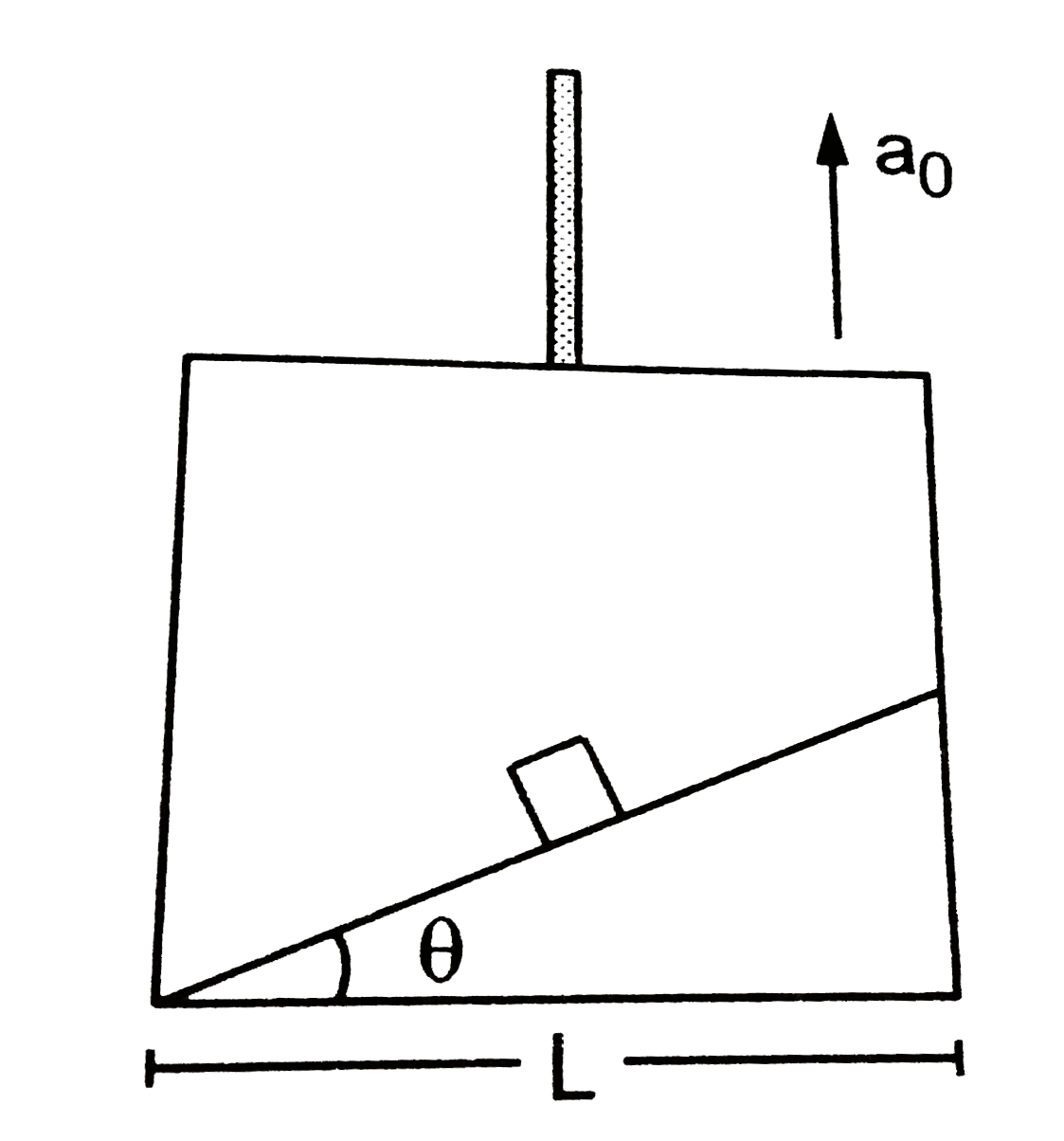
A particle slides down a smooth in clined plane of elevation `theta` fixed in an elevastor going up with an acceleration`a_0`. The base of the incline has a length L.Find the time taken by the particle to reach the bottom.

Text Solution

Verified by Experts
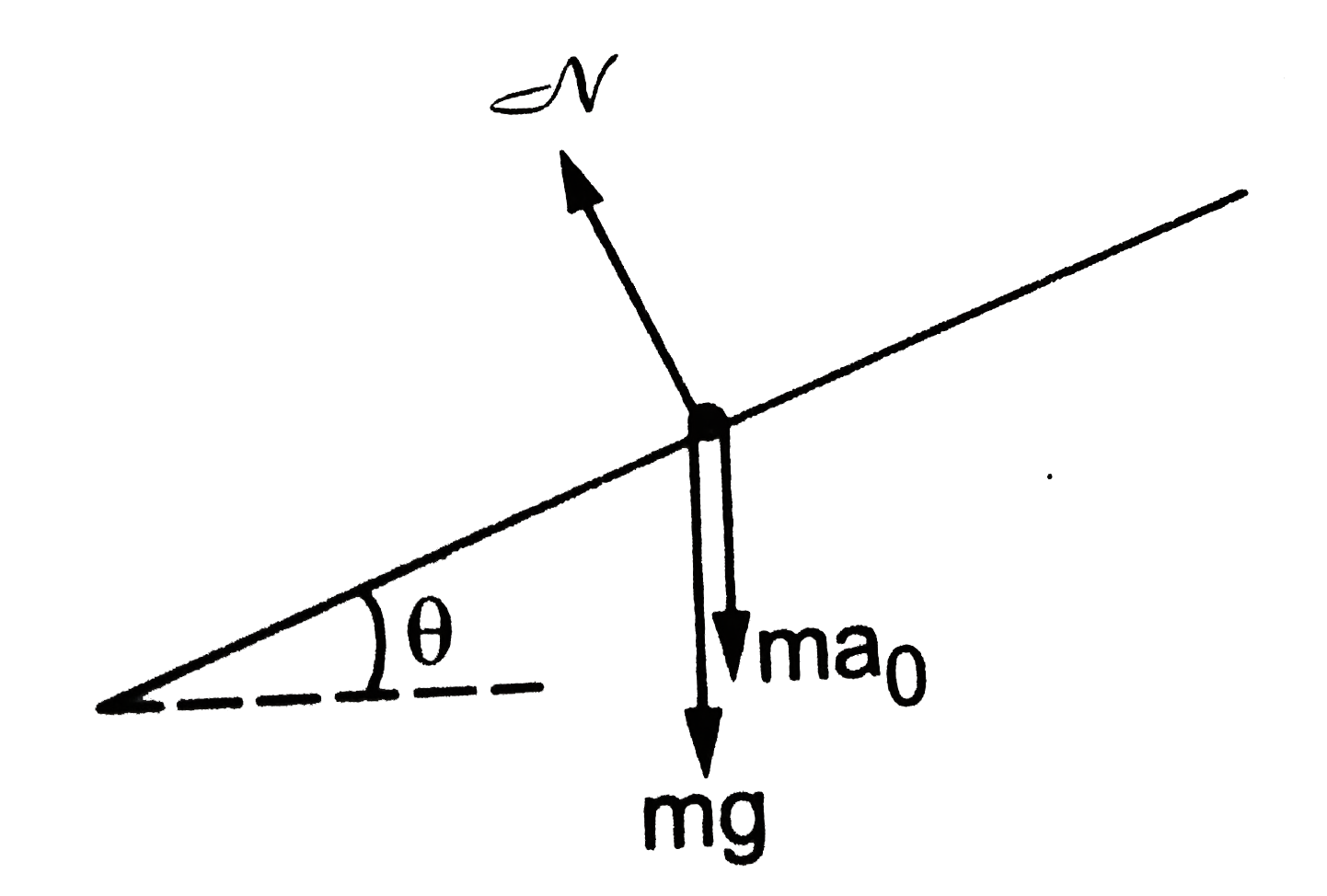
Let us wormk in the elevator frame. A pseudo force `m_0` n the downward direction is to be applied on the particle of mass m are.
i. N normal force
ii. mg downward (by the earth),
iii. `ma_0` downward (pseudo)
Let a be the acceleration of eth partice withrespect to the incline. Taking components of the forces paralel to the incline and applying Newton's law,

`mg sintheta +ma_0 sin theta =m a
or ` a=(g+a_0) sin theta`
This is the acceleration with respect t the elevator. In this frame the distnce traveled by the particle is `L/costheta.` Hence,
`L/costheta=1/2(g+a_0) sin theta.t^2,
or, `t=[(2L)/((g+a_0)sinthetacostheta)]^(1/2)]`
Promotional Banner

Similar Questions

Explore conceptually related problems

A body is released from the top of a smooth inclined plane of inclination theta . It reaches the bottom with velocity v . If the angle of inclina-tion is doubled for the same length of the plane, what will be the velocity of the body on reach ing the ground .

A large , heavy box is sliding without friction down a smooth plane of inclination theta . From a point P on the bottom of the box , a particle is projected inside the box . The initial speed of the particle with respect to the box is u , and the direction of projection makes an angle alpha with the bottom as shown in Figure . (a) Find the distance along the bottom of the box between the point of projection p and the point Q where the particle lands . ( Assume that the particle does not hit any other surface of the box . Neglect air resistance .) (b) If the horizontal displacement of the particle as seen by an observer on the ground is zero , find the speed of the box with respect to the ground at the instant when particle was projected .

An inclined plane of length 5.60 m making an angle of 45^(@) with the horizontal is placed in an uniform electric field E= 100 Vm^(-1) . A particle of mass 1 kg and charge 10^(@)C is allowed to slide down from rest position from maximum height of slope. If the co-efficient of friction is 0.1, the time taken by the particle to reach the bottom is________

A particle starts from point x = (-sqrt(3))/(2)A and move towards negative extreme as shown, (a) Find the equation of the SHM (b) Find the time taken by the particle to go directly from its initial position to negative extreme. (c) Find the time taken by the particle to reach at mean position.

A body is slipping from an inclined plane of height h and length l . If the angle of inclination is theta , the time taken by the body to come from the top to the bottom of this inclined plane is

A bead can slide on asmooth straight wire and a particle of mass m attached to the bead by a light string of length L. The particle is held in contact with the wire and with the string taut and is then let fall. If the bead has mass 2m then when the string makes an angle theta with the wire, the bead will have slipped a dsitance.

A rectangular box lies on a rough inclined surface. The coefficient of friction between the surface and the box is mu . Let the mass of the box be m. (a) At what angle of inclination 0 of the plane to the horizontal will the box just start to slide down the plane ? (b) What is the force acting on the box down the plane, if the angle of inclination of the plane is increased to a gt theta (c) What is the force needed to be applied upwards along the plane to make the box either remain stationary or just move up with uniform speed ? (d) What is the force needed to be applied upwards along the plane to make the box move up the plane with acceleration a ?

A solid cylinder of mass M and radius R rolls without slipping down an inclined plane of length L and height h. What is the speed of its centre of mass when the cylinder reaches its bottom?

A particle starts sliding down a frictionless inclined plane. If S_(n) is the distance travelled by it from time t = n-1 sec , to t = n sec , the ratio (S_(n))/(s_(n+1)) is

Assertion:- A coin dropped in a closed trolley moving-down the smooth inclined plane. appears to fall normal to the floor of the trolley to a man fixed with the trolley. Reason:- The acceleration of coin relative to car (i.e. man) is g cos theta downward perpendicular inclined plane.
