Home
Class 11
PHYSICS
All the surfaces shownin figure are assu...

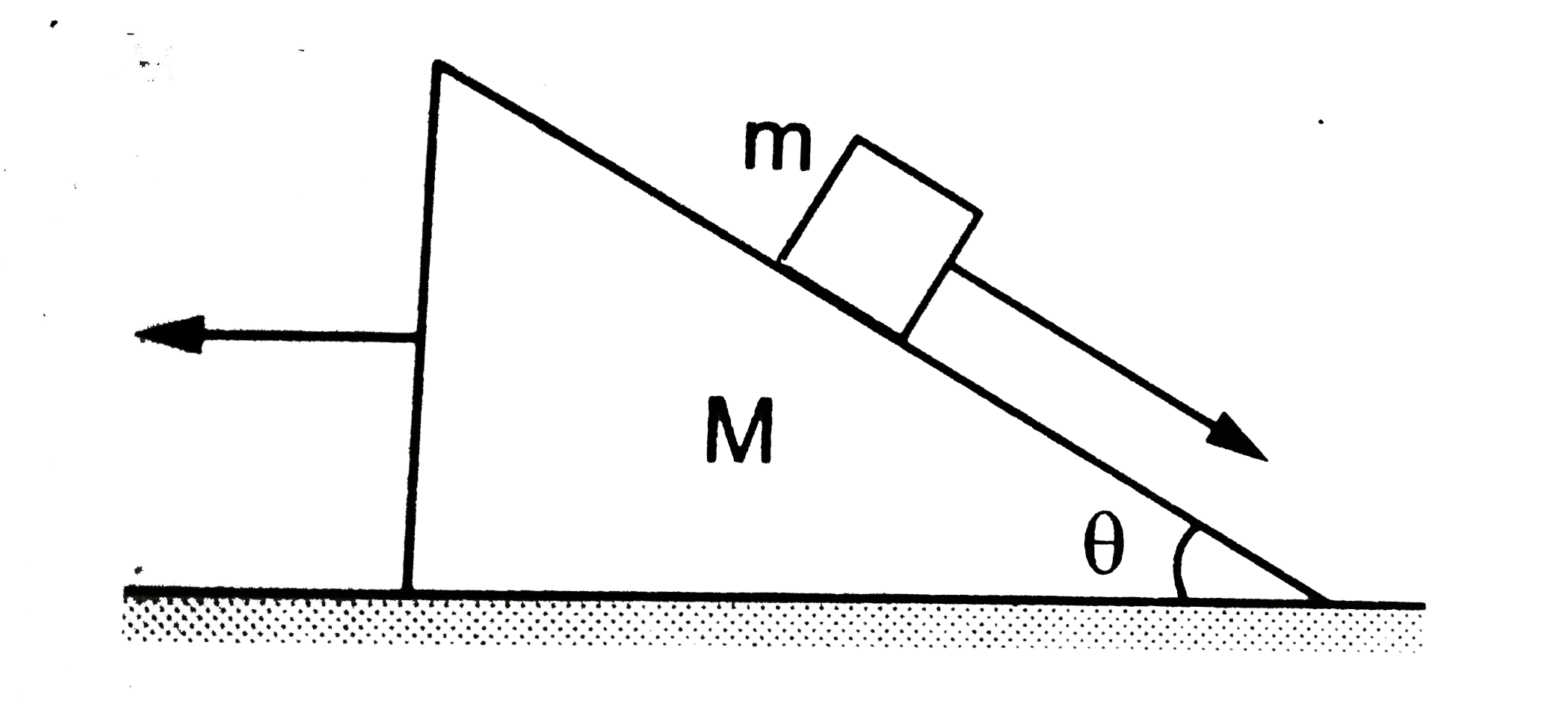
All the surfaces shownin figure are assumed to be frictionless. The block of mass m slides on the prism which in turn slides backwasrd on the horizontal surface. Find the aceleration of the smaller block with respect to the prism.

Text Solution

Verified by Experts
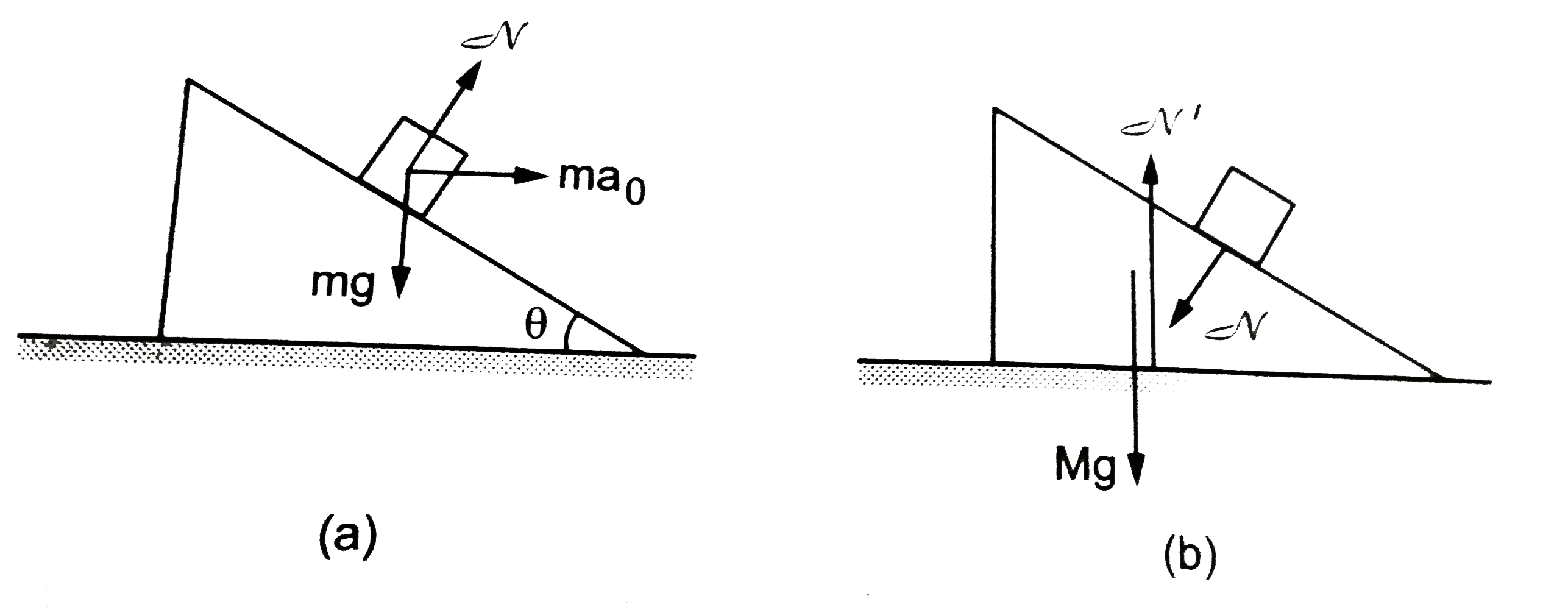
Let the acceleration of the prism be `a_0` in the backward direction. Consider the motion of the smaller block fro the frame of the prism.
The force on the block are

i. N normal force,
mg downward (gravity)
`ma_0` forward (psuedo)`

The block slides down the plane. components of the forces parallel to the incline give
`ma_0costheta+mg sintheta=ma`
or, `a=a_0costheta+g sin theta` .........i
Components of teh force perpendicular to the incline give
`N +ma_0sintheta=mg costheta` .........ii
Non consider the motion of the prism from the lab frame. No pseudo force isneeded as the frame used is inertial. The forces are ure 16 b
i. Mg downward,
ii. N normal to the incline (by the block)
`N upward (by the horizontal surface).
Horizontal components give,
`N sintheta=Ma_0 or, N Ma_0/sintheta` ..............iii
Putting in ii.
`(Ma_0)/(sintheta)+ma_0 sintheta=costheta`
or, `a_0 = (mg sinthetacostheta)/(M+msin^2theta)`
From i. `a=(mg sintheta cos^2theta)/(M+msin^2theta)+g sintheta`
`=((M+m)g sintheta)/(M+m sin^2 theta)`
Promotional Banner

Similar Questions

Explore conceptually related problems

A force of 50N acts in the direction as shown in figure. The block of mass 5kg, resting on a smooth horizontal surface. Find out the acceleration of the block.

A block of mass M is pulled along a horizontal frictionless surface by a rope of mass m as shown in A horizontal force F is applied to one end of the rope. Find (a) the acceleration of the rope and block (b) the force that the rope exerts on the block (c) the tension in the rope at its mid point

A very light rod of length l pivoted at O is connected with two springs of stiffness k_1 & k_2 at a distance of a & l from the pivot respectively. A block of mass ma attached with the spring k_(2) is kept on a smooth horizontal surface. Find the angular frequency of small oscillation of the block m .

A block of mass m rests on a rough horizontl surface as shown in figure (a) and (b). Coefficient of friciton between block and surface is mu . A force F-mg acting at an angle theta with the vertical side of the block. Find the condition for which block will move along the surface.

A block weighing 40N travels down a smooth fixed curved track AB joined to a rough horizontal surface (figure). The rough surface has a friction coefficient of 0.10 with the block. If the block starts slipping on the track from a point 2.0m above the horizontal surface, the distance it will move on the rough surface is :-

A block of mass 3kg is at rest on a rough inclined plan as shown in the Figure. The magnitude of net force exerted by the surface on the block will be

A cubical block of mass m and edge a slides down a rough inclned plane of inclination theta with a uniform speed. Find the torque of the normal force acting on the block about its centre.

In the situation shown in figure, both the pulleys and the strings are light and all the surfaces are frictionless. The acceleration of mass M, tension in the string PQ and force exerted by the clamp on the pulley, will respectively be -

In the arrangement shows in fig. if the surface is smooth then find out acceleration of the block m_(2) .

In a body A of mass tn slides on plane inclined at angle theta_(1) , to the horizontal and p is the coefficent of friction between A and the plane. A is connected by a light string passing over a frictionless pulley to another body B, also of mass m, sliding on a frictionless plane inclined at an angle theta_(2) to the horizontal. Which of the following statements are true ?

