Home
Class 11
PHYSICS
Fif. shows the displacement of a particl...

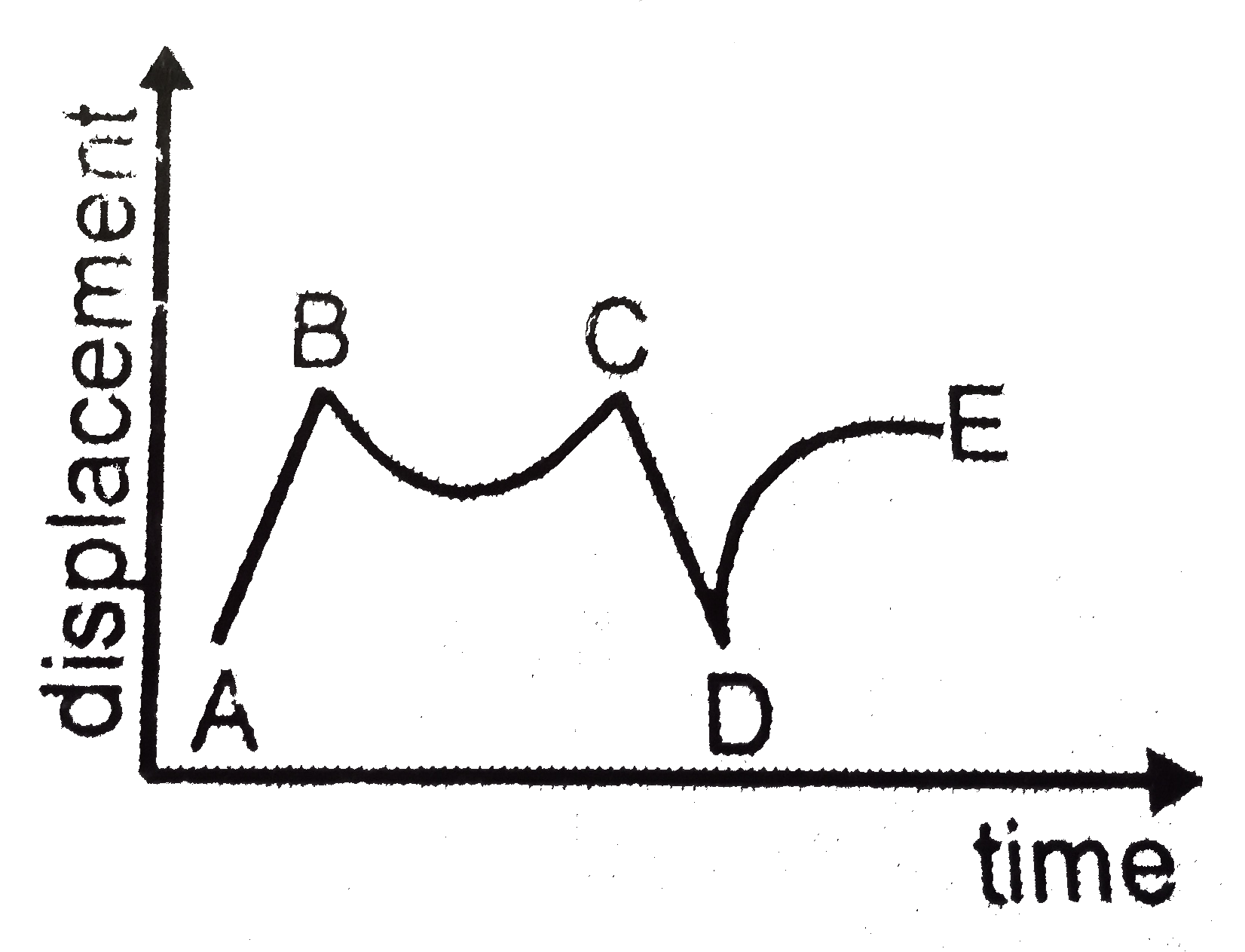
Fif. shows the displacement of a particle going along x-axis as a function of time. The acceleration of the particle is zero in the region:-

A

AB

B

BC

C

CD

D

DE

Text Solution

Verified by Experts

The correct Answer is:

A, C
Promotional Banner

Similar Questions

Explore conceptually related problems

Figure shows the displacement of a particle going along the X-axis as a function of time. The force acting on the particle is zero in the region

The displacement of particle along the X-axis is given by x= a sin^(2) omega t . The motion of the particle corresponds to………..

In the diagram shown, the displacement of particles is given as a function of time. The particle a is moving under constant velocity of 9 m//s . The particle B is moving under variable acceleration. From time t=0 s to t=6 s . The average velocity of the particle B will be equal to :-

The displacement 'x' of a particle moving along a straight line at time t is given by x=a_(0)+a_(1)t+a_(2)t^(2) . The acceleration of the particle is :-

The fig. shows the displacement time graph of a particle moving on a straight line path. What is the magnitude of average velocity of the particle over 10 seconds?

For a particle moving along x- axis, speed must be increasing for the following graph :

The rate of doing work by force acting on a particle moving along x-axis depends on position x of particle and is equal to 2x. The velocity of particle is given by expression :-

Position of particle moving along x-axis is given as x=2+5t+7t^(2) then calculate :

Figure shows the graph of velocity versus time for a particle going along x axis. Initially at t=0, particle is at x=3m. Find postion of particle at t=2s. (in m) ltimg src="https://d10lpgp6xz60nq.cloudfront.net/physics_images/ALN_PHY_R05_E03_017_Q01.png" width="80%"gt

The velocity of a particle moving along x-axis is given as v=x^(2)-5x+4 (in m // s) where x denotes the x-coordinate of the particle in metres. Find the magnitude of acceleration of the particle when the velocity of particle is zero?
