Home
Class 11
PHYSICS
A paticle of mass 50 g moves on a straig...

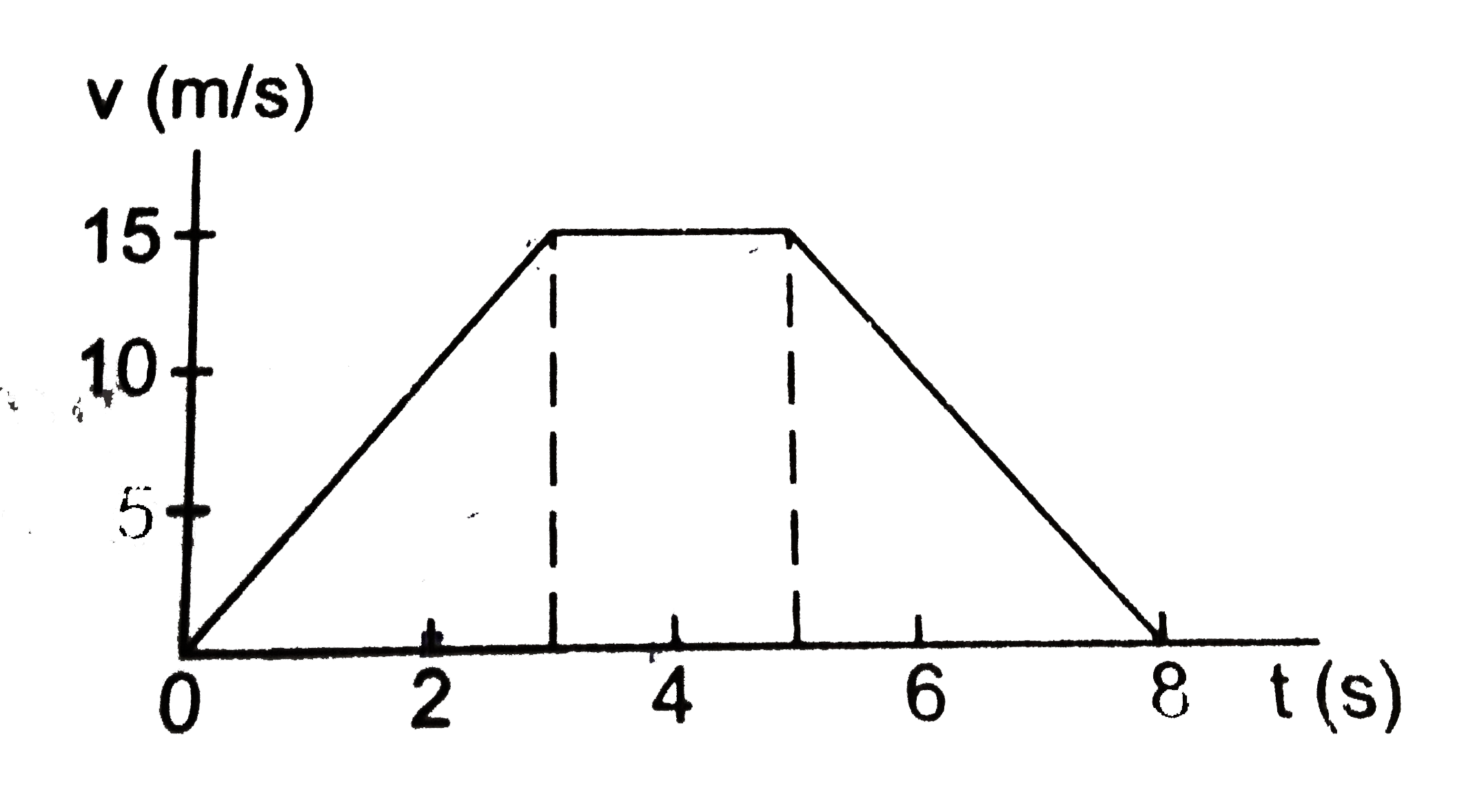
A paticle of mass 50 g moves on a straight line. The vatiation of speed with time is shown in figure. Find the force acting on the particle at t=2,4 and 6 secons.

Text Solution

Verified by Experts
Given `m= 50 g = 5xx 10^-2 kg`
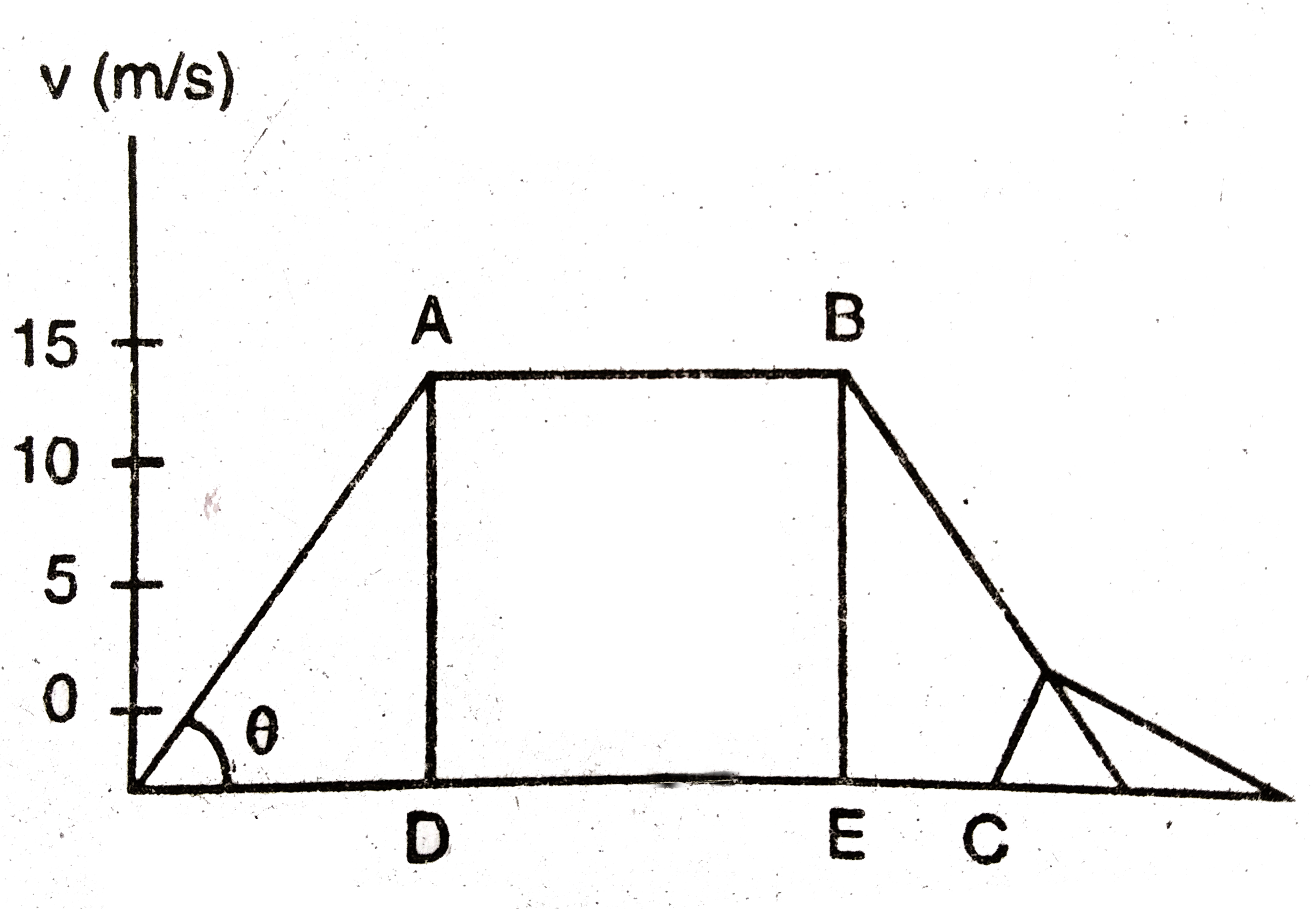
As shown in the ure
Slopd of `OA = tan theta`
` =(AD)/(OD) = 15/3 = m/s^2`

So, at t=2 sec, acceleration is 5 m/s^2
Force `= ma= 5xx 10^-2 xx 5`
` = 0.25 N ` along the motion ltBrgt At `t=4 sec`,
Slope of `ab=0`
and acceleration =0 [Since `tan theta = 0^0]`
`t t=6 sec`,
acceleration = slope of BC
`In /_\ BEC, tan theta =5`
`Slope of BC = tan (108^0-theta)-tan theta`
` = 5 m/s^2 (deceleration )
`:. Force = ma= 5xx 10^-2 xx5` ltBrgt `=0.25 N`
Opposite to the motion.
Promotional Banner

Similar Questions

Explore conceptually related problems

A particle starts motion from rest and moves along a straight line. Its acceleration-time graph is shown. Find out speed of particle at t=2s and at t=3s.

For body of 50 kg. mass, the velocity time graph is shown in figure. Then force acting on the body is :-

A particle moves in a straight line from origin. Its velocity time curve is shown. Find the distance of particle at the =8sec. From the origin and the distance travelled by the particle during first 8 seconds.

Position time graph of a particle of mass 2 kg is shown in figrure. Total work done on the particle from t=0 to t=4s is

Power due to a force actoing on a block varies with time t as shown in figure. Then angle between force acting on the block and its velocity is :-

The motion of a particle of mass m is described by y = ut + 1/2 "gt"^2 . Find the force acting on the particle.

A car is moving on a straight road. The velocity of the car varies with time as shown in the figure. Initially (at t=0), the car was at x=0 , where, x is the position of the car at any time 't'. The displacement time graph will be best represented by :-

A car is moving on a straight road. The velocity of the car varies with time as shown in the figure. Initially (at t=0), the car was at x=0 , where, x is the position of the car at any time 't'. Average speed from t=0 to t=70 s will be :-

A car is moving on a straight road. The velocity of the car varies with time as shown in the figure. Initially (at t=0), the car was at x=0 , where, x is the position of the car at any time 't'. The maximum displacement from the starting position will be :-

A body of mass 2 kg is kept on a rough horizontal surface as shown in the figure. Find the work done by frictional force in the interval t=0 to t=5 sec

