Home
Class 11
PHYSICS
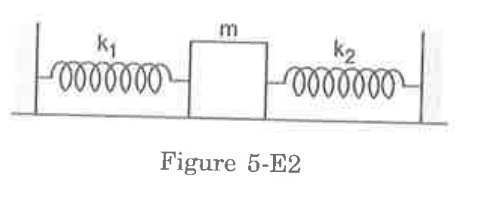
Both the springs shown in figure are unt...

Both the springs shown in figure are untretched. If the block is displaced by a distance x and released, what will be the initial acceleration?

Text Solution

Verified by Experts

Given, `x=20 cm= 0.2 m,`
`k=15 N/m, m=0.3 kg`
` Acceleration, a= F/m = (-kx)/m= (-15(0.2))/0.3`
= - 3/0.3 = - 10 m/s^2`
(deceleration),
So, the acceleration is 10 m/s^2 opposite to the direction of motion.
Promotional Banner

Similar Questions

Explore conceptually related problems

In the setup shown, fird acceleration of the block C.

Relation between displacement x and time t is x=2-5t+6t^(2) , the initial acceleration will be :-

Two identical springs of spring constant k are attached to a block of mass m and to fixed supports as shown in figure. When the mass is displaced from equilibrium position by a distance x towards right, find the restoring force.

Passage VIII A disc of mass m and radius R is attached with a spring of force contant k at its center as shown in figure. At x-0, spring is unstretched. The disc is moved to x=A and then released. There is no slipping between disc and ground. Let f be the force of friction on the disc from the ground. f versus t (time) graph will be as

A block (B) is attached to two unstriched sprig S_(1) and S_(2) with spring constant K and 4K , respectively (see fig 1) The other ends are atteched in identical support M_(1) and M_(2) not attached in the walls . The springs and supports have negligible mass . There is no friction anywhere . The block B is displaced toword wall 1 by a small distance z (figure (ii)) and released . THe block return and moves a maximum displacements x and y are musured with reoact to the equalibrum of the block B and the ratio y//x is

In the figure, block A is released from rest when the spring is its natural length for the block B of mass m to leave contact with the ground at some stage what should be the minimum mass of block A? .

On end of a light spring of natural length d and spring constant k is fixed on a rigid wall and the other is attached to a smooth ring of mass m which can slide without friction on a vertical rod fixed at a distance d from the wall. Initially the spring makes an angle of 37^@ with the horizontal. as shown in figure. When the system is released from rest, find the speed of the ring when the spring becomes horizontal. (sin 37^@=3/5) .

A mass m is attached to a spring. The spring is stretched to x by a force F and refeased. After being released, the mass comes to rest at the initial equilibrium position. The coeffiecient of friction, mu_(k) , is :-
