Home
Class 11
PHYSICS
A small block B is placed on another blo...

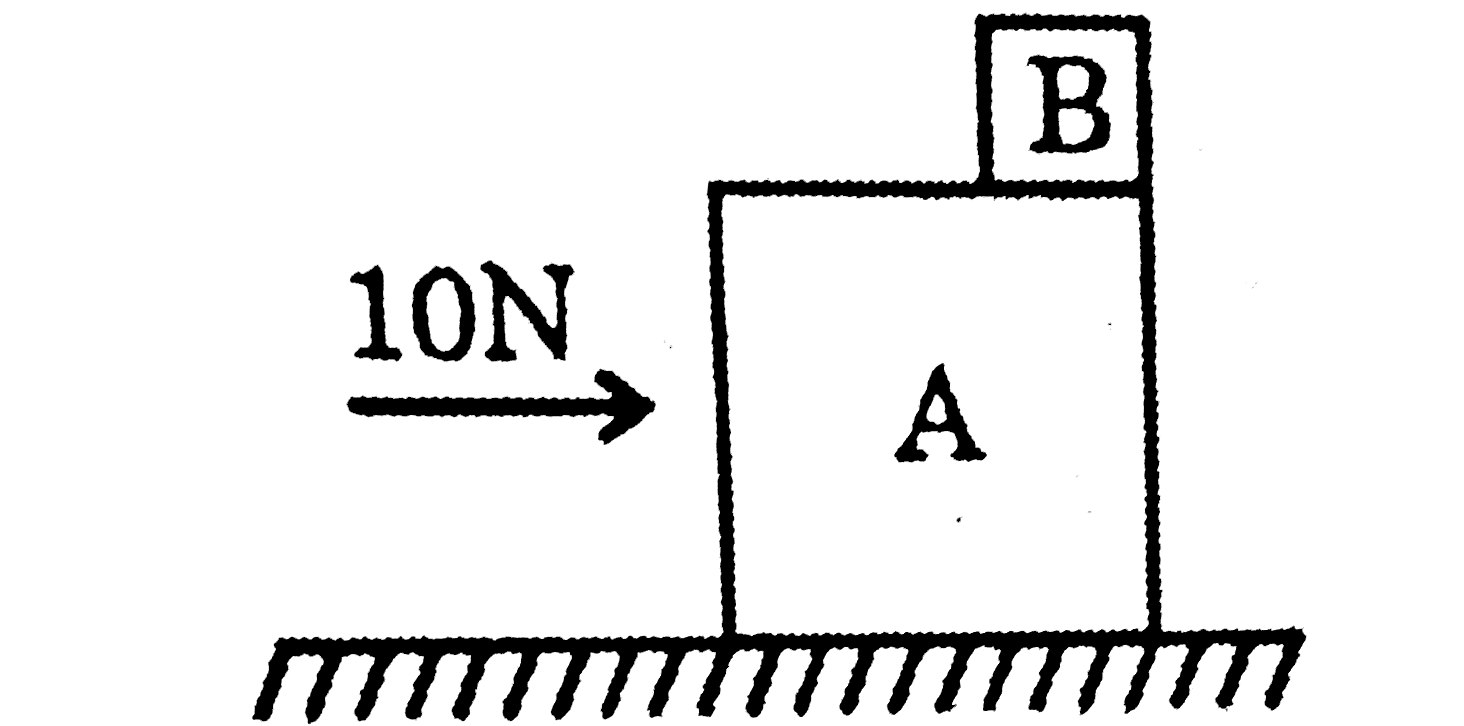
A small block B is placed on another block A of mass 5 kg and length 20 cm. Initially, the block B is near the right end of block A. A constant horizontal force of 10 N is applied to the block A. All the surfaces are assumed frictionless. Find the time elapsed before the block B separates from A.

Text Solution

Verified by Experts

Let the block m, towrds left through displacement x
` :. F_1 = k.x (compressed)`
` F_2 = k_2 x(expanded)`
Since they are in same directiion
`:. Resultant F= F_1+F_2=k_1x+k_2x`
`=x(k_1 +k_2)`
So, acceleration
`a=F/m (x(k_1+k_2))/m`.
Promotional Banner

Similar Questions

Explore conceptually related problems

Two blocks of masses 2 kg and 1 kg are in contact with each other on a frictionless table. When a horizontal force of 3.0 N is applied to the block of mass 2 kg the value of the force of contact between the two blocks is:

A block of mass 4 kg is placed on another block of mass 5 kg and the block B rests on a smooth horizontal table. If the maximum force that can be applied on A so that both the blocks move together is 12N, find the maximum force that can be applied on B for the blocks to move together.

A block A of mass 2 kg rests on another block B of mass 8 kg which rests on a horizontal floor. The coefficient of friction between A and B is 0.2 while that between B and floor is 0.5. when a horizontal force of 25 N is applied on the block B. the force of friction between A and B is

A block A of mass 2 kg is placed over another block B of mass 8 kg and supported by a ledge L fixed on block B on its smooth surface as its extended part. If a force F=100 N is applied on block B , it starts moving on rough horizontal surface. Find the force exerted by block B on block A . (Take g=10m//s^(2) )

A block is kept on a rough horizontal surface as shown. Its mass is 2 kg and coefficient of friction between block and surface (mu)=0.5. A horizontal force F is acting on the block. When

A 4.0 kg block is put on top of a 5.0kg block. In order to cause the top block to slip on the bottom one, a horizontal force of 12N must be applied to the top block. Assuming a friction less table the maximum horizontal force F which can be applied to the lower block so that the blocks, will move together should be

A block of mass'm' it kept over the smooth surface of the plank of mass M. the plank of length l is kept over the smooth horizontal surface. A constant horizontal force F is applied onto the plank as shown in figure. Calculate the time after which the block falls off the plank?

In arrangement shown the block A of mass 15 kg supported in equilibrium by the block B. Mass of the block B is closest to

A block is placed on a rough horizontal plane. Three horizontalforces are applied on the block as shown in the figure. If the block is in equilibrium, find the friction force acting on the block.

Two blocks of m asses 6 kg and 2 kg are placed in contact on a horizontal frictionless surface. If a horizontal force of 2N is applied to m ass 6 kg to move them together, what will be the acceleration of 2 kg block ? What will be the force on this block ?
