For addition and subtraction of phasors, we use the _________ form.
a) Rectangular
b) Polar
c) Either rectangular or polar
d) Neither rectangular nor polar
For addition and subtraction of phasors, we use the _________ form.
a) Rectangular
b) Polar
c) Either rectangular or polar
d) Neither rectangular nor polar
a) Rectangular
b) Polar
c) Either rectangular or polar
d) Neither rectangular nor polar
Text Solution
Verified by Experts
Given, `M=2k, k= 100 N/m
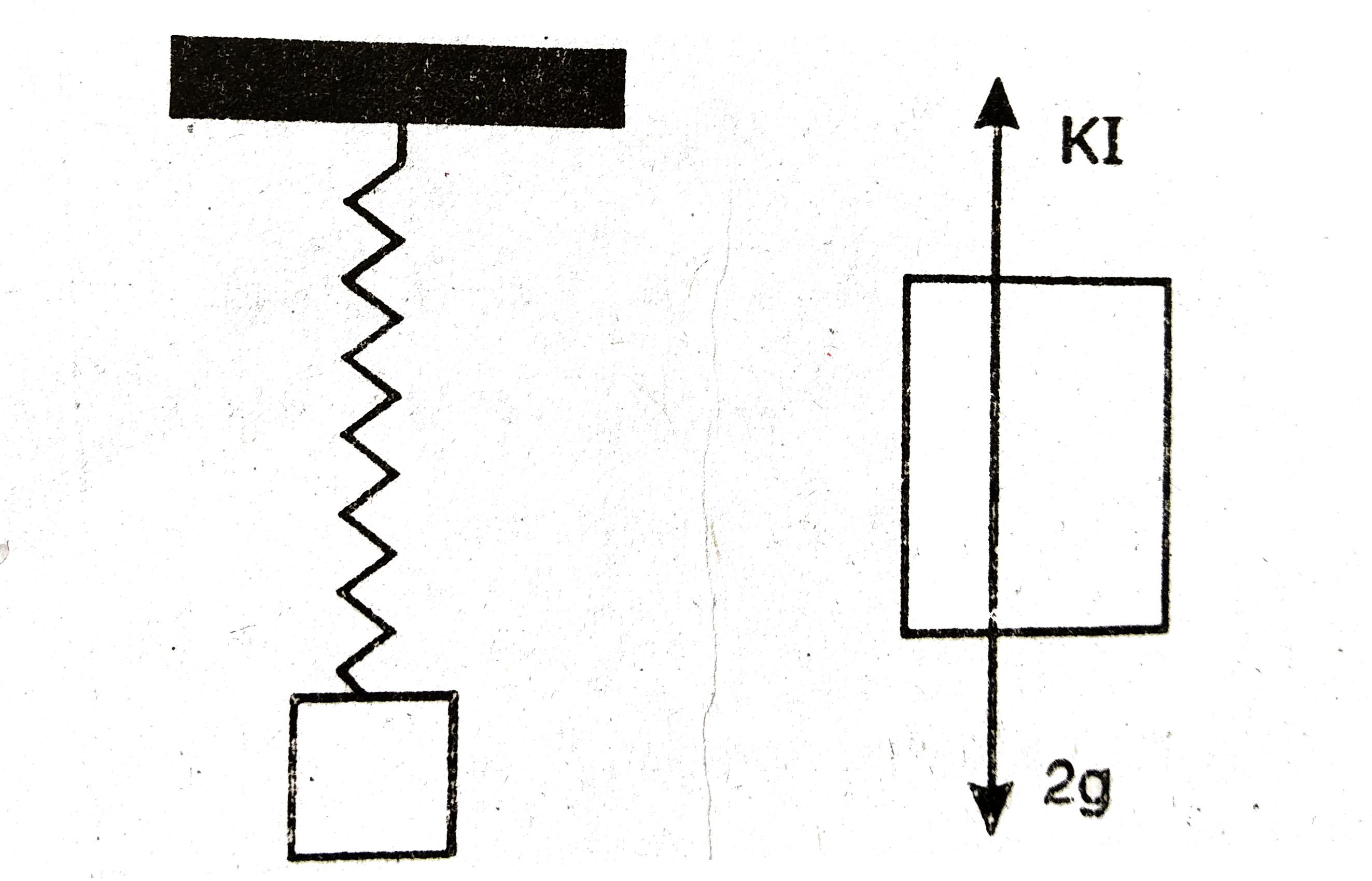
From the free body diagram………….
kl-2g=0`
`rarr kl=2g`
`rarr l (2g)/k= (2xx9.8)/100`
`=19.6/100=0.196~~0.2m`
Suppose further elongation happens when 1 kg block is added be x.
`Then k(l+x)=3g`
`rarr Kkx= 3g-2g=9.8N`
`rarr (2g)/k= (2xx9.8)/100`
` =19.6/100 = 0.098 = 0.1 m`.
From the free body diagram………….
kl-2g=0`
`rarr kl=2g`
`rarr l (2g)/k= (2xx9.8)/100`
`=19.6/100=0.196~~0.2m`
Suppose further elongation happens when 1 kg block is added be x.
`Then k(l+x)=3g`
`rarr Kkx= 3g-2g=9.8N`
`rarr (2g)/k= (2xx9.8)/100`
` =19.6/100 = 0.098 = 0.1 m`.



Similar Questions
Explore conceptually related problems
For each of the following, draw a circle and inscribe the figure given. If a polygon of the given type can’t be inscribed, write not possible. (a) Rectangle (b)Trapezium (c) Obtuse triangle (d) Non-rectangular parallelogram (e) Accute isosceles triangle
Find the number of permutations of letters a ,b ,c ,d ,e ,f,g taken all together if neither beg nor c a d pattern appear.
(a) A closed loop is held stationary in the magnetic field between the north and south poles of two permanent magnets held fixed. Can we hope to generate current in the loop by using very strong magnets ? (b) A closed loop moves normal to the constant electric field between the plates of a large capacitor. Is a current induced in the loop (i) when it is wholly inside the region between the capacitor plates (ii) when it is partially outside the plates of the capacitor? The electric field is normal to the plane of the loop. (c) A rectangular loop and a circular loop are moving out of a uniform magnetic field region (Figure) to a field-free region with a constant velocity v. In which loop do you expect the induced emf to be constant during the passage out of the field region? The field is normal to the loops.
Represent the following situations in the form of quadratic equation: The area of a rectangular plot is 528 m^(2) . The length of the plot is one metre more than twice its breadth. We need to find the length and breadth of the plot.
A rectangular box lies on a rough inclined surface. The coefficient of friction between the surface and the box is mu . Let the mass of the box be m. (a) At what angle of inclination 0 of the plane to the horizontal will the box just start to slide down the plane ? (b) What is the force acting on the box down the plane, if the angle of inclination of the plane is increased to a gt theta (c) What is the force needed to be applied upwards along the plane to make the box either remain stationary or just move up with uniform speed ? (d) What is the force needed to be applied upwards along the plane to make the box move up the plane with acceleration a ?
Two clocks are being tsted against a standard clock located in the national laboratory. At 10: 00: 00 AM by the standard clock, the readings of the clocks are : If you are doing an experiment that requires prescision time interval measurements, which of the two clock will you prefer ? (a) Clock A (b) Clock B (c) Either Clock A or B (d) Neithr A nor B
Represent the following situations in the form of quadratic eqautions : (1) The area of a rectangular plot is 528 m^(2) . The length of the plot (in metres) is one more than twice its breadth. We need to find the length and breadth of the plot. (2) The product of two consecutive positive integers is 306. We need to find the integers. (3) Rohan's mother is 26 years older than him. The product of their ages (in years) 3 years from now will be 360. We would like to find Rohan's present age. (4) A train travels a distance of 480 km at a uniform speed. If the speed had been 8km/h less, it would have taken 3 hours more to cover the same distance. We need to find the speed of the train.
A right angled prism of refractive index mu_(1) is placed in a rectangular block of refractive index mu_(2) , which is surrounded by a medium of refractive index mu_(3) ,as shown in the figure . A ray of light 'e' enters the rectangular block at normal incidence . depending upon the relationship between mu_(1) , mu_(2) "and" mu_(3) , it takes one of the four possible paths 'ef' , 'eg' , 'eh' or 'ef' Match the paths in List I with conditions of refractive indices in List II and select the correct answer using the codes given below the lists: {:("List" I , "List" II) , ( P. e rarr f , 1. mu_(1)gt sqrt(2mu_(2))) , ( Q. e rarr g , 2. mu_(2) gt mu_(1) "and" mu_(2) gt mu_(3)), ( R. e rarr f , 3. mu_(1) = mu_(2)), ( S. e rarr f , 4. mu_(2) lt mu_(1) lt sqrt(2mu_(2)) "and" mu_(2) gt mu_(3)):} Codes : {:( P , Q , R , S) , ((A) 2 , 3 , 1 , 4), ((B) 1 , 2 , 4 , 3) , ((C) 4 , 1 , 2 , 3) , ((D) 2, 3 , 4 , 1):}
(a) What happens if a bar magnet is cut into two pieces: (i) transverse to its length, (ii) along its length? (b) A magnetised needle in a uniform magnetic field experiences a torque but no net force. An iron nail near a bar magnet, however, experiences a force of attraction in addition to a torque. Why? (c) Must every magnetic configuration have a north pole and a south pole? What about the field due to a toroid? (d) Two identical looking iron bars A and B are given, one of which is definitely known to be magnetised. (We do not know which one.) How would one ascertain whether or not both are magnetised? If only one is magnetised, how does one ascertain which one? [Use nothing else but the bars A and B.)
Nucleophilic substitution reactions generally expressed as Nu^(-) +R-L rarr R-Nu +L^(-) Where Nu^(-) rarr Nucleophile , R-L rarr substrate, L rarr leaving group The best leaving groups are those that become the most stable ions after they depart. since most leaving group leave as a negative ion, the best leaving groups are those ions that stabilize a negative charge most effectively. A good leaving group should be (a) electron-withdrawing to polarize the carbon (b) stable once it has left (not a strong base) (c) polarise able to maintain partial bonding with the carbon in the transition state (both S_(N)1 and S_(N)2) . This bonding helps to stabilise the transition state and reduces the activation energy. Among the following which is false statement?
Recommended Questions
- For addition and subtraction of phasors, we use the form. a) Rectang...
Text Solution
|
- Express the polar equation r=2costheta in rectangular coordinates.
Text Solution
|
- Assertion : trans - Pent -2- ene is polar but trans - but -2- ene is n...
Text Solution
|
- Answer the following : (a) C Cl(4) is non-polar but CH(3)Cl is polar...
Text Solution
|
- ध्रुवित प्रकाश उत्पन्न करने के लिये हम प्रयोग करते है:
Text Solution
|
- Polar Form
Text Solution
|
- The polar coordinates of a point P are (2,200^(@)) The rectangular coo...
Text Solution
|
- A point has rectangular coordinates (3,4) . The polar coordinates are ...
Text Solution
|
- पोलेरॉइड.क्या है ? इसकी सहायता से समतल ध्रुवित प्रकाश किस प्रकार प्राप...
Text Solution
|