An empty plastic box of mass sm is found to accelerate up at the rate of g/6 when placed deep inside water. How much sand should be put inside the box so tht it may accelerate down at the rate of g/6?
An empty plastic box of mass sm is found to accelerate up at the rate of g/6 when placed deep inside water. How much sand should be put inside the box so tht it may accelerate down at the rate of g/6?
Text Solution
Verified by Experts
Let the air resistance force is `F_a` aned Bouyant force is B.
Given that, `F_a =av`
where v= velocity
`rarr F_M=kv, `
where k= proportioN/Ality constant
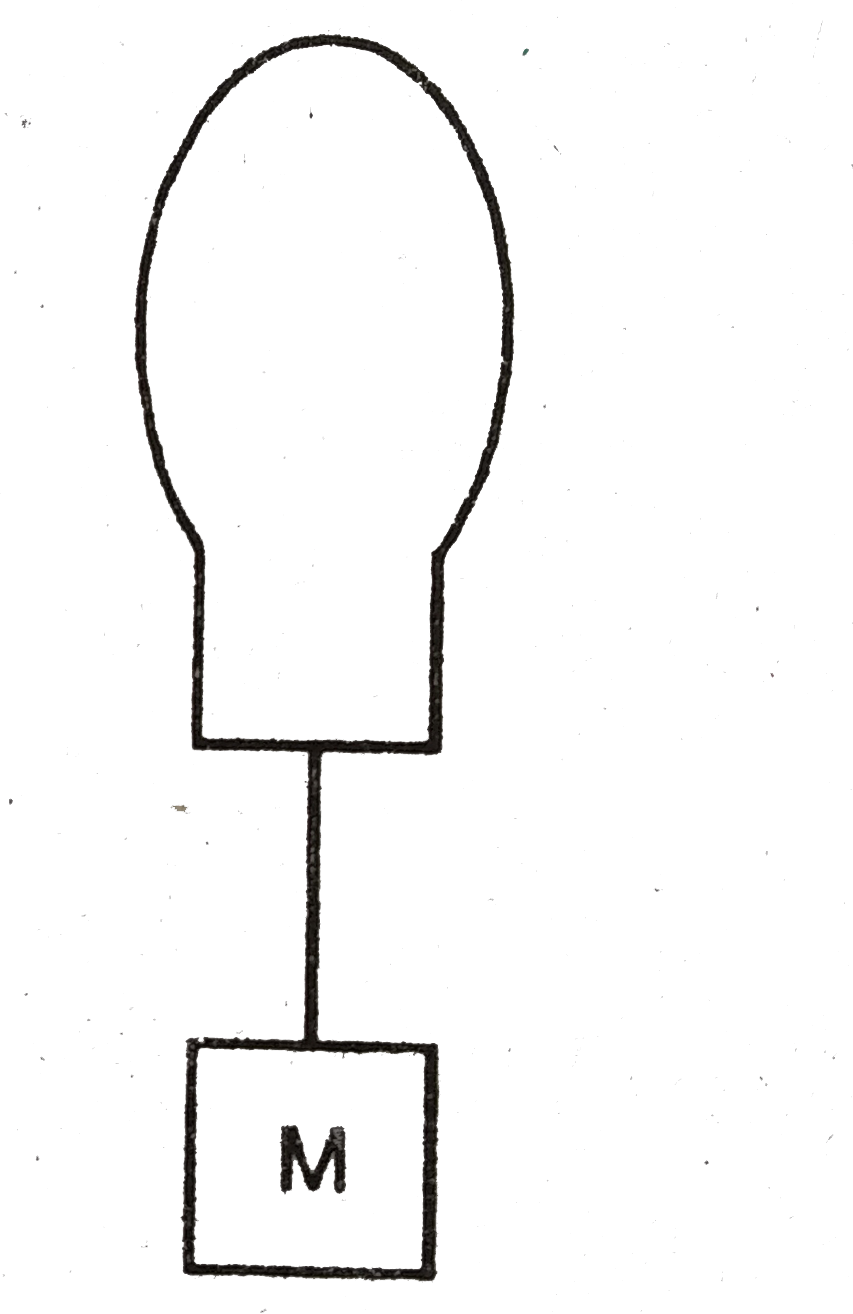
When the ballon is moving downward
`B+kv=Mg` ................i.
`rarr m= (b+kv)/g`
`for the balloon to rise with a constant velocity v (upward) let the mass of m
` Here , B-(mg+kv)=0`
` B=mg+kv` ltbr. `rarr m=(B+kv)/g`
`:.` Amount of mass that should be removed =M-m`
`=(B+kv)/g- (B-kv)/g`
` = (B+kv-B+kv)/g`
`(2kv)/g= (2(Mg-B))/g`
`2{M-B/g}`
Given that, `F_a =av`
where v= velocity
`rarr F_M=kv, `
where k= proportioN/Ality constant
When the ballon is moving downward
`B+kv=Mg` ................i.
`rarr m= (b+kv)/g`
`for the balloon to rise with a constant velocity v (upward) let the mass of m
` Here , B-(mg+kv)=0`
` B=mg+kv` ltbr. `rarr m=(B+kv)/g`
`:.` Amount of mass that should be removed =M-m`
`=(B+kv)/g- (B-kv)/g`
` = (B+kv-B+kv)/g`
`(2kv)/g= (2(Mg-B))/g`
`2{M-B/g}`



Similar Questions
Explore conceptually related problems
A ballon with mass 'm’ is descending down with an acceleration ‘a' (where a le g ). How much mass should be removed from it so that is starts moving up with an acceleration ‘a ’ ?
The rear side of a truck is open and a box of mass 20kg is placed on the truck 4m away from the open end mu = 0.15 and g = 10m//s^(2) The truck starts from rest with an acceleration of 2m//s^(2) on a straight road The box will fall off the truck when it is at a distance from the starting point equal to .
An elevator is accelerating upward at a rate of 6ft(sec^(2) when a bolt from its celling falls to the floor of the lift (Distance=9.5feet). The time taken (in seconds) by the falling bolt to hit the floor is (take g=32ft//sec^(2) )
If the container filled with liquid gets accelerated horizontally or vertically, pressure in liquid gets changed. In liquid ( a_(y) ) for calculation of pressure, effective g is used. A closed box horizontal base 6 m by 6 m and a height 2m is half filled with liquid. It is given a constant horizontal acceleration g//2 and vertical downward acceleration g//2 . What is the value of vertical acceleration of box for given horizontal acceleration (g//2) , so that no part of the bottom of the box is exposed?
If the container filled with liquid gets accelerated horizontally or vertically, pressure in liquid gets changed. In liquid ( a_(y) ) for calculation of pressure, effective g is used. A closed box horizontal base 6 m by 6 m and a height 2m is half filled with liquid. It is given a constant horizontal acceleration g//2 and vertical downward acceleration g//2 . The maximum value of water pressure in the box is equal to
If the container filled with liquid gets accelerated horizontally or vertically, pressure in liquid gets changed. In liquid ( a_(y) ) for calculation of pressure, effective g is used. A closed box horizontal base 6 m by 6 m and a height 2m is half filled with liquid. It is given a constant horizontal acceleration g//2 and vertical downward acceleration g//2 . Water pressure at the bottomof centre of the box is equal to (atmospheric pressure =10^(5)N//m^(2) density of water =1000 kg//m^(3),g=10m//s^(2) )
When an object moves through a fluid, as when a ball falls through air or a glass sphere falls through water te fluid exerts a viscous foce F on the object this force tends to slow the object for a small sphere of radius r moving is given by stoke's law, F_(w)=6pietarv . in this formula eta in the coefficient of viscosity of the fluid which is the proportionality constant that determines how much tangential force is required to move a fluid layer at a constant speed v, when the layer has an area A and is located a perpendicular distance z from and immobile surface. the magnitude of the force is given by F=etaAv//z . For a viscous fluid to move from location 2 to location 1 along 2 must exceed that at location 1, poiseuilles's law given the volumes flow rate Q that results from such a pressure difference P_(2)-P_(1) . The flow rate of expressed by the formula Q=(piR^(4)(P_(2)-P_(1)))/(8etaL) poiseuille's law remains valid as long as the fluid flow is laminar. For a sfficiently high speed however the flow becomes turbulent flow is laminar as long as the reynolds number is less than approximately 2000. This number is given by the formula R_(e)=(2overline(v)rhoR)/(eta) In which overline(v) is the average speed rho is the density eta is the coefficient of viscosity of the fluid and R is the radius of the pipe. Take the density of water to be rho=1000kg//m^(3) Q. If the sphere in previous question has mass of 1xx10^(-5)kg what is its terminal velocity when falling through water? (eta=1xx10^(-3)Pa-s)
When an object moves through a fluid, as when a ball falls through air or a glass sphere falls through water te fluid exerts a viscous foce F on the object this force tends to slow the object for a small sphere of radius r moving is given by stoke's law, F_(w)=6pietarv . in this formula eta in the coefficient of viscosity of the fluid which is the proportionality constant that determines how much tangential force is required to move a fluid layer at a constant speed v, when the layer has an area A and is located a perpendicular distance z from and immobile surface. the magnitude of the force is given by F=etaAv//z . For a viscous fluid to move from location 2 to location 1 along 2 must exceed that at location 1, poiseuilles's law given the volumes flow rate Q that results from such a pressure difference P_(2)-P_(1) . The flow rate of expressed by the formula Q=(piR^(4)(P_(2)-P_(1)))/(8etaL) poiseuille's law remains valid as long as the fluid flow is laminar. For a sfficiently high speed however the flow becomes turbulent flow is laminar as long as the reynolds number is less than approximately 2000. This number is given by the formula R_(e)=(2overline(v)rhoR)/(eta) In which overline(v) is the average speed rho is the density eta is the coefficient of viscosity of the fluid and R is the radius of the pipe. Take the density of water to be rho=1000kg//m^(3) Q. Which of the following may be concluded from the information in the passage?
Recommended Questions
- An empty plastic box of mass sm is found to accelerate up at the rate ...
Text Solution
|
- An empty plastic box of mass sm is found to accelerate up at the rate ...
Text Solution
|
- An empty box of mass 5kg is found to accelerate up at the rate of g/6 ...
Text Solution
|
- An empty plastic box of mass 9 kg is found to accelerate up at the rat...
Text Solution
|
- चित्र में एक बड़े बॉक्स को निचे की ओर a त्वरण से गिरता हुआ दिखाया गया ह...
Text Solution
|
- m द्रव्यमान का प्लास्टिक का एक खाली डिब्बा जब पानी में पूरा डुबाकर छोड़...
Text Solution
|
- चित्र में एक बड़े बॉक्स को नीचे की ओर a त्वरण से गिरता हुआ दिखाया गया ह...
Text Solution
|
- An empty plastic box of mass 5 kg is observed to accelerate up at the ...
Text Solution
|
- A balloon with mass m is descending down with an acceleration a (where...
Text Solution
|