Home
Class 11
PHYSICS
The length of the phasor represents? a)...

The length of the phasor represents?
a) Magnitude of the quantity
b) Direction of the quantity
c) Neither magnitude nor direction
d) Either magnitude or direction

Text Solution

Verified by Experts
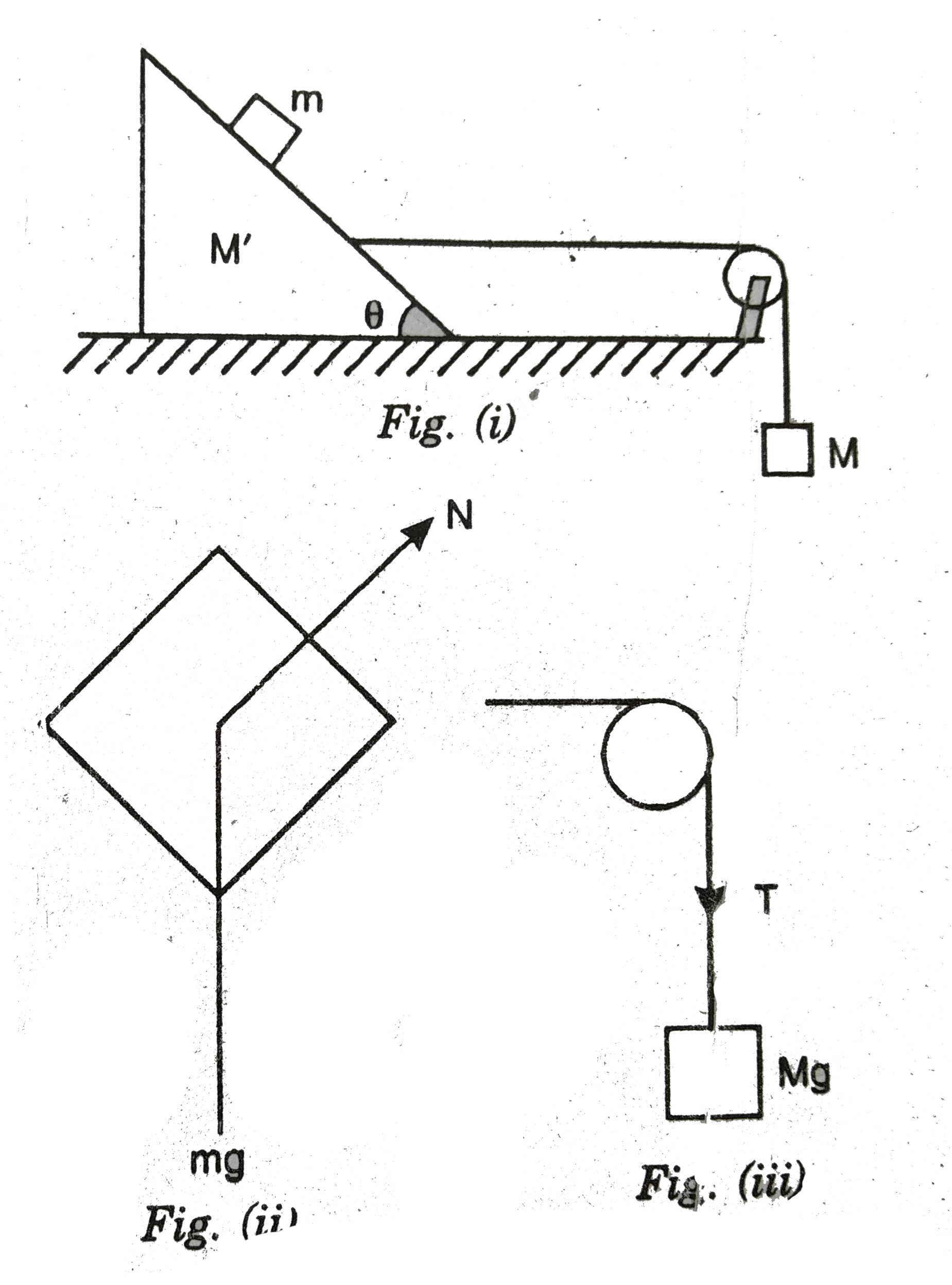
Free body diagram

The block m does not slip over M'
From ure i. `T-N sin theta = M'a` ………….i.
`From ure ii, N cos theta = Mg`…..ii.
` N sin theta = Mg ……….iii`
` From ure iii, Mg-T=Ma`.......iv.
From equations i. and iv
`Mg-N sin theta = (M'+M) a`

From equation (ii),
`Mg-Mg tan theta j= (M'+M)a`
and a= g tan theta
`Mg-Mg tan theta = (M'+M)g tan theta`
:. M= (M'+M)/(cot theta -1)`.
Promotional Banner

Similar Questions

Explore conceptually related problems

A physical quantity which has a direction:-

A physical quantity which has a direction and magnitude

A square coil of side 10 cm consists of 20 turns and carries a current of 12 A. The coil is suspended vertically and the normal to the plane of the coil makes an angle of 30^@ with the direction of a uniform horizontal magnetic field of magnitude 0.80 T. What is the magnitude of torque experienced by the coil?

Assertion: In projectile motion, the acceleration is constant in both magnitude and direction but the velocity changes in both magnitude and direction. Reason: When a force or accelration is acting in an oblique direction to the direction of velocity then both magnitude and direction of the velocity may be changed.

Assertion: A vector quantity is a quantity that has both magnitude and a direction and obeys the triangle law of addition or equivalent the parallelogram law of addition. Reason: The magnitude of the resultant vector of two given vectors can never be less than the magnitude of any of the given vector.

Given a+b+c+d=0 , which of the following statements are correct (a) a,b,c and d must each be null vector , (b) The magnitude of (a+c) equals the magnitude of (b+d), (c ) The magnitude of a can never be greater than the sum of the magnitudes of b ,c and d, (d) b+c must lie in the plane of and d if a and d are not collinear , and in the line of a and d , if they are collimear ?

A horizontal power line carries a current of 90A in east to west direction. What is the magnitude and direction of the magnetic field due to the current 1.5m below the line?

A horizontal power line carries a current of 90 A in east to west direction. What is the magnitude and direction of the magnetic field due to the current 1.5 m below the line ?

