Home
Class 11
PHYSICS
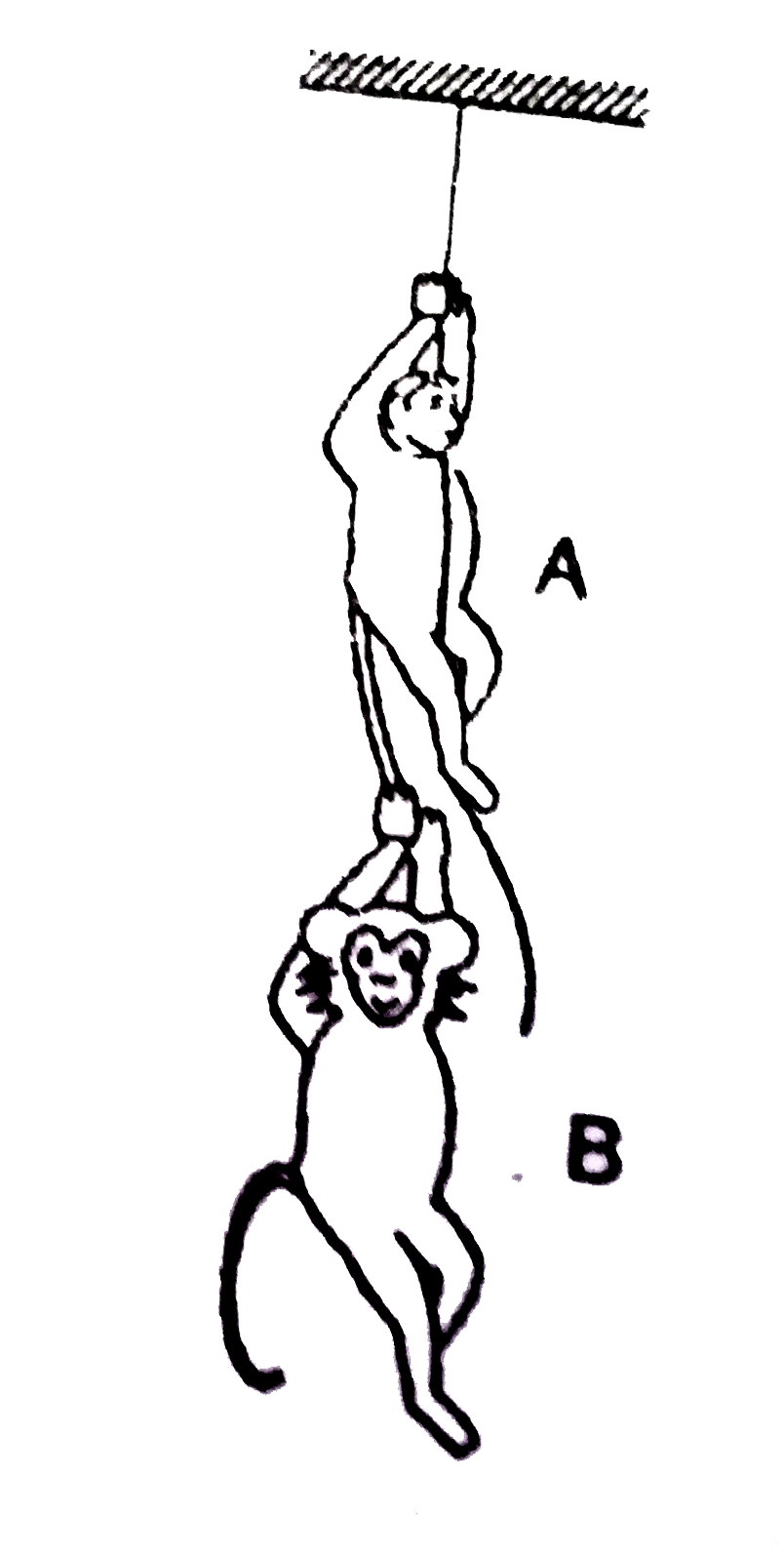
The monkey B shown in fig. is holding on...

The monkey B shown in fig. is holding on to the tall of the monkey A which is climbing up a rope. The masses of the monkeys A and B are 5 kg and 2kg respectively. If A can tolerate a tension of 30N in its tall, what force should it apply on the rope in order to carry the monkey B with it ?
(Take `g=10 ms^(-2)`)

Text Solution

Verified by Experts

Suppose A moves upward with acceleration a such that in the tail of a maximum tension 30 N produced.
`T-5g-30-5a=0`…..i ltbRgt `30-2g-2a=0` …….ii.
Form equation i. and ii, we have
`rarr T=105 N (max.)`
and `a=5 m/s^2`
So, A can apply a maximum forc eof 105 N in the rope to carry the monkey B with it.
For minimum force there is no acceleration of monkey A and B.
`rarr a=0`
From equation ii,
`T_1 -2g=0`
`rarr T_1 = 20 N` (weight of monkey B)
From equation i.
` T-5g-20=0`
`as T_1 =20`
`rarr T-5g-20=0`
` T=70N`
`:.` The monkey A should apply force betwen 70 N and 105 N to carry the monkey B with it.
Promotional Banner

Similar Questions

Explore conceptually related problems

In the adjacent figure, mass of A, B and C are 1 kg , 3 kg and 2 kg, respectively. Find (a) the acceleration of the system, and (b) tensions in the string . Neglect friction. (g =10ms^(-2) )

Three masses of 1 kg, 6 kg and 3 kg are connected to each other with threads and are placed on a table as shown in figure. What is the accelration with which the system is moving? Take g=10ms^(-2) :

The elevator shown in fig. is descending with an acceleration of 2ms^(-2) . The mass of the block A=0.5kg . Find the force (in Newton) exerted by block A on block B.

A block of mass 1 kg falls freely on a spring form a height of 20 cm as shown in figure . Find the compression in the spring if its force constant is 10^(3) N/m . ( Take g = 10.0 m//s^(2) )

A mass of 2kg is put on a flat pan attached to a vertical spring fixed on the ground as shown in figure. The mass of the spring and the pan is negligible. When spring is pressed and released the mass executes a simple harmonic motion. The spring constant is 200 N"/"m . What should be the minimum amplitude of the motion so that the mass gets detached from the pan? (take g= 10 m"/"s^(2) )

A monkey of mass 20kg is holding a vertical rope. The rope will not break when a mass of 25kg is suspended from it but will break it the mass exeeds 25kg . What is the maximum acceleration with which the monkey can climb up along the rope? (g=10m//s^(2)) .

A monkey weighing 10 kg climbing up a light rope and frictionless pulley attached to 15 kg mass at other end as in figure. In order to raise the 15 kg mass off the ground the monkey must climb-up

A plank of mass 2 kg and length 1 m is placed on horizontal floor.A small block of mass 1 kg is placed on top of the plank , at its right extreme end .The coefficient of friction between plank and floor is 0.5 and that between plank and block is 0.2 . If a horizontal force = 30 N starts acting on the plank to the right ,the time after which the block will fall off the plank is (g = 10 ms^(-2))

A rod of length 1.05 m having negligible mass is supported at its ends by two wires of steel (wire A) and aluminium (wire B) of equal lengths as shown in figure. The cross-sectional areas of wires A and B are 1.0 mm^(2) and 2.0 mm^(2), respectively. At what point along the rod should a mass m be suspended in order to produce (a) equal stresses and (b) equal strains in both steel and aluminium wires.
