Home
Class 11
PHYSICS
A car is speeding up on a horizontal roa...

A car is speeding up on a horizontal road with anaccelerationa. Consider the following situations in the car. i. A ball is suspended from the ceiling through a string and is maintaining a constant angel with the vertical. Find this angle. Ii. A block is kept on a smooth incline and does not slip on the incline. Find the angle of the incline with a horizontal.

Text Solution

Verified by Experts

The correct Answer is:
A, C

Suppose pendulum makes angle theta with the vertical.
Letm=mass of the pendulum
From the freee body diagram
`T cos theta - mg = 0`
` rarr T cos theta = mg`

`rarr T= (mg) / (cos theta) ` …....i
` and ma-T sin theta =0`
` rarr ma= T sin theta`
` rarr T= (ma)/(sin theta)` ..........ii
`rarr tan theta = a/g`
` rarr theta= tan^-1 = a/g`
i.e. angle formed is `tan^-1 (a/g)` with verticle.
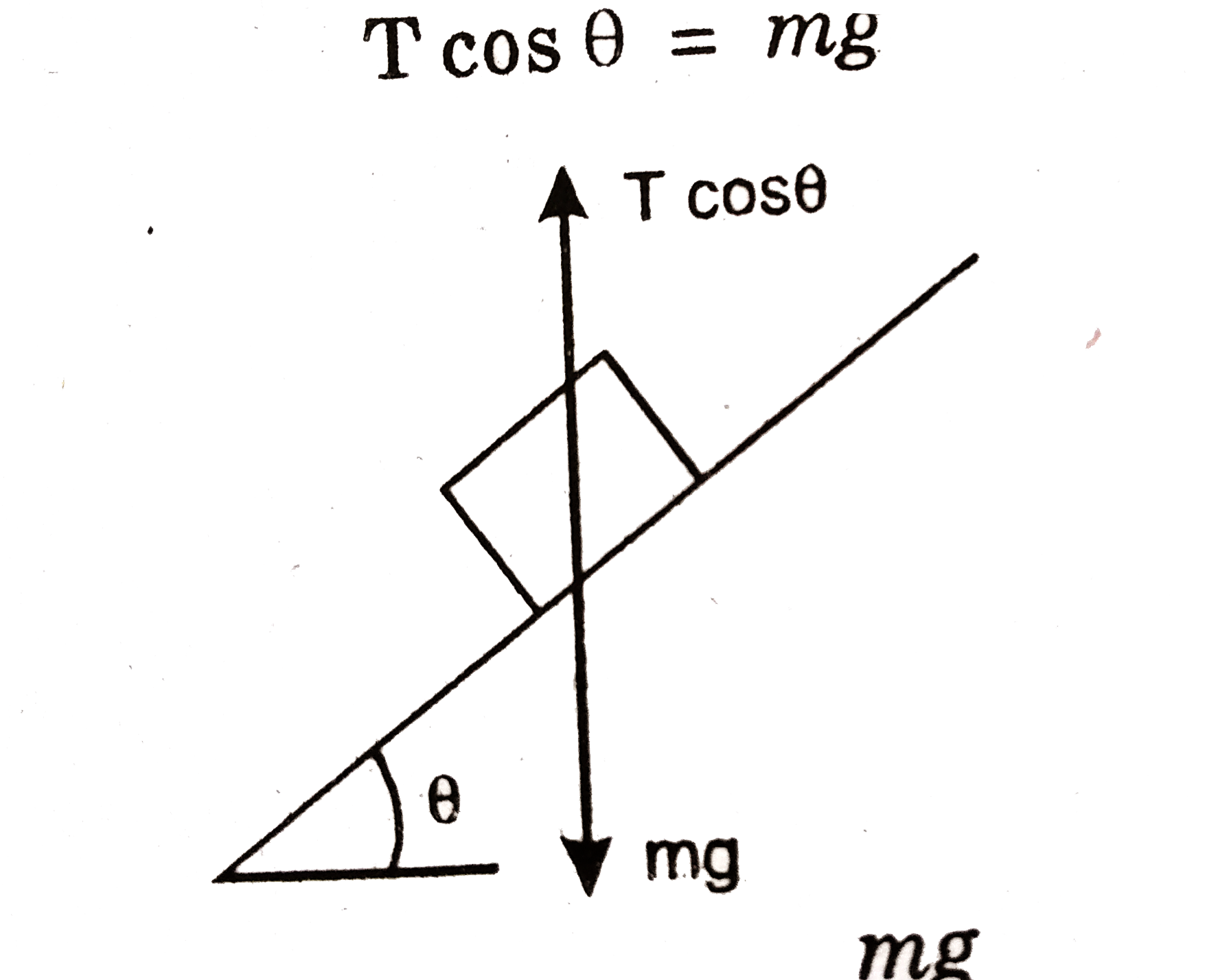
ii. Let M mass of block
Suppose the ngle of incline is theta,
From the diagram,
`rarr ma cos theta = mg sin theta`
` (sin theta)/(cos theta)=a/g`
` tan theta = a/g theta = tan^-1 (a/g)`
The angle of incline is `tan^-1 (a/g)`.
Promotional Banner

Similar Questions

Explore conceptually related problems

A small sphere is suspended by a string from the ceiling of a car. If the car beings to move with a constant acceleration a, the inclination of the string to the vertical is:

Consider a conical pendulum having bob is mass m is suspended from a ceiling through a string of length L. The bob moves in a horizontal circle of radius r. Find (a) the angular speed of the bob and (b) the tension in the string.

A through inclined is placed on car moving with a constant velocity u on horizontal ground . A block of mass M rests on the inclined plane . Is any work done by force of friction then a dissipation of energy ?

How much work done in pulling up a block of wood weighing 2kN for length of 10 m on smooth incline plane at angle 15^(@) with horizontal ?

A force of 4N is inclined at an angle of 60^(@) from the vertical. Find out its components along horizontal and vertical directions.

A particle is projected with a speed of 10 m/s at an angle 37^(@) with the vertical. Find (i) time of flight (ii) maximum height above ground (iii) horizontal range.

On end of a light spring of natural length d and spring constant k is fixed on a rigid wall and the other is attached to a smooth ring of mass m which can slide without friction on a vertical rod fixed at a distance d from the wall. Initially the spring makes an angle of 37^@ with the horizontal. as shown in figure. When the system is released from rest, find the speed of the ring when the spring becomes horizontal. (sin 37^@=3/5) .

A car P is moving with a uniform speed 5sqrt3 m//s towards a carriage of mass 9 kg at rest kept on the rails at a point B as shown in figure. The height AC is 120 m. Cannon balls of 1 kg are fired from the car with an initial velocity 100m//s at an angle 30^@ with the horizontal. The first cannon hall hits the stationary carriage after a time t_0 and sticks to it. Determine t_0 . At t_0 , the second cannon ball is fired. Assume that the resistive force between the rails and the carriage is constant and ignore the vertical motion of the carriage throughout. If the second ball also hits and sticks to the carriage, what will be the horizontal velocity of the carriage just after the second impact?

A rocket is fired vertically from the earth with an acceleration of 2g, where g is the gravitational acceleration. On an inclined plane inside the tocket, making an angle theta with the horizontal, a point object of mass m is kept, the minimum coefficient of friction mu_(min) between the mass and the inclined suface such that the mass does not move is:

Hailstones falling vertically with speed of 10 m/s hit with respect to himself the windscreen of a moving car and rebound elastically. Find the velocity of the car if the driver find the haolstones rebound vertically after striking. Windscreen makes an angle 30^(@) with the horizontal.

