Home
Class 11
PHYSICS
The coefficient of static friction betw...

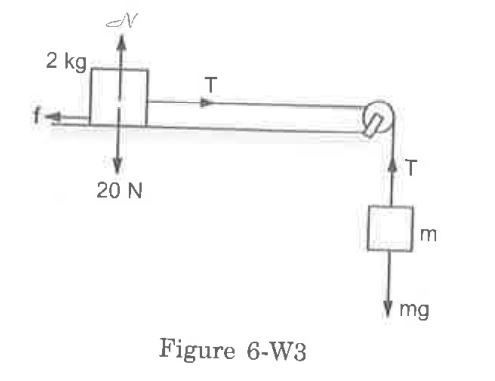
The coefficient of static friction between the block of 2 kg and the table shown in figure is `mu_s=0.2.` What should be the maximum value of m so tht the blocks do not move? Take `g=10 m/s^2.` The string and the pulley are light and smooth.

A

0.4 kg

B

0.2 kg

C

0.1 kg

D

0.5 kg

Text Solution

Verified by Experts

The correct Answer is:

A

Consider the equilibrium of the block of mass m. The forces on this block are
a. mg downward by the earth and
T upward by the string.
hence `T-mg=0 or, T=mg`…….i
Now consider the equilibrium of the 2 kg block. The forces on this block are
a. T towards rightby the string,
b. f towards left (friction)by the table,
c. 20 N downward (weight) by the earth and
d. N upward (normal force) by the table
For vertical equilibrium of this block,
N=20N...........ii
A m is the largest mass which can be used without moving the system, the friction is limiting
Thus, `f=mu_sN` ...........iii
For horizontal equilibrium of the 2 kg block
f=T
Using equations i, iii and iv
`mu_sN=mg`
or `02xx20N=mg`
or, `m=(02xx20)/10kg=04kg`
Promotional Banner

Similar Questions

Explore conceptually related problems

The coefficient of static friction, mu_(s) between block A of mass 2 kg and the table as shown in the figure is 0.2. What would be the maximum mass value of block B so that the two blocks do not move? The string and the pulley are assumed to be smooth and massless. (g=10m//s^(2))

The coefficient of static friction mu s, between block A of mass 2 kg and the table as shown in the figure is 0.2. What would be the maximum mass value of block B, so that two blocks do not move ? The string and the pully are assumed to be smooth and massless.

What is the maximum value of force, so that both the blocks will move together ? m1=m2=2kg ,μ=1/3

If coeffiecient of friction between the block of mass 2kg and table is 0.4 then out acceleration of the system and tension in the string. (g=10m//s^(2))

The fricition coefficient between the table and block shown in fig. is 0.2 find the acceleration of the system (Take g=10 m//s^(2) )

For the situation shown in the figure, what should be the value of force required to move the rod with constant velocity v = 2 m/s ?

A block is placed over a plank. The coefficient of friction between the block and the plank is mu= 0.2. Initially both are at rest, suddenly the plank starts moving with acceleration a_(0) = 4m//s^(2). The displacement of the block in 1 is (g=10m//s^(2))

The coefficient of static and kinetic friction between the two blocks and also between the lower block and the ground are mu_(s)=0.6 and mu_(k)=0.4 Find the value of tension T applied on the lower block at which the upper block begins to slip relative to lower block.

When force F applied on m_(2) and there is no friction between m_(1) and surface and the coefficient of friction between m_(1) and m_(2) is mu. What should be the minimum value of F so that there is no relative motion between m_(1) and m_(2)
