Home
Class 11
PHYSICS
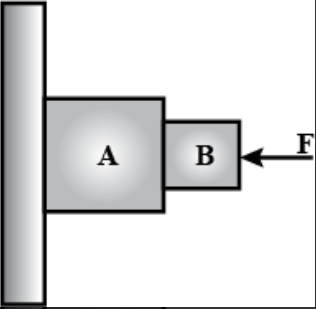
Consider the situation shown in figure. ...

Consider the situation shown in figure. The wall is smooth but the surfces of A and B in contact are rough. The friction on B due to A in equilibrium.

(a) is upward
(b) is downward
(c) is zero
(d) the system cannot remain in equilibrium

A

only a

B

only b

C

only d

D

c and d both

Text Solution

Verified by Experts

The correct Answer is:

D
Promotional Banner

Similar Questions

Explore conceptually related problems

Blocks shown in figure moves with constant velocity 10 m/s towards right. All surgaces in contact are rough. The friction force applied by B on A is :-

Figure shows two block A and B pushed against the wall with the force F . The wall is smooth but the surfaces in contact of A and B are rough. Which of the following is true for the system of blocks to be at rest againts wall?

Six similar bulbs are connected as shown in the figure with a DC source of emf E, and zero internal resistance. The ratio of power consumption by the bulbs when (i) all are glowing and (ii) in the situation when two from section A and one from section B are glowing, will be : (a) 2: 1 (b) 4 : 9 (c) 9 : 4 (d) 1 : 2

On which surface of cell Donnan equilibrium occur? (A) Tonoplast (B) Cell wall (C) Plasma membrane (D) Nuclear membrane

A block rest on a rough inclined plane as shown in fig. A horizontal force F is applied to it (a) Find out the force of reaction, (b) Can the force of friction be zero if yes when? And (c) Assuming that fricition is not zero find its magnitude and direction of its limiting value.

Assertion:A point charge q is placed near an arbitrary shaped solid conductor as shown in figures.The potential difference between the points A and B within the conductor remain same irrespective of the magnitude of charge q Reason: The electric field inside a solid conductor is zero under electrostatic conditions

A charged metallic sphere A is suspended by a nylon thread. Another charged metallic sphere B held by an insulating handle is brought close to A such that the distance between their centres is 10 cm, as shown in figure (a). The resulting repulsion of A is noted (for example, by shining a beam of light and measuring the deflection of its shadow on a screen). Spheres A and B are touched by uncharged spheres C and D respectively, as shown in figure (b). C and D are then removed and B is brought closer to A to a distance of 5.0 cm between their centres, as shown in figure (c). What is the expected repulsion of A on the basis of Coulomb's law ? Spheres A and C and spheres B and D have identical sizes. Ignore the sizes of A and B in comparison to the separation between their centres.

In the circuit shown in figure, when the input voltage of the base resistance is 10V, V_(BE) is zero and V_(CE) is also zero. Find the values of I_(B), I_(C ) and beta .

A cycle followed by an engine (made of one mole of an ideal gas in a cylinder with a piston) is shown in figure. Find heat exchanged by the engine, with the surroundings for each section of the cycle. C_V=3/2R (a) A to B : constant volume (b) B to C: constant pressure (c) C to D: adiabatic (d) D to A: constant pressure
