Home
Class 11
PHYSICS
A block slides down an inclined surface ...

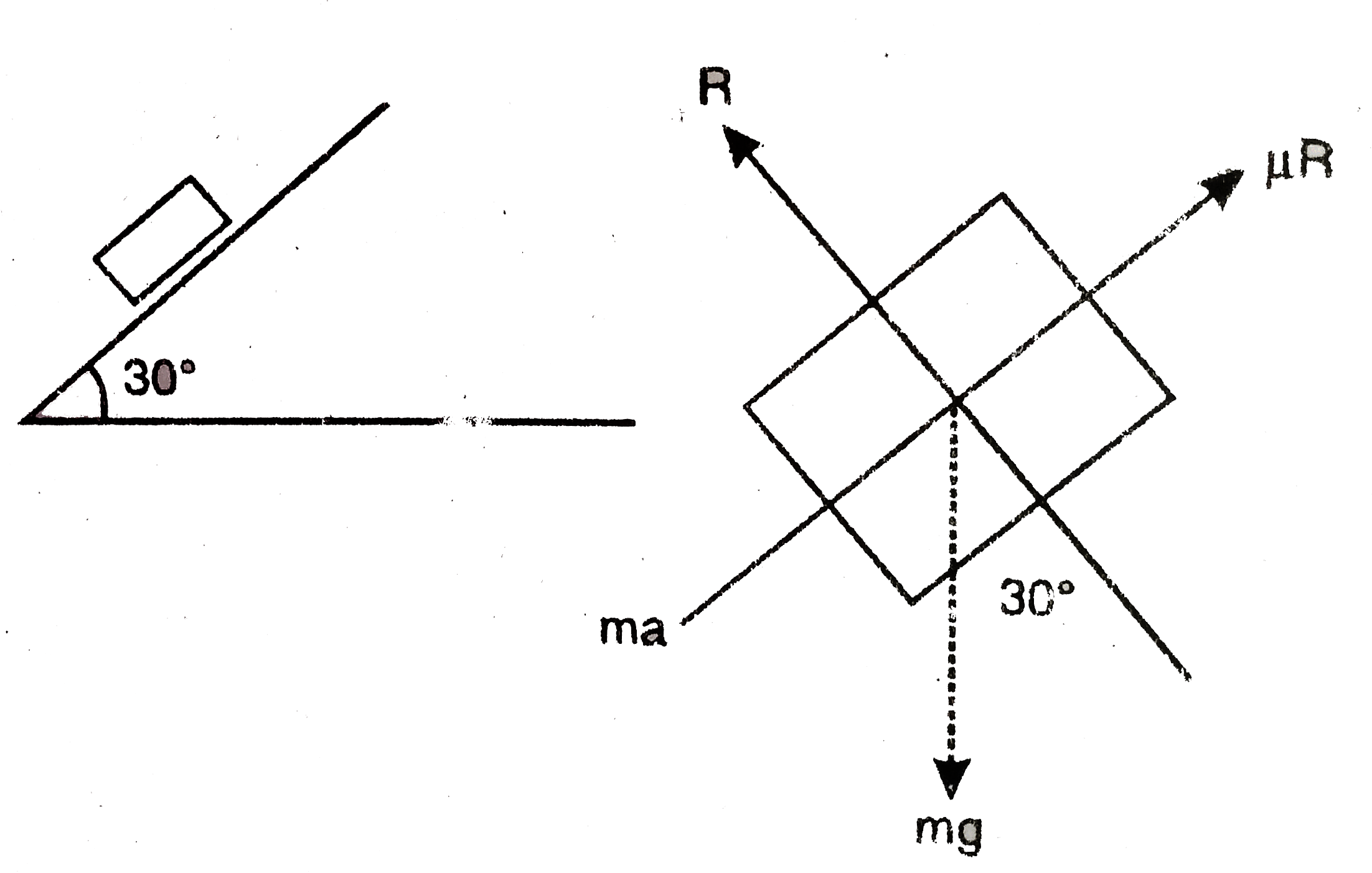
A block slides down an inclined surface of inclination `30^0` with the horizontal. Starting from rest it covers 8 m in the first two seconds. Find the coefficietn of kinetic friction between the two.

Text Solution

Verified by Experts

The correct Answer is:
A

From the free body diagram
`R-mg costheta=0`
`rarr R=mg cos theta`
For the block `u=9, S=8m, t=2sec,
From `S=ut+1/2at^2`
`8=0+1/2a2^2`
`rarr a=4m/s^2 `
Again`muR=ma-mg sinthetas=0`
Again `mu R+ma-mgsintheta=0`

From equation i. `mu mg costheta+mamg sintheta` ltbrge0`
`rarr m(mug cos theta+a-gsin theta)=0`
`rarr muxx10xxcos30^0=g sin 30^0-a`
`rarr mu xx 10 sqr3/2=10xx(1/2)-4`
`rarr(5sqrt3)mu=1`
`mu=(1/(5sqt(3)))=0.11`
Hence co efficient of kinetic friction between the two is 0.11.
Promotional Banner

Similar Questions

Explore conceptually related problems

A plank w ith a box on it atone end is gradually raised about the other end . As the ang le of in clin ation with the horizontal reaches 30^(@) , the box starts to slip and slides 4.0 m down the plan k in 4.0s. The coefficients of static and k inetic friction between the box and the plank will be, respectively:

A mass of 4 kg rests on a horizontal plane. The plane is gradually inclined until at an angle 0 = 15^(@) with the horizontal, the mass just begins to slide. What is the coefficient of static friction between the block and the surface

A 1 kg block situated on a rough incline is connected to a spring constant 100 Nm^(-1) as shown in figure . The block is released from rest with the spring in the unstretched position . The block moves 10 cm down the incline before coming to rest . Find the coefficient of friction between the block and the incline .Assume that the spring has a negligible mass and the pulley is frictionless.

A block has been placed on an inclined plane . The slope angle of theta of the plane is such that the block slides down the plane at a constant speed . The coefficient of kinetic friction is equal to :

A block of mass m1 = 1 kg another mass m2 = 2 kg, are placed together (see figure) on an inclined plane with angle of inclination theta . Various values of theta are given in List I. The coefficient of friction between the block m_(1) and the plane is always zero. The coefficient of static and dynamic friction between the block m_(2) and the plane are equal to mu = 0.3 . In List II expressions for the friction on block m_(2) are given. Match the correct expression of the friction in List II with the angles given in List I, and choose the correct option. The acceleration due to gravity is denoted by g [Useful information : tan (5.5^(@)) ~~ 0.1, tan (11.5^(@)) ~~ 0.2 , tan (16.5^(@))~~ 0.3 ].

A block of mass 1 kg is pushed up a surface inclined to horizontal at an angle of 30^(@) by a force of 10 N parallel to the inclined surface (figure) . The coefficient of friction between block and the incline is 0.1 .If the block is pushed up by 10 m along teh inclined calculate (a) work done against gravity (b) work done against force of friction (c ) increases in potential energy (d) increases in kinetic energy (e) work done by applied force

A block rests on a rough inclined plane making an angle of 30° with the horizontal. The coefficient of static friction between the block and the plane is 0.8. If the frictional force on the block is 10 N, the mass of the block ((in kg) is .......... (Take g = 10 m//s^(2) )

A block of mass m is being pulled up the rough incline , inclined at angle theta with horizontal by an agent delivering constant power P. The coefficient of friction between block & incline is mu . Then during the upward motion along the inclined plane , maximum velocity of the block will be :

A block is moving on an inclined plane making an angle 45^@ with the horizontal and the coefficient of friction is mu . The force required to just push it up the inclined plane is 3 times the force required to just prevent it from sliding down. If we define N=10mu , then N is

