Home
Class 11
PHYSICS
A car starts from rest on a half kilomet...

A car starts from rest on a half kilometer long bridge. The coefficiet of friction between the tyre and the road is 1.0. Show that one cannot drive thrugh the bridge in less than 10 s.

Text Solution

Verified by Experts
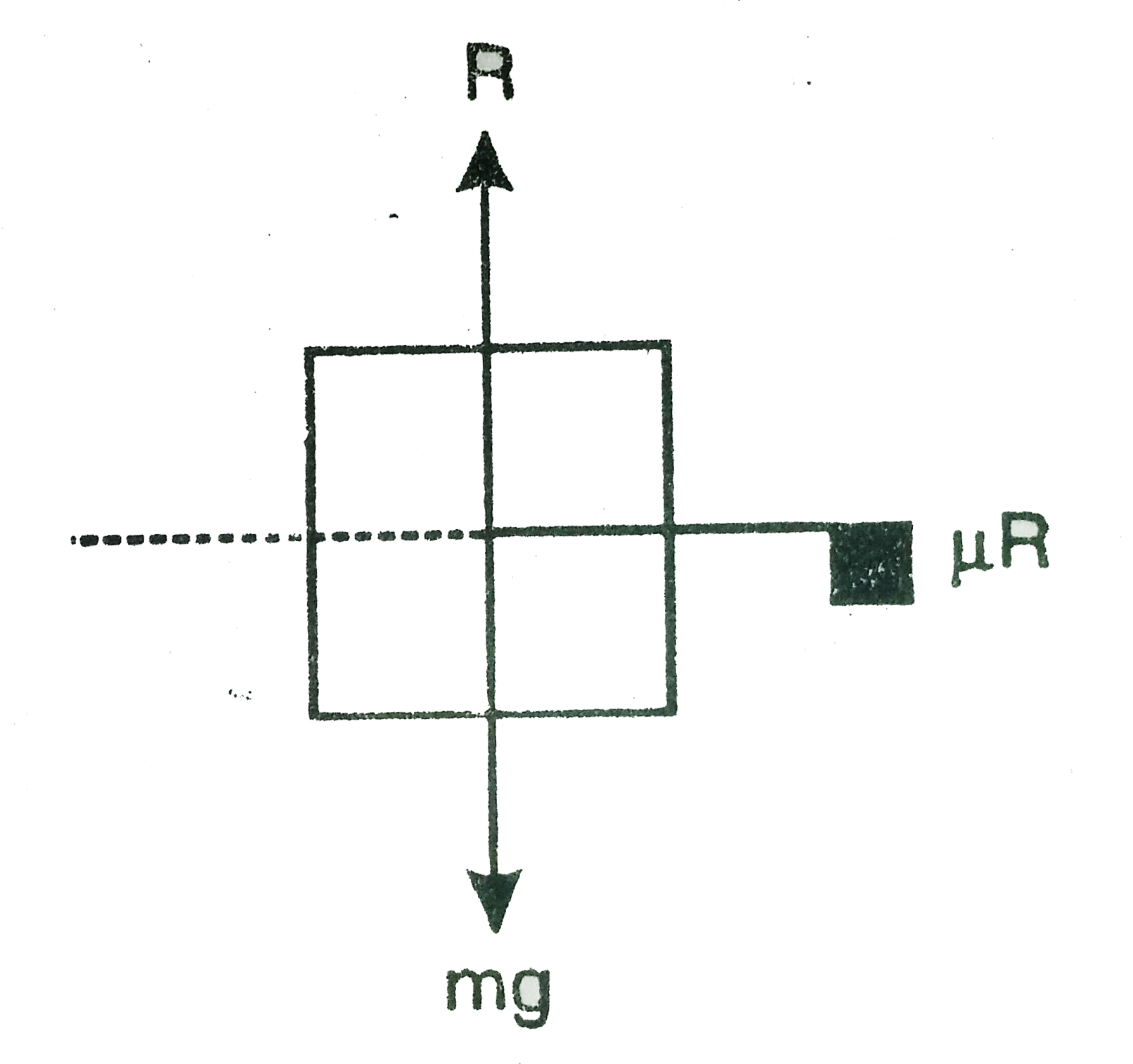
Let a maximum acceleratin is produced in car
`ma-mu R`
(for more accelerations the tyres will slip)
`rarr ma =mu mg`
`rarr a=mu g=1xx10=10 m/s^2` Force crossing of the bridge in minimum time, it has to travel with maximum acceeleration.
u=0, S=500m, a=10m/s
`From S=ut+1/2 at^2`
`500=0+(1/2)10t^2`
`rarr t=sqrt100=10sec`

If acceleration is less than `10 m/s^2` timewill be more than 10 sec. So one can't drive throughthe bridge in less than 10 s.
Promotional Banner

Similar Questions

Explore conceptually related problems

Find the maximum speed at which a car can take turn round a curve of 30 cm radius on a level road if the coefficient of friction between the tyres and the road is 0.4. Take g = 10 ms^(-2) .

The rear side of a truck is open and a box of 40 kg mass is placed 5 m away from the open end as shown in figure. The coefficient of friction between the box and the surface below it is 0.15. On a straight road, the truck starts from rest and accelerates with 2 ms^(2) . At what distance from the starting point does the box fall off the truck ? (Ignore the size of the box)

Two bodies A and B of mass 5 kg and 10 kg contact with each other rest on a table against a rigid The coefficient of friction between the bodies and the table is 0.05 A force of 200 N is applied horizontal on A What are (a) the reaction of thee wall (b) the the action , reaction forces between A & B ? What happens when the wall is removed ? Does the answer to (b) Change , when the bodies are in motion ? Ignore differnce between mu_(s) and mu_(k) .

Two bodies A and B of masses 5 kg and 10 kg in contact with each other rest on a table against a rigid wall as shown in figure. The coefficient of friction between the bodies and the table is 0.15. A force of 200 N is applied horizontally to A. What are (a) the reaction of the partition, (b) The action-reaction forces between A and B ? What happens when the wall is removed ? Does the answer to (b) change, when the bodies are in motion ? Ignore the difference between p_(s) and p_(k) .

A car is moving along a banked road laid out as a circle of radius r . (a) What should be the banking angle theta so that the car travelling at speed v needs no frictional force from tyres to negotiate the turn ? (b) The coefficient of friction between tyres and road are mu_(s) = 0.9 and mu_(k) = 0.8 . At what maximum speed can a car enter the curve without sliding toward the top edge of the banked turn ?

A cyclist on a level road takes a sharp circular tu rn of rad iu s 3 m (g = 10 ms^(- 2) ). If th e coefficient of static friction between the cycle tyres and the road is 0.2, at which of the following speeds will the cyclist not skid while taking the turn ?

A block of mass 15 kg is placed on a long trolley. The coefficient of static friction between the block and the trolley is 0.18. The trolley accelerates from rest with 0.5 m s^(-2) for 20 s and then moves with uniform velocity. Discuss the motion of the block as viewed by (a) a stationary observer on the ground, (b) an observer moving with the trolley.

A block of mass 15 kg is placed on a long trolley. The coefficien t of static friction between the block and the trolley is 0.18. The trolley accelerates from rest with 0.5 ms^(2) for 20 s and then moves with uniform velocity. Discuss the motion of the block as viewed by (a) a stationary observer on the ground, (b) an observer moving with the trolley.

Two blocks of mass m_(1)=10kg and m_(2)=5kg connected to each other by a massless inextensible string of length 0.3m are placed along a diameter of the turntable. The coefficient of friction between the table and m_(1) is 0.5 while there is no friction between m_(2) and the table. the table is rotating with an angular velocity of 10rad//s . about a vertical axis passing through its center O . the masses are placed along the diameter of the table on either side of the center O such that the mass m_(1) is at a distance of 0.124m from O . the masses are observed to be at a rest with respect to an observed on the tuntable (g=9.8m//s^(2)) . (a) Calculate the friction on m_(1) (b) What should be the minimum angular speed of the turntable so that the masses will slip from this position? (c ) How should the masses be placed with the string remaining taut so that there is no friction on m_(1) .

A block of mass 15kg is placed on a long trolley. The cofficient of fricition between the block and trolley is 0.18. The trolley accelerates from rest with 0.5m//s^(2) for 20s. then what is the friction force:-

