Home
Class 11
PHYSICS
IN a rotor, a hollow verticla cylindrica...

IN a rotor, a hollow verticla cylindrical structure rotates about its axis and a person rests asgainst he inner wall. At a particular speed of the rotor, the floor below the person is removed and the person hangs resting against the wall without any floor. If the radius of the roter is 2m and the coefficient of static frictioin between the wall and theperson is 0.2, find the minimum speed at which the floor may be removed Take `g=10 m/s^2`.

Text Solution

Verified by Experts
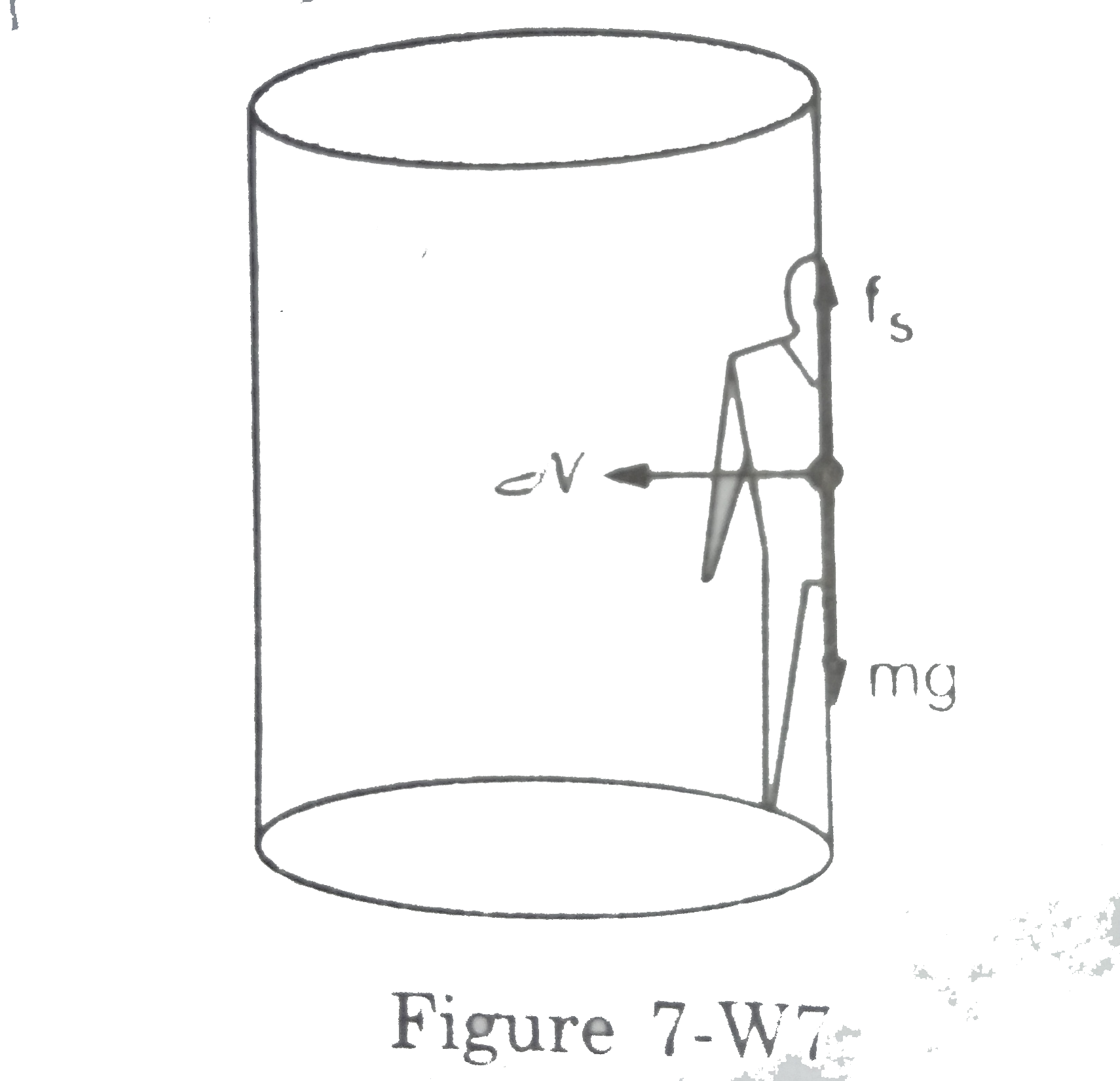
The situation is shown in ure.

When the floor removed, the forces on the person are
a. weight mg downwrd
b. normal force N due to the wall, towards the centre
c. frictioN/Al force `f_s` parallel to teh wll, upward.
The perso is moving in a circle with as uniform speed, so its acceleration is `v^2/r` towards the centre.
Newton's law for the horizontal direction (2nd law) and for the vertical direction (1st law) give
`N=mv^2/r`........i
and `f_s=mg` ...........i
for the minimum speed when the floor may be removed, the friction is limiting one and so equals `mu_sN`.This gives
`mu_sN=mg`
or, ` (mu_smv^2)/r=mg[using i]`
or `v=sqrt((rg)/mu_s)=sqrt((2mxx10m/s^2)/0.2)=10 m/s`
Promotional Banner

Similar Questions

Explore conceptually related problems

A horizontal force of 10N is necessary to just hold a block stationary against a wall. The coefficient of fricition between the block and the wall is 0.2 then find the weight of the block. (g=10m//s^(2))

A cyclist speeding at 18 km// h on a level road takes a sharp circular turn of radius 3 m without reducing the speed . The coefficient of static friction between the tyres and the road is 0.1 Will the cyclist slip while taking the turn ?

Determine the maximum acceleration of the train in which a box lying on its floor will remain stationary, given that the co-efficient of static friction between the box and the train’s floor is 0.15.

A block of mass 0.1 is held against a wall applying a horizontal force of 5N on block. If the coefficient of friction between the block and the wall is 0.5, the magnitude of the frictional force acting on the block is:

Find the minimum value of horizontal force (F) required on the block of mass m to keep it at rest on the wall. Given the coefficient of friction between the surfaces is mu .

A horizontal force of 10N is necessary to just hold a block stationary against as well. The coefficient of friction between the block and the wall is 0.2. The weight of the block is

The force exerted by the floor of an elevator on the foot of a person standing there is more than the weight of the person if the elevator is :

A disc rotating about its axis, from rest it acquires a angular speed 100rev/s in 4 second. The angle rotated by it during these four seconds (in radian) is

force F = 100 N is applied horizontally on a block of mass 4 kg. Which is in contact with a wall. Such that it does not fall. The coefficient of friction between the block and the wall is

