Home
Class 11
PHYSICS
A hemispherical bowl of radius R is set ...

A hemispherical bowl of radius R is set rotating about its axis of symmetry which is kept vertical. A small block kept in the bowl rotates with the bowl without slipping on its surface. If the surfaces of the bowl is smooth, and the angle made by the radius through the block with the vertical is `theta`, find the angular speed at which the bowl is rotating.

Text Solution

Verified by Experts
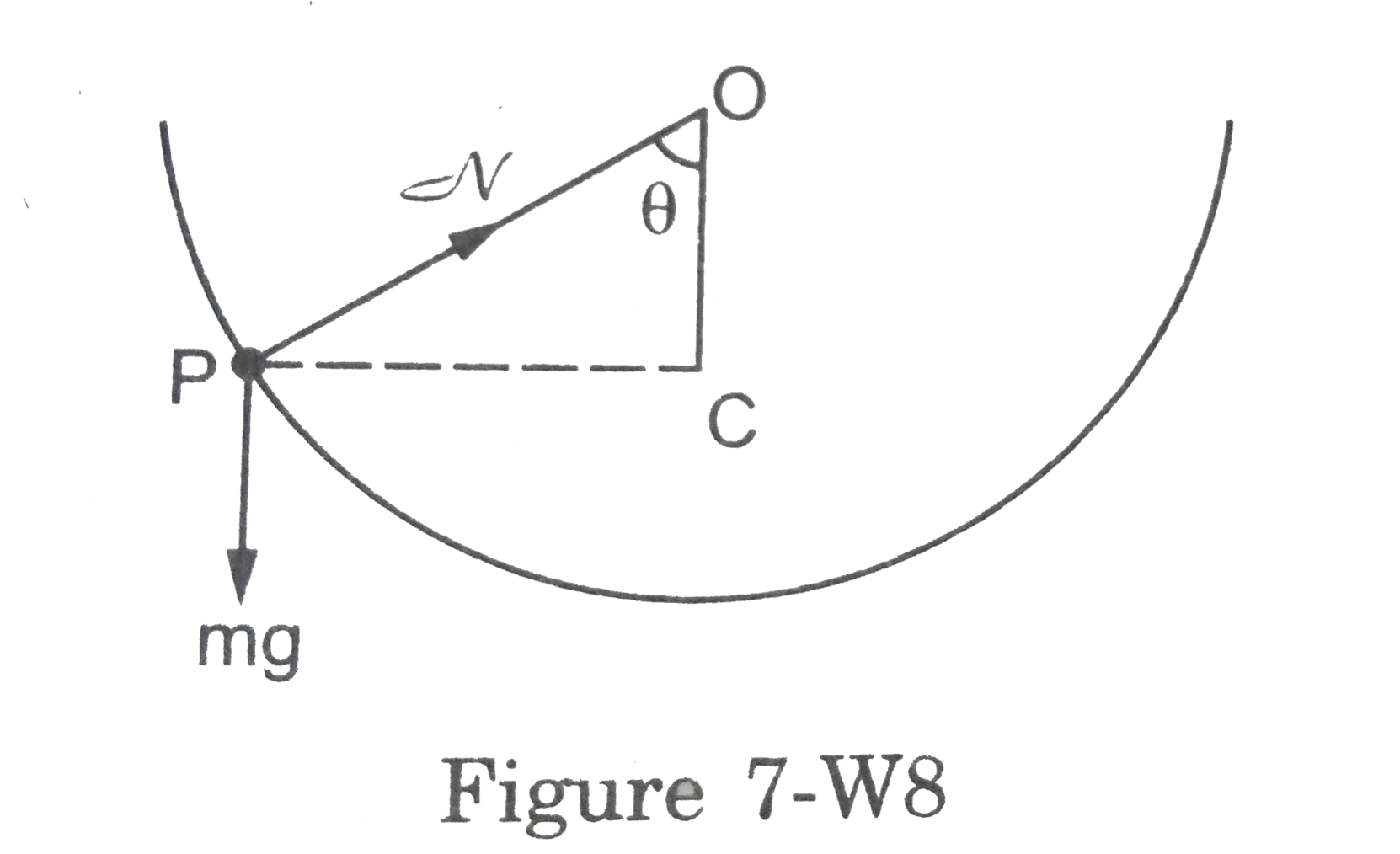
Suppose the angular speed of rotatioin of the bowl is `omega`. The block also moves with this angular speed. The forces on the block are ure.
a. the normal force N and
b. the weight mg

The block moves in a horizontal circle with the centre at C, so that teh radius is PC=OP `sintheta=Rsintheta.` Its acceleration is therefore `omega^2Rsintheta.` Resolving the forces along PC and applying Newton's second law,
`Nsintheta=momega^2Rsintheta`
`or, N=m omega^2R` ........i
As there is vertical acceleration,
`Ncostheta=mg`..........ii
Dividing i by ii
`1/(costheta)=(omega^2R)/g`
or, `omega=sqrt(g/(Rcostheta))`
Promotional Banner

Similar Questions

Explore conceptually related problems

A hemispherical bowl of radius R si set rotating abouv its axis of symmetry whichis kept vertical. A small blcok kept in the bowl rotates with the bowl without slippingn on its surface. If the surfaces of the bowl is mooth, and the abgel made by the radius through the block with the vertical is theta , find the angular speed at which the bowl is rotating.

If the coefficient of friction between an insect and bowl is mu and the radius of the bowl is r, find the maximum height to which the insect can crawl in the bowl.

A hemispherical bowl is made of steel, 0.25 cm thick. The inner radius of the bowl is 5 cm. Find the outer curved surface area of the bowl.

A hemispherical bowl is made up of stone whose thickness is 5 cm. If the inner radius is 35 cm, find the total surface area of the bowl.

A disc of mass m and radius r is free to rotate about its centre as shown in the figure. A string is wrapped over its rim and a block of mass m is attached to the free end of the string. The system is released from rest. The speed of the block as it descends through a height h, is :-

A thin circular wire of radius R rotatites about its vertical diameter with an angular frequency omega . Show that a small bead on the wire remain at its lowermost point for omegalesqrt(g//R) . What is angle made by the radius vector joining the centre to the bead with the vertical downward direction for omega=sqrt(2g//R) ? Neglect friction.

A 100 turn closely wound circular coil of radius 10 cm carries a current of 3.2 A. (a) What is the field at the centre of the coil? (b) What is the magnetic moment of this coil? The coil is placed in a vertical plane and is free to rotate about a horizontal axis which coincides with its diameter. A uniform magnetic field of 2T in the horizontal direction exists such that initially the axis of the coil is in the direction of the field. The coil rotates through an angle of 90^@ under the influence of the magnetic field. (c) What are the magnitudes of the torques on the coil in the initial and final position? (d) What is the angular speed acquired by the coil when it has rotated by 90^@ ? The moment of inertia of the coil is 0.1 kg m^2 .

On a frictionless horizontal surface , assumed to be the x-y plane , a small trolley A is moving along a straight line parallel to the y-axis ( see figure) with a constant velocity of (sqrt(3)-1) m//s . At a particular instant , when the line OA makes an angle of 45(@) with the x - axis , a ball is thrown along the surface from the origin O . Its velocity makes an angle phi with the x -axis and it hits the trolley . (a) The motion of the ball is observed from the frame of the trolley . Calculate the angle theta made by the velocity vector of the ball with the x-axis in this frame . (b) Find the speed of the ball with respect to the surface , if phi = (4 theta )//(4) .

A ball rolls without slipping. The radius of gyration of the ball about an axis passing through its centre of mass is K. If radius of the ball be R, then the fraction of total energy associated with its rotational energy will be …………..

