Home
Class 11
PHYSICS
A table with smooth horiztonal surface i...

A table with smooth horiztonal surface is truning at an angular speed `omega` abouyt its axis. A groove is made on the surface along a radius and a particle is gently placed inside the groove at a distance a from the centre. Find the speed of the speed of the particle as its distance from teh centre becomes L.

Text Solution

Verified by Experts
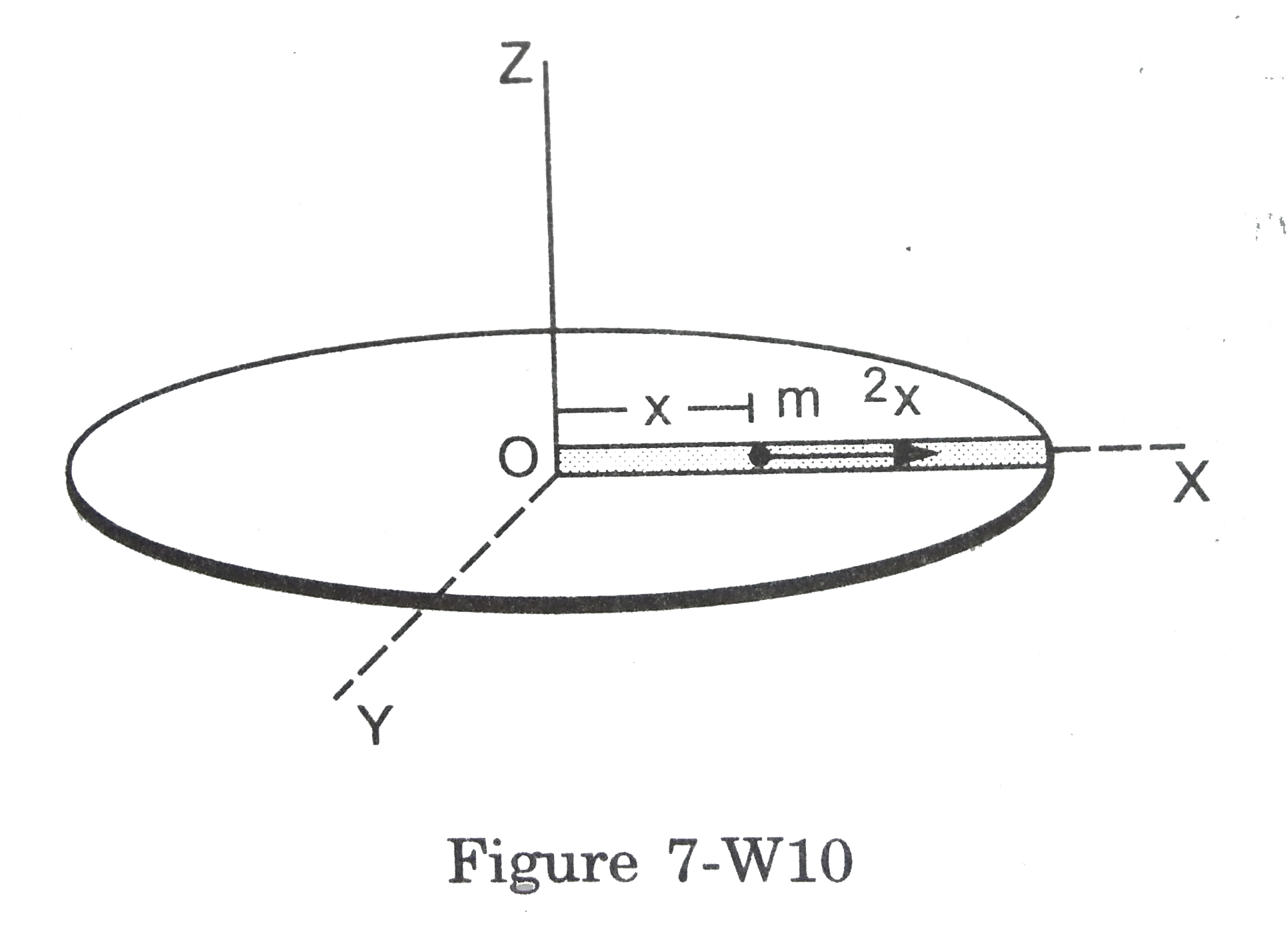
The situation is hwon in ure.

Let us work from the frame of reference of the table. Let us take the origin at the centre of rottion O an the X-axis along the groove ure. The Y-axis is along the lineperpendicular to OX coplaN/Ar with the surface of the table and the Z-axis is along the vertical.
Suppose at time t particle in the groove is at a distance x fromn the origin and is moving along The X-axis witha speed v. The forces acting on the particle (including the pseudeo forces that we must assume because we have taken our frame on the table which is rotating and is nonintertial) are
a. weight mg vetically downward
b. normal contact force `N_1` verticall upward by te bottom surfce of the groove,
c. normal contact force `N_2` parallel to the Y-axis by the side walls of the groove,
d. centrifugal force `momega^2x` alongthe X-axis, and
e. Coriolis force along Y-axis (coriolis force is perpendicular to the velocity of the particle and the axis of rotation).
As the particle can only move in the groove. Its acceleration is along the X-axis. The only force along teh X-axis is the centrifugal force `momega^2x`. all the other forces are perpendicular to the X-axis adn have no components along the X-axis.
Thus, the acceleration along the X-axis is
`a=F/m =(momega^2x)/m = omega^2x`
or, `(dv)/(dt)=omega^2x`
or ` (dv)/(dx).(dx)/(dt)=omega^2x`
or `(dv)/(dx).v=omega^2x`
or, ` v dv = omega^2 x dx `
or, `int^v_0 v dv = int^L_aomega^2 x dx `
or, ` [1/2 v^2]_0^v=[1/2 omega^2x^2]^L_a`
or, `v^2/2=1/2 omega^2(L^2-a^2)`
or, v=omega sqrt(L^2-a^2)`
Promotional Banner

Similar Questions

Explore conceptually related problems

A very small groove is made in the earth, and a particle of mass m_(0) is placed at (R)/(2) distance from the centre. Find the escape speed of the particle for that place.

a narrow tunnel is dug along the diameter of the earth, and a particle of mass m_(0) is placed at R/2 distance from the centre. Find the escape speed of the particle from that place.

An object is allowed to fall freely towards the earth from a distance r ( gt R_e) from the centre of the earth. Find the speed of the object when it strikes the surface of the earth.

A hollow metal sphere of radius 5 cm is charged such that the potential on its surface is 10V . The potential at the distance 3 cm from the centre of the sphere is:

Near the earth's surface time period of a satellite is 4 hrs. Find its time period if it is at the distance '4R' from the centre of earth :-

An object of mass m is raised from the surface of the earth to a height equal to the radius of the earth, that is, taken from a distance R to 2R from the centre of the earth. What is the gain in its potential energy ?

A satellite of mass m revolves around the earth of radius R at a height x from its surface. If g is the acceleration due to gravity on the surface of the earth, the orbital speed of the satellite is

A particle of mass M is placed at the centre of a spherical shell of same mass and radius a. What will be the magnitude of the gravitational potential at a point situated at a/2 distance from the centre ?

A particle of mass m is moving with constant speed in a vertical circle in X-Z plane. There is a small both at some distance on Z- axis. The maximum distance of the shadow of the particle on X- axis from origin equal to :-

A particle starts motion from rest and moves along a straight line. Its acceleration-time graph is shown. Find out speed of particle at t=2s and at t=3s.

