Home
Class 11
PHYSICS
What is the reason for the occurrence of...

What is the reason for the occurrence of systematic errors in an instrument ?
a) No use for a long time
b) High use
c) Manufacturing fault
d) Delivery fault

Text Solution

Verified by Experts
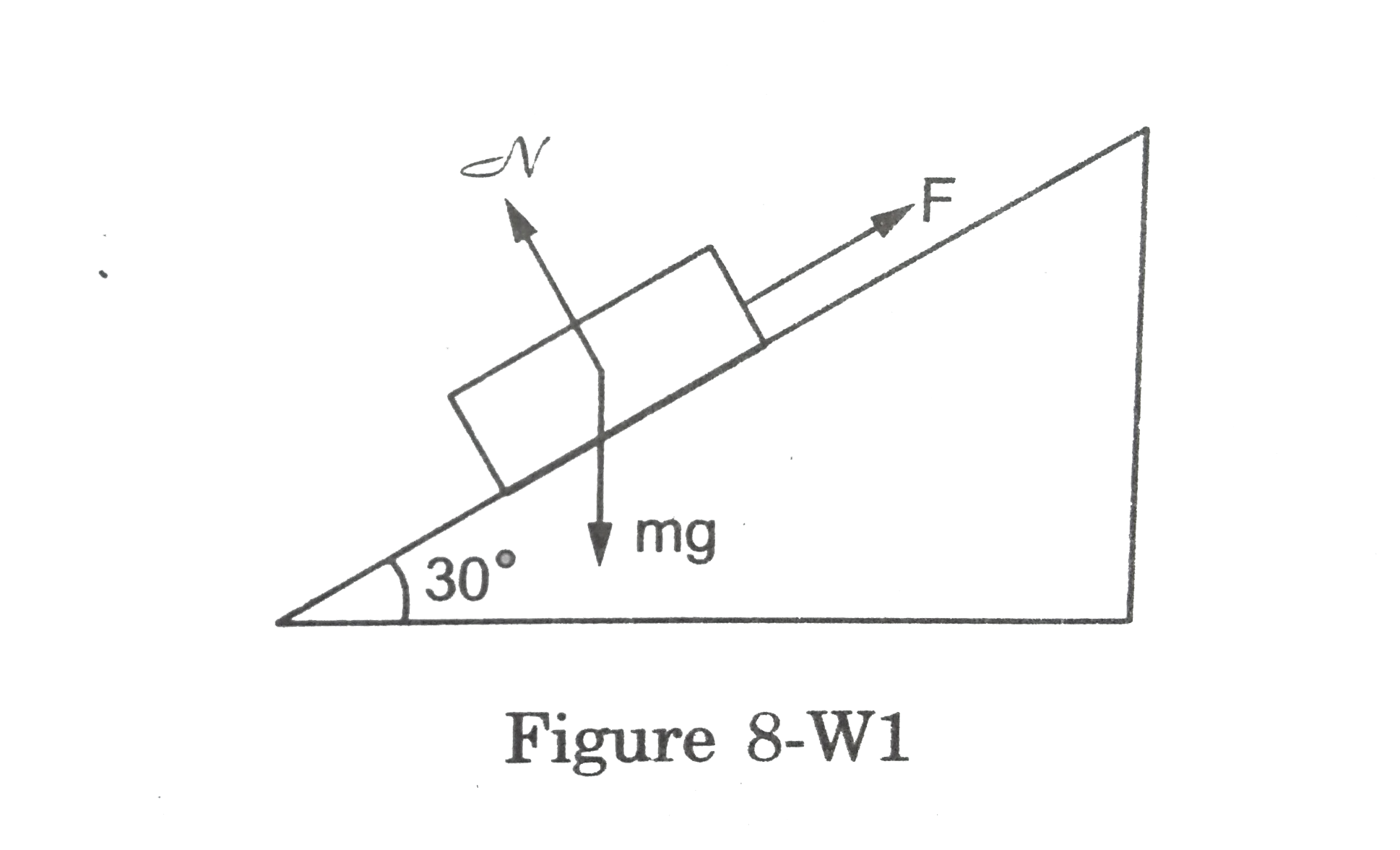
The forces acting on the block are shown in ure. Resolving the forces parallel to the incline, we get
`F-mg sintheta=ma`
`or, F=mgsintheta+ma`
`=(2.0)(9.8 m/s^2)(1/2)+1.0m/s^2]=11.8N`

The velocity at t=4.0 s is
`v=at=(1.0 m/s^2)(4.0s)=4.0m/s`
The power delivered by the force at t=4.0s is
`P=vecF.vecv=(11.8N)(4.0m/s)~~47W`
The displacement during the first four seconds is
`x=1/2at^2=1/2(1.0m/s^2)(16s^2)=8.0m`
The work done in these four seconds is therefore
`W=vecF.vecd=(11.8N)(8.0m)=9.44J`
The average power delivered `=(94.4J)/(4.0s)`
`=23.6W~~24W`
Promotional Banner

Similar Questions

Explore conceptually related problems

What is used to decrease cholesterol in blood ? (A) Stains (B) Lipase (C) Cyclosporin (D) Insulin

Assertion : Large number of methanogens bacteria are found in dung of cattle. Reason : The excreta (dung) is used to prepare biogas. (A) Assertion and Reason are true and Reason is the correct explanation of Assertion. (B) Assertion and Reason are true but Reason is not the correct explanation of Assertion (C) Both Assertion and Reason are false. (D) Assertion is true but reason is false

Two ideal gas thermometers A and B use oxygen and hydrogen respectively. The following observations are made : What do you think is the reason behind the slight difference in answers of thermometers A and B ? (The thermometers are not faulty). What further procedure is needed in the experiment to reduce the discrepancy between the two readings ?

A steel rular exactly 20 cm long is graduated to give correct measurements at 20^@C . (a) Will it give readings that are too long or too short at lower temperatures? (b) What will be that actual length of the rular when it is used in the desert at a temperature of 40^@ C ? alpha_(steel = 1.2 xx 10^-5(.^@ C)^-1 .

A physical quantity P is related to four observables a,b,c and d as follows: P = a^(3)b^(2)/(sqrtcd) The percentage errors of measurement in a,b, c and d are 1%, 3% , 4% and 2% respectively. What is the percentage error in the quantity P ? If the value of P calculated using the above relation turns out to be 3.763, to what value should you round off the result ?

A physical quantity X is related to four measurable quantities a, b, c and d as follows X=a^(2)b^(3)c^((5)/(2))d^(-2) . The percentange error in the measurement of a, b, c and d are 1 %, 2%, 3% and 4% respectively. What is the percentage error in quantity X? If the value of X calculated on the basis of the above relation is 2.763. to what value should you round off the result.

