A box weighing 2000 N is to be slowly slid through 20 m on a straigh track having friction coefficient 0.2 with the box. A find the work done by the person pulling the box wilth a chain at angle `theta` with the horizontal. B. find the work when the person has chosen a value of `theta` which ensures him the minimum magnitude of the force.
A box weighing 2000 N is to be slowly slid through 20 m on a straigh track having friction coefficient 0.2 with the box. A find the work done by the person pulling the box wilth a chain at angle `theta` with the horizontal. B. find the work when the person has chosen a value of `theta` which ensures him the minimum magnitude of the force.
Text Solution
Verified by Experts
The correct Answer is:
A, B, D
Weight =2000 N,S=20 m `mu=2`
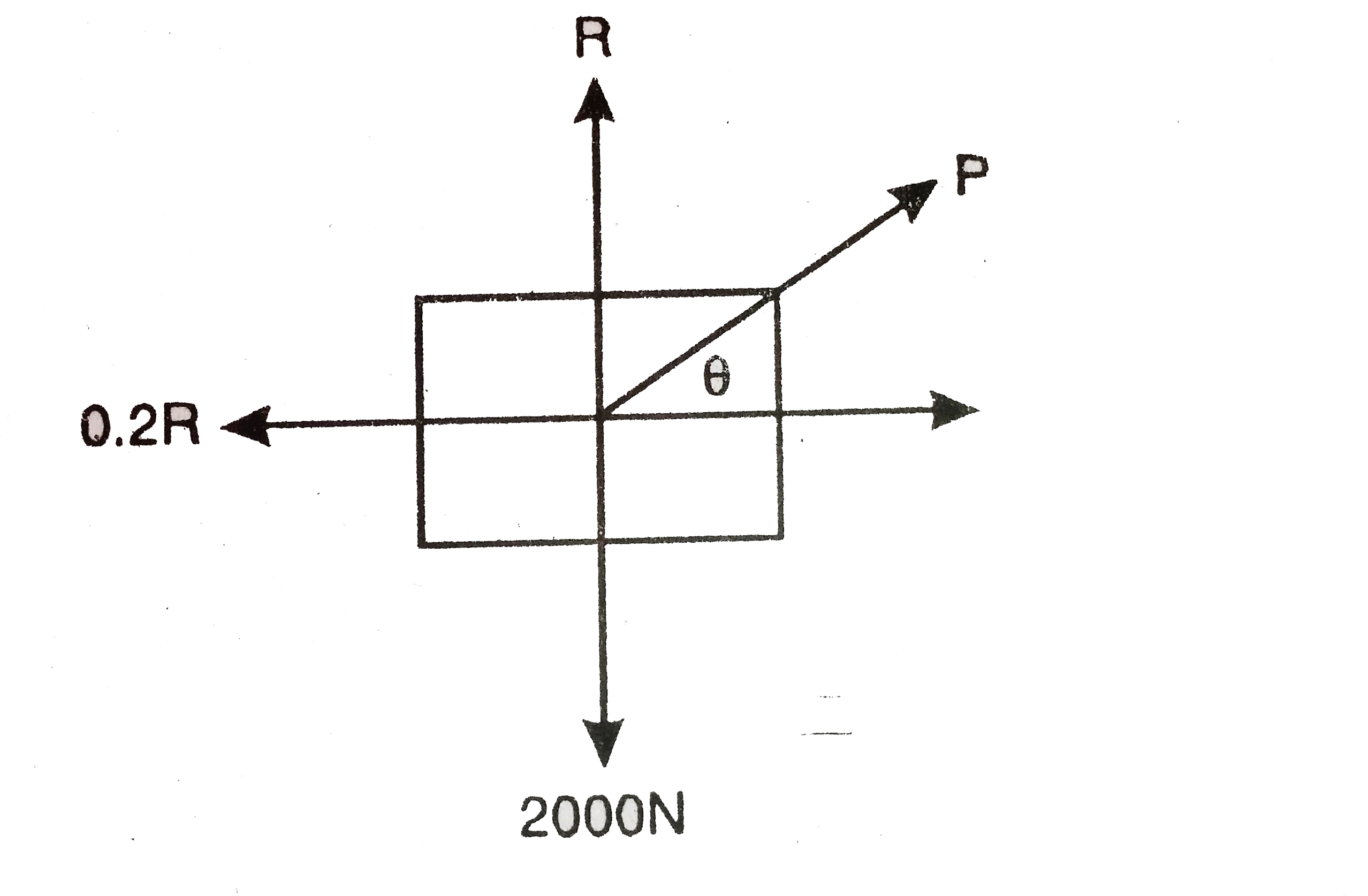
a. `R+psintheta-2000=0`………i
`Pcostheta-0.2R=0`………ii
From i and ii
`Pcostheta-0.2(2000-Psintehta)=0`
`P(costheta+0.2sintheta)=400 `
`P=400/(costheta+0.2sinthet)` ......iii
So, work done by the person,
W=PScostheta`
`=(8000costheta)/(costheta+0.2sintheta)`
`=8000/(1+0.32tantheta)`
`=40000/(5+tantheta)`......iv
b. From minium magnitude of force foerm equation i
`d/(dk)(costheta+0.2sintheta)=0`
`rarr tantheta=0.2`
putting the value in equation i
`W=40000/(5+tantheta)`
=40000/(5+0.2)~~7692J`
a. `R+psintheta-2000=0`………i
`Pcostheta-0.2R=0`………ii
From i and ii
`Pcostheta-0.2(2000-Psintehta)=0`
`P(costheta+0.2sintheta)=400 `
`P=400/(costheta+0.2sinthet)` ......iii
So, work done by the person,
W=PScostheta`
`=(8000costheta)/(costheta+0.2sintheta)`
`=8000/(1+0.32tantheta)`
`=40000/(5+tantheta)`......iv
b. From minium magnitude of force foerm equation i
`d/(dk)(costheta+0.2sintheta)=0`
`rarr tantheta=0.2`
putting the value in equation i
`W=40000/(5+tantheta)`
=40000/(5+0.2)~~7692J`



Similar Questions
Explore conceptually related problems
A rectangular box lies on a rough inclined surface. The coefficient of friction between the surface and the box is mu . Let the mass of the box be m. (a) At what angle of inclination 0 of the plane to the horizontal will the box just start to slide down the plane ? (b) What is the force acting on the box down the plane, if the angle of inclination of the plane is increased to a gt theta (c) What is the force needed to be applied upwards along the plane to make the box either remain stationary or just move up with uniform speed ? (d) What is the force needed to be applied upwards along the plane to make the box move up the plane with acceleration a ?
A large , heavy box is sliding without friction down a smooth plane of inclination theta . From a point P on the bottom of the box , a particle is projected inside the box . The initial speed of the particle with respect to the box is u , and the direction of projection makes an angle alpha with the bottom as shown in Figure . (a) Find the distance along the bottom of the box between the point of projection p and the point Q where the particle lands . ( Assume that the particle does not hit any other surface of the box . Neglect air resistance .) (b) If the horizontal displacement of the particle as seen by an observer on the ground is zero , find the speed of the box with respect to the ground at the instant when particle was projected .
A block lying on a rough horizontal surfaces as show in figure . Its mass is M and it is dispalced through a distance d by a force vec(F ) acting at an angle theta with horizontal . If mu is the coefficient of friction between a block and the surface and mass of block is M . then work done is ...........
A cord of negligible mass is wound round the rim of a fly wheel of mass 20 kg and radius 20 cm. A steady pull of 25 N is applied on the cord as shown in Fig. 7.35. The flywheel is mounted on a horizontal axle with frictionless bearings. (a) Compute the angular acceleration of the wheel. (b) Find the work done by the pull, when 2m of the cord is unwound. (c) Find also the kinetic energy of the wheel at this point. Assume that the wheel starts from rest. (d) Compare answers to parts (b) and (c).
When an object moves through a fluid, as when a ball falls through air or a glass sphere falls through water te fluid exerts a viscous foce F on the object this force tends to slow the object for a small sphere of radius r moving is given by stoke's law, F_(w)=6pietarv . in this formula eta in the coefficient of viscosity of the fluid which is the proportionality constant that determines how much tangential force is required to move a fluid layer at a constant speed v, when the layer has an area A and is located a perpendicular distance z from and immobile surface. the magnitude of the force is given by F=etaAv//z . For a viscous fluid to move from location 2 to location 1 along 2 must exceed that at location 1, poiseuilles's law given the volumes flow rate Q that results from such a pressure difference P_(2)-P_(1) . The flow rate of expressed by the formula Q=(piR^(4)(P_(2)-P_(1)))/(8etaL) poiseuille's law remains valid as long as the fluid flow is laminar. For a sfficiently high speed however the flow becomes turbulent flow is laminar as long as the reynolds number is less than approximately 2000. This number is given by the formula R_(e)=(2overline(v)rhoR)/(eta) In which overline(v) is the average speed rho is the density eta is the coefficient of viscosity of the fluid and R is the radius of the pipe. Take the density of water to be rho=1000kg//m^(3) Q. Blood vessel is 0.10 m in length and has a radius of 1.5xx10^(-2) m blood flows at rate of 10^(-7)m^(3)//s through this vessel. The pressure difference that must be maintained in this flow between the two ends of the vessel is 20 Pa what is the viscosity sufficient of blood?
A circus wishes to develop a new clown act. Fig. (1) shows a diagram of the proposed setup. A clown will be shot out of a cannot with velocity v_(0) at a trajectory that makes an angle theta=45^(@) with the ground. At this angile, the clown will travell a maximum horizontal distance. The cannot will accelerate the clown by applying a constant force of 10, 000N over a very short time of 0.24s . The height above the ground at which the clown begins his trajectory is 10m . A large hoop is to be suspended from the celling by a massless cable at just the right place so that the clown will be able to dive through it when he reaches a maximum height above the ground. After passing through the hoop he will then continue on his trajectory until arriving at the safety net. Fig (2) shows a graph of the vertical component of the clown's velocity as a function of time between the cannon and the hoop. Since the velocity depends on the mass of the particular clown performing the act, the graph shows data for serveral different masses. If the angle the cannot makes with the horiaontal is increased from 45^(@) , the hoop will have to be
A circus wishes to develop a new clown act. Fig. (1) shows a diagram of the proposed setup. A clown will be shot out of a cannot with velocity v_(0) at a trajectory that makes an angle theta=45^(@) with the ground. At this angile, the clown will travell a maximum horizontal distance. The cannot will accelerate the clown by applying a constant force of 10, 000N over a very short time of 0.24s . The height above the ground at which the clown begins his trajectory is 10m . A large hoop is to be suspended from the celling by a massless cable at just the right place so that the clown will be able to dive through it when he reaches a maximum height above the ground. After passing through the hoop he will then continue on his trajectory until arriving at the safety net. Fig (2) shows a graph of the vertical component of the clown's velocity as a function of time between the cannon and the hoop. Since the velocity depends on the mass of the particular clown performing the act, the graph shows data for serveral different masses. If the clown's mass is 80 kg , what initial velocity v_(0) will have as he leaves the cannot?
A circus wishes to develop a new clown act. Fig. (1) shows a diagram of the proposed setup. A clown will be shot out of a cannot with velocity v_(0) at a trajectory that makes an angle theta=45^(@) with the ground. At this angile, the clown will travell a maximum horizontal distance. The cannot will accelerate the clown by applying a constant force of 10, 000N over a very short time of 0.24s . The height above the ground at which the clown begins his trajectory is 10m . A large hoop is to be suspended from the celling by a massless cable at just the right place so that the clown will be able to dive through it when he reaches a maximum height above the ground. After passing through the hoop he will then continue on his trajectory until arriving at the safety net. Fig (2) shows a graph of the vertical component of the clown's velocity as a function of time between the cannon and the hoop. Since the velocity depends on the mass of the particular clown performing the act, the graph shows data for serveral different masses. If the mass of a clown doubles, his initial kinetic energy, mv_(0)^(2)//2 , will :-
A circus wishes to develop a new clown act. Fig. (1) shows a diagram of the proposed setup. A clown will be shot out of a cannot with velocity v_(0) at a trajectory that makes an angle theta=45^(@) with the ground. At this angile, the clown will travell a maximum horizontal distance. The cannot will accelerate the clown by applying a constant force of 10, 000N over a very short time of 0.24s . The height above the ground at which the clown begins his trajectory is 10m . A large hoop is to be suspended from the celling by a massless cable at just the right place so that the clown will be able to dive through it when he reaches a maximum height above the ground. After passing through the hoop he will then continue on his trajectory until arriving at the safety net. Fig (2) shows a graph of the vertical component of the clown's velocity as a function of time between the cannon and the hoop. Since the velocity depends on the mass of the particular clown performing the act, the graph shows data for serveral different masses. From figure 2, approximately how much time will it take for clown with a mass of 60 kg to reach the safety net located 10 m below the height of the cannot?
A circus wishes to develop a new clown act. Fig. (1) shows a diagram of the proposed setup. A clown will be shot out of a cannot with velocity v_(0) at a trajectory that makes an angle theta=45^(@) with the ground. At this angile, the clown will travell a maximum horizontal distance. The cannot will accelerate the clown by applying a constant force of 10, 000N over a very short time of 0.24s . The height above the ground at which the clown begins his trajectory is 10m . A large hoop is to be suspended from the celling by a massless cable at just the right place so that the clown will be able to dive through it when he reaches a maximum height above the ground. After passing through the hoop he will then continue on his trajectory until arriving at the safety net. Fig (2) shows a graph of the vertical component of the clown's velocity as a function of time between the cannon and the hoop. Since the velocity depends on the mass of the particular clown performing the act, the graph shows data for serveral different masses. The slope of the line segments plotted in figure 2 is a figure constant. Which one of the following physical quantities does this slope represent?
Recommended Questions
- A box weighing 2000 N is to be slowly slid through 20 m on a straigh t...
Text Solution
|
- A box weighing 2000 N is to be slowly slid through 20 m on a straigh t...
Text Solution
|
- A box of bananas weighing 40.0N rests on a horizontal surface is 0.40 ...
Text Solution
|
- A woman lifts a box weighing 40N from the floor to a shelf 1.5 m above...
Text Solution
|
- A horizontal force F pulls a 20 kg box at a constant speed along a rou...
Text Solution
|
- A box of mass 200 kg is kept on a rough horizontal floor having coeffi...
Text Solution
|
- एक बॉक्स का भार 2000 N है, इसको एक समतल सतह पर 20 m तक धीरे-धीरे खिसक...
Text Solution
|
- A box is pulled with a force of 25 N to produce a displacement of 15 m...
Text Solution
|
- A box is pulled with a force of 25 N to produce a displacement of 15 m...
Text Solution
|