Home
Class 11
PHYSICS
The displacement of a particle is given ...

The displacement of a particle is given as function of time as `x = t^2 + 2t`. How much displacement is covered in the first 10 seconds?
a) 5 units
b) 35 units
c) 40 units
d) 120 units

Text Solution

Verified by Experts
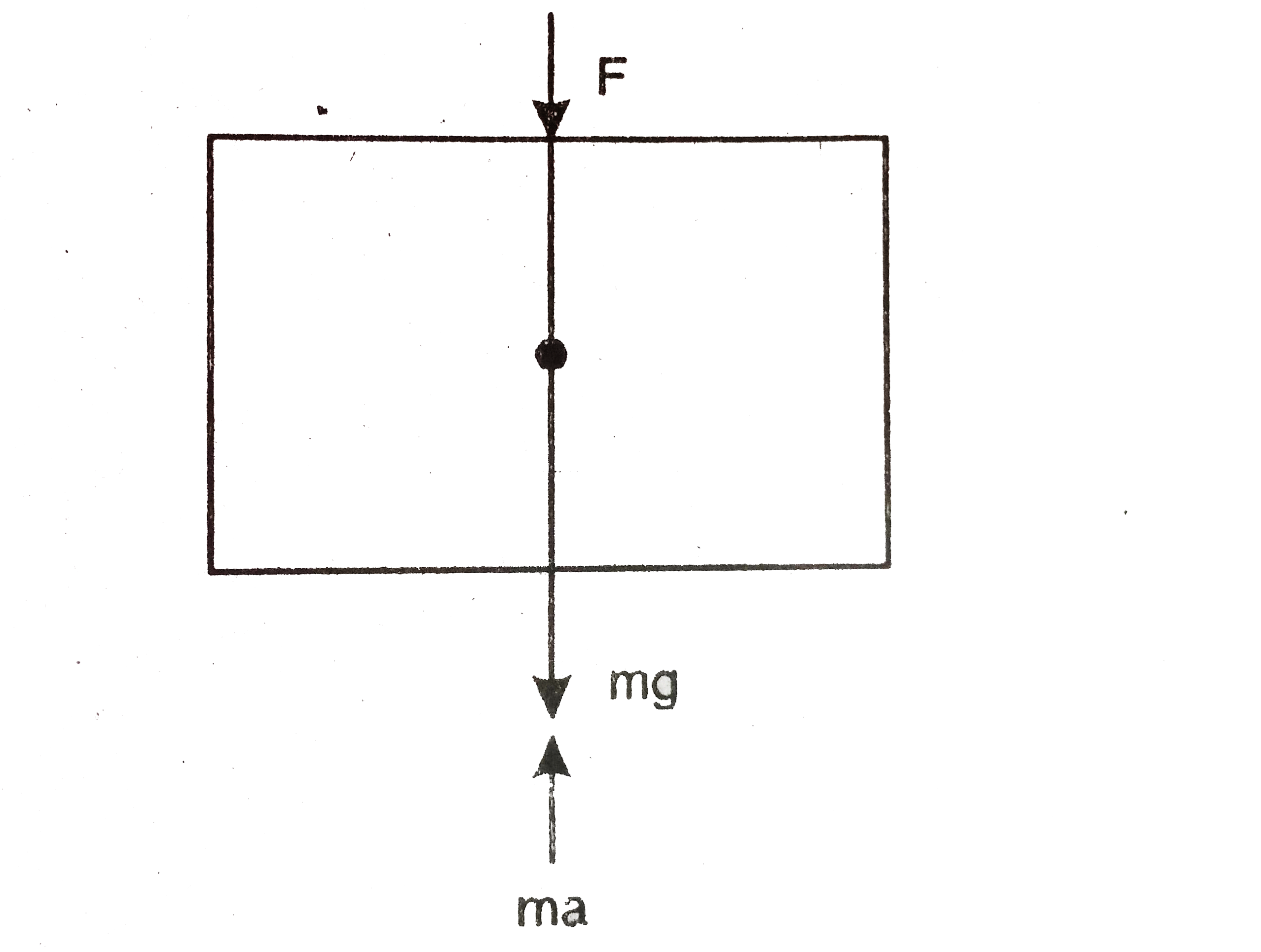
Given, `m=30 kg`
`v=40 cm/sec` ltbr. `=0.4m/sec`
`S=2m` ltbr. From the free body digram the force given by the chain is
`F=(ma-mg)`
`=m(a-g)`
`[where a=acceleration of the block]`
`a=(v^2-u^2)/(2S)`
`16/(-4)=0.04m/sec^2`
so, work done `=W=FScostheta`

`=m(a-g)S cos0^0`
=30(0.04-9.8)xx2`
`=-30xx(9.76)xx2`
=585.6=-586J`
So, `W=-586J`
Promotional Banner

Similar Questions

Explore conceptually related problems

The displacement of a particle is given by x = (t-2)^(2) where x is in metre and t in second. The distance covered by the particle in first 4 seconds is

The displacement of a particle is given by x(t) = (4t ^(2) +8) meter. The instantaneous velocity of a particle at t = 2s is

The position vector of a particle is determined by the expression vec r = 3t^2 hat i+ 4t^2 hat j + 7 hat k . The displacement traversed in first 10 seconds is :

The displacement of a particle is given by y (t) =2t ^(2) +5m. Hence its velocity at the end of 6 sec. will be ...... m/s.

The displacement of particle along the X-axis is given by x= a sin^(2) omega t . The motion of the particle corresponds to………..

Velocity of a particle varies with time as v=4t. Calculate the displacement of particle between t=2 to t=4 sec.

The displacement of particle with respect to time is s = 3^(t3) - 7t^(2) + 5t + 8 where s is in m and t is in s, then acceleration of particle at t = ls is

In the diagram shown, the displacement of particles is given as a function of time. The particle a is moving under constant velocity of 9 m//s . The particle B is moving under variable acceleration. From time t=0 s to t=6 s . The average velocity of the particle B will be equal to :-

The displacement equation of a particle is x=3 sin 2t+4cos2t . The amplitude and maximum velocity will be respectively

The displacement 'x' of a particle moving along a straight line at time t is given by x=a_(0)+a_(1)t+a_(2)t^(2) . The acceleration of the particle is :-

