Home
Class 11
PHYSICS
A block of mass m moving at a speed v co...

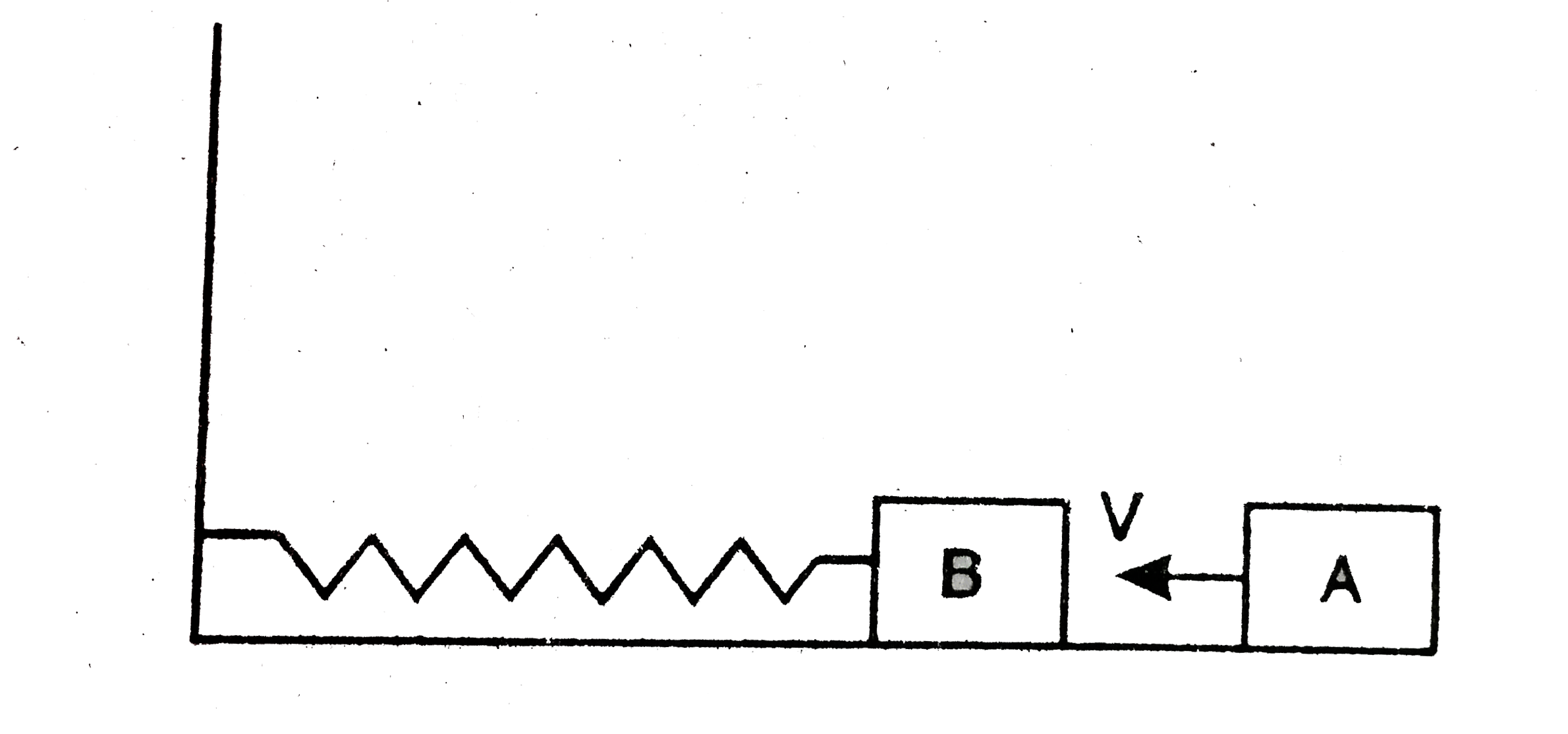
A block of mass m moving at a speed v compresses as spring thrugh a distance x before its speed is halved. Find the spring constant of the spring.

Text Solution

Verified by Experts

The correct Answer is:
B, C, D

Let the velocity o th body at A be v.
so, the velocity of the body at B is `v/2`
Energy at point A =Energy at point B`

`So, /2 mv_A^2-(1/2)mv_B^2=1/2kx^2`
`rarr 1/2 kx^2=1/2m(V_A^2-V_B^2)`
`rarr kx^2=m(v^2-v^2/4)`
`rarr kx^2=m((4v^2-v^2))/4`
`k=(3mv^2)/(4x^2)`
Promotional Banner

Similar Questions

Explore conceptually related problems

A block of mass m is pushed up against a spring, compressing it a distance x , and the block is then released. The spring projects the block along a frictionaless horizontal surface, grving the block a speed v . The same spring projects a second block of mass 4m , giving it a speed 3v . What distance was the spring compressed in the second case ?

A block of mass m is pushed up against a spring, compressing it to a distance x , and the block is then released. The spring projects the block along a frictionless horizontal surface, giving the block a speed v . The same spring projects a second block of mass 4m , giving it a speed 3v . What distance was the spring compressed in the second case ?

Two blocks of masses m and M connected by a spring are placed on frictionless horizontal ground. When the spring is relaxed, a constant force F is applied as shown. Find maximum extension of the spring during subsequent motion.

As, block of mass 5 kg is attached to spring balance reading of spring balance will be

A vessel filled with water is kept on a weighing pan and the scale adjusted to zero .A block of mass M and density rho is suspended by a massless spring of spring constant k. This block is submerged inside into the water in the vessel .What is the reading of the scale ?

A block of mass m lies on a horizontal frictionless surface and is attached to one end of a horizontal spring (with spring constant k ) whose other end is fixed . The block is intinally at rest at the position where the spring is unstretched (x=0) . When a constant horizontal force vec(F) in the positive direction of the x- axis is applied to it, a plot of the resulting kinetic energy of the block versus its position x is shown in figure. What is the magnitude of vec(F) ?

A block of mass m lies on a horizontal frictionless surface and is attached to one end of a horizontal spring (with spring constant k ) whose other end is fixed . The block is intinally at rest at the position where the spring is unstretched (x=0) . When a constant horizontal force vec(F) in the positive direction of the x- axis is applied to it, a plot of the resulting kinetic energy of the block versus its position x is shown in figure. What is the magnitude of vec(F) ?

A block of mass m suspended from a spring of spring constant k . Find the amplitude of S.H.M.

A block of mass 8 kg is released from the top of an inclined smooth surface as shown in figure. If spring constant of spring is 200 Nm^(-1) and block comes to rest after compressing spring by 1 m then find the distance travelled by block before it comes to rest

As shown in the figure, initially both th springs are in normal length (L_(0)) . At t=0, the block is given a rightward velocity v_(0)=2 m//s . The mass of the block is (14//3)kg . How much distance does th block cover before it comes to rest for the first time? (The spring constant of the left spring is K_(0)=2N//m and that of the right spring is not constant and varies as k=k_(0)x , where x is the compression in the spring)

