Home
Class 11
PHYSICS
A block of mass m sliding n a smooth hor...

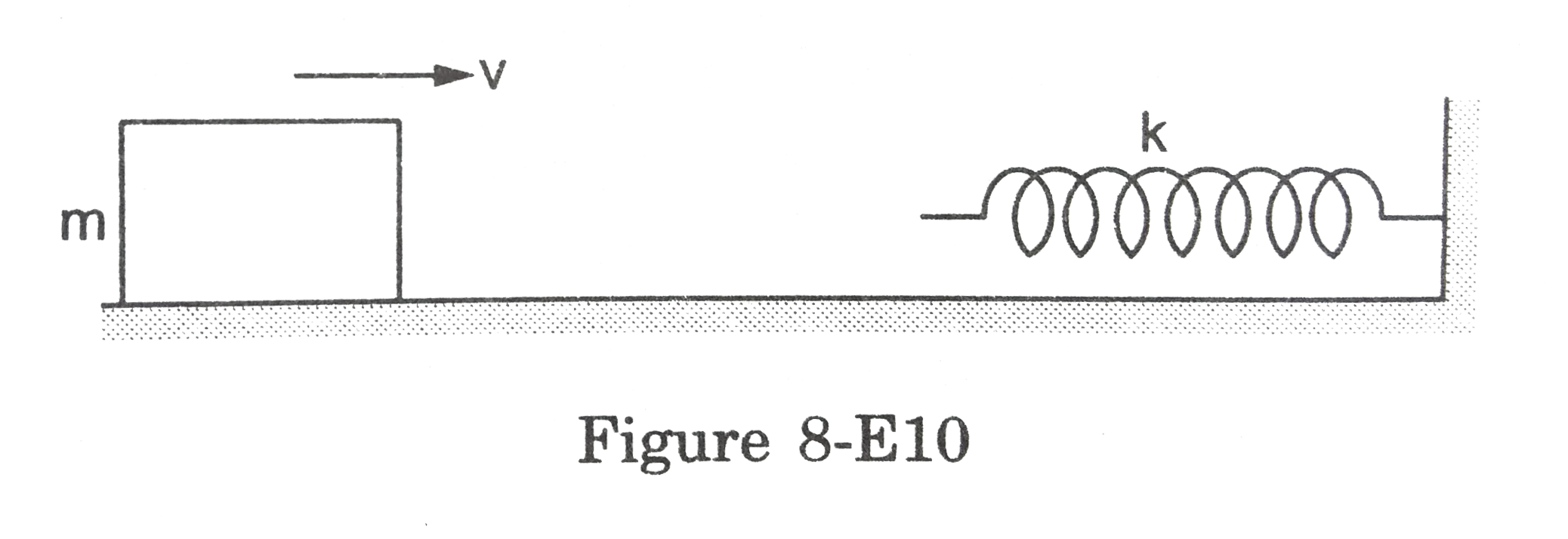
A block of mass m sliding n a smooth horizontal surface with velocity `vecv` meets a long horizontal spring fixed ast one end and having spring constant k as shown n figure. Find the maximum compression of the spring. Will the velocity of the block be the same as v whenit comes back to the original position shown?

Text Solution

Verified by Experts
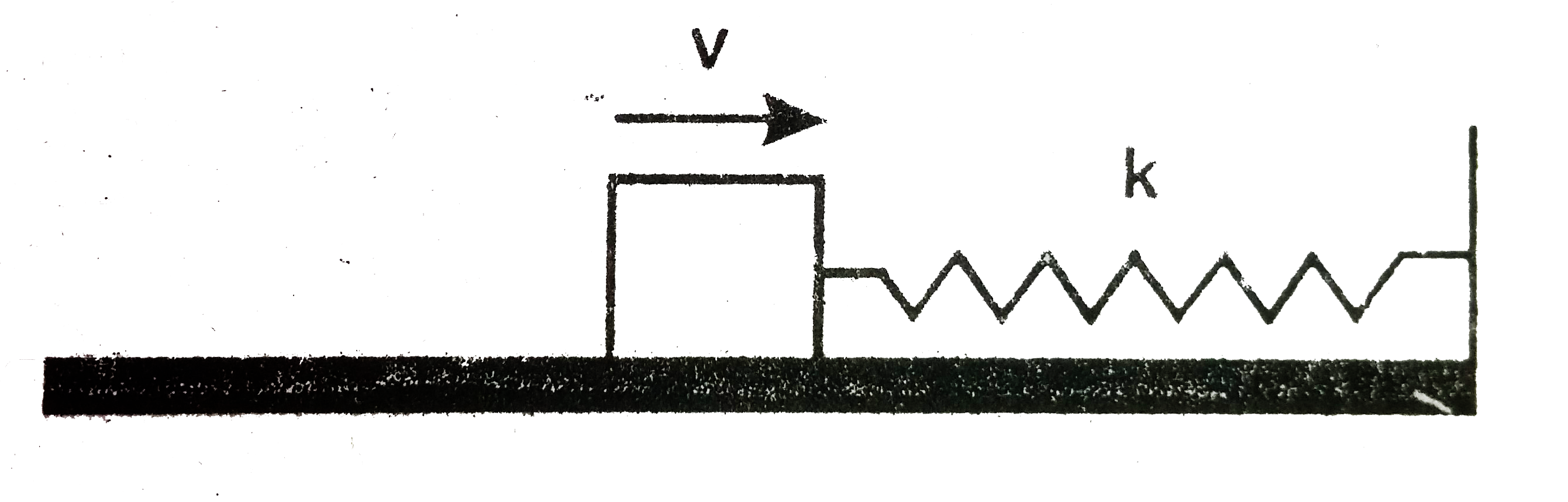
Let the compreshension be x
a. According to law of conservation of energy
`1/2 mv^2=1/2 kx^2`
`rarr x^2=(mv^2)/k`
`x=v sqrt((m/k))`
b.
No. It will be in the opposite direction and magnitude will be less due to loss in spring.
Promotional Banner

Similar Questions

Explore conceptually related problems

A constant force produces maximum velocity V on the block connected to the spring of force constant K as shown in the fig. When the force constant of spring becomes 4K the maximum velocity of the block is

A mass of 0.5 kg moving with a speed of 1.5 m/s on a horizontal smooth surface collides with string of force constant 50 N/m . How much maximum compression on the spring will be ?

A block of mass m lies on a horizontal frictionless surface and is attached to one end of a horizontal spring (with spring constant k ) whose other end is fixed . The block is intinally at rest at the position where the spring is unstretched (x=0) . When a constant horizontal force vec(F) in the positive direction of the x- axis is applied to it, a plot of the resulting kinetic energy of the block versus its position x is shown in figure. What is the magnitude of vec(F) ?

A block of mass m lies on a horizontal frictionless surface and is attached to one end of a horizontal spring (with spring constant k ) whose other end is fixed . The block is intinally at rest at the position where the spring is unstretched (x=0) . When a constant horizontal force vec(F) in the positive direction of the x- axis is applied to it, a plot of the resulting kinetic energy of the block versus its position x is shown in figure. What is the magnitude of vec(F) ?

A block of mass M is pulled along a horizontal frictionless surface by a rope of mass m as shown in A horizontal force F is applied to one end of the rope. Find (a) the acceleration of the rope and block (b) the force that the rope exerts on the block (c) the tension in the rope at its mid point

Two blocks of masses m and M connected by a spring are placed on frictionless horizontal ground. When the spring is relaxed, a constant force F is applied as shown. Find maximum extension of the spring during subsequent motion.

A block of mass 1 kg falls freely on a spring form a height of 20 cm as shown in figure . Find the compression in the spring if its force constant is 10^(3) N/m . ( Take g = 10.0 m//s^(2) )

A block of mss m is placed on a level frictionless table. The block is attached to a horizontally aligned spring fixed with its other end and is vibrating in a horizontal with the pariod T . Suddenly at the instant of time when the spring comes to the position of euilibrium and becomes unstretched the block disconnects form the spring and continues sliding across the frictionless surface away from the until it encounters loop of radius R . What must be the amplitude of vibrations of the block s on the spring in order for the block to complets one loop without falling down?

A block is dragged on a smooth plane with the help of a rope which moves with a velocity v as shown in figure. The horizontal velocity of the block is :

Two springs are connected to a block of mass M is placed on a frictionless surface as shown in figure. If both springs have a spring constant k, the frequency of oscillation of the block is………

