Home
Class 11
PHYSICS
Path length does not depend on a) Init...

Path length does not depend on ____
a) Initial point
b) Final point
c) Path taken
d) Coordinate system

Text Solution

Verified by Experts

The correct Answer is:
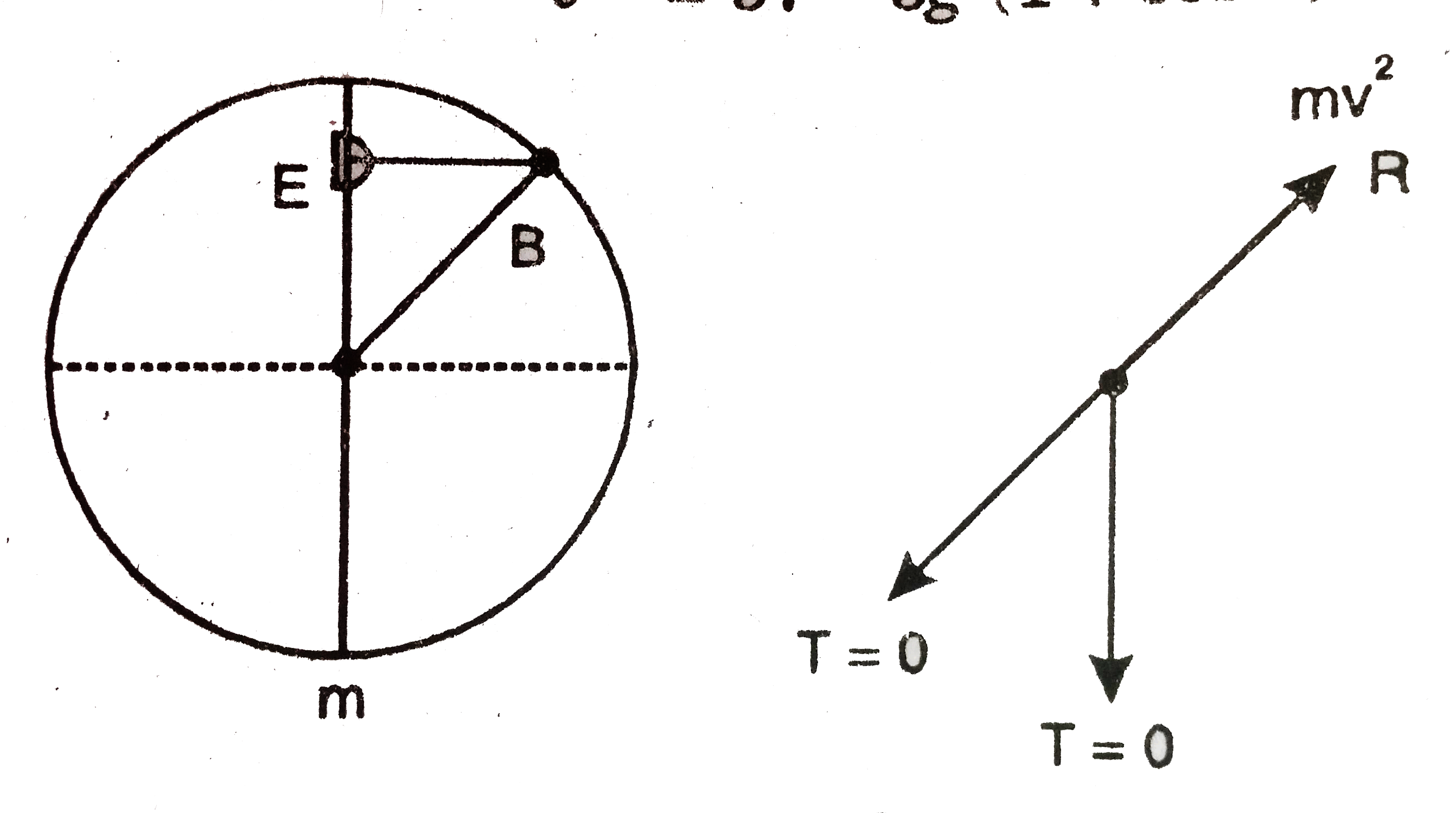
A, B, C

`L=1.5m, u=sqrt57 m/sec`
a. `mgcostheta=(mv^2)/L`
`v^2=Lgcostheta`
change in K.E.= work done
` 1/2 mv^2-1/2mu^2=mgh`
`rarr v^2-57=-2xx1.5g(1+costheta)` ……….ii
`rarr v^2=57-3g(1+costheta)`

Putting the value of v from equaltion i.
`15 cos theta-57-3g(1+costheta)`
`rarr 15 costheta=57-30-30 costheta`
`rarr 45costheta=27`
`rarr costheta =3/5`
`rarr theta=cos^-13/5=53^0`
b. `v=sqrt(57-3g(1+costheta))` from equation i
`sqrt9=e/sec.
c. as the string become slack at point B,the particle will start makign projection tile motion
`H=OF+DC`
`=1.5costheta+(u^2sin^2theta)/(2g)`
`(1.5)xx3/5xx(9xx(0.8)^2)/(2xx10)`
`1.2m`
Promotional Banner

Similar Questions

Explore conceptually related problems

Does displacement depend on the selection of origin of cartasian coordinate system?

An object thrown at a certain angle to the ground moves in a curved path and falls back to the ground. The initial and the final points of the path of the object lie on the same horizontal line. What is the work done by the force of gravity on the object?

A particle is performing SHM. Its path length is 8 cm, amplitude is 4/1 th the path length and time period 0.2s. If the particle is initially in the mean position, the time at which it will be at 1 cm will be

Three girls skating on a circular ice ground of radius 200 m start from a point P on the edge of the ground and a point Q diametrically opposite to P following different paths as shown in figure. What is the magnitude of the placement for each ? For which girl is this equal to the actual to the actual length of path skate ?

A rod AB of length 15 cm rests in between two coordinate axes is such a way that the end point A lies on x-axis and end Point B lies on y-axis. A point P (x,y) is taken on the rod in such a way that AP=6cm . Show that the locus of P is an ellipse.

Find out the shift in point B, C and D

Two charges –q and +q are located at points (0, 0, –a) and (0, 0, a), respectively. (a) What is the electrostatic potential at the points (0, 0, z) and (x, y, 0) ? (b) Obtain the dependence of potential on the distance r of a point from the origin when r//a gt gt 1 . (c) How much work is done in moving a small test charge from the point (5,0,0) to (–7,0,0) along the x-axis? Does the answer change if the path of the test charge between the same points is not along the x-axis?

The length of a line segment is 10 units . If the coordinates of its one end point are (2,-3) and the abscissa of the other end point is 10, then its ordinate is . . . . .

