Home
Class 11
PHYSICS
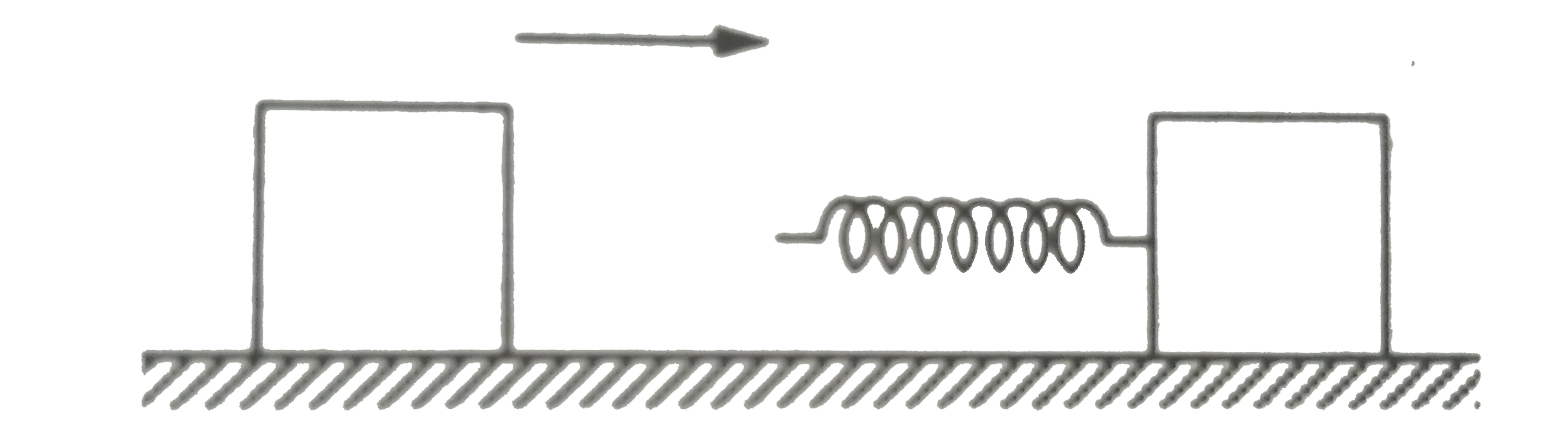
Each of the blocks shown in figure has m...

Each of the blocks shown in figure has mass 1 kg. The rear block moves with a speed of 2 m/s towards the front block kept at rest. The spring attached to the front block islight and has a spring constant 50 N/m. find the maximum compression of the spring.

Text Solution

Verified by Experts

Maximum compression will take place when the blocks move with equal velocity. As no net exterN/Al force acts on the system of the two blocks, the totla linear momentum will remain constant. If V is the common speed at maximum compression we hae ,
`(1kg)(2m/s)=(1kg)V+(1kg)V`
or, `V=1m/s`
INitial kinetic energy `=1/2 (kg)(2m/s)^2=2J`
FiN/Al kinetic energy
`=1/2(1kg)(1m/s)^2+1/2(1kg)(1m/s)^2`
`=1j`
`The kinetic energh lost is stored as the elastic energy in spring.
Hence, `1/2(50N/m)x^2=2J-1=1J`
`or x=0.2m`
Promotional Banner

Similar Questions

Explore conceptually related problems

A mass of 0.5 kg moving with a speed of 1.5 m/s on a horizontal smooth surface collides with string of force constant 50 N/m . How much maximum compression on the spring will be ?

A spring of force constant k is kept in the compressesd condition between two blocks masses m and M on the smooth surface of a table as shown in figure .When the spring is released , both the blocks move in opposite directions .When the spring attains the orginal (normal ) position . both blocks lose the constacts with the spring . If x is the intial compression of the spring find the speeds of block while getting detached from the spring .

A block of mass m suspended from a spring of spring constant k . Find the amplitude of S.H.M.

If the two blocks moves with a constant uniform speed then find coefficient of fricition between the surface of the block B and the table. The spring is massless and the pulley is fricitionless.

A block of mass 2.0 kg is given an initial speed along the floor towards a spring as shown. The coefficient of kinetic friction between the floor and the block is 0.4 and force constant of the spring is 5.6xx10^(3) N/m. The block compresses the spring by 10cm before it stops for a moment. What is the initial speed (m/s) of the block?

A block of mass 0.50kg is moving with a speed of 2.00m//s on a smooth surface. It strikes another mass of 1 kg at rest and they move as a single body. The energy loss during the collision is

The block of mass M moving on the frictionless horizontal surface collides with the spring constant k and compresses it by length L . The maximum momention of the block after collision is

As shown in the figure, initially both th springs are in normal length (L_(0)) . At t=0, the block is given a rightward velocity v_(0)=2 m//s . The mass of the block is (14//3)kg . How much distance does th block cover before it comes to rest for the first time? (The spring constant of the left spring is K_(0)=2N//m and that of the right spring is not constant and varies as k=k_(0)x , where x is the compression in the spring)

Two block A and B of masses m and 2m respectively are connected by a spring of spring cosntant k. The masses are moving to the right with a uniform velocity v_(0) each, the heavier mass leading the lighter one. The spring is of natural length during this motion. Block B collides head on with a thrid block C of mass 2m . at rest, the collision being completely inelastic. The maximum compression of the spring after collision is -
