Home
Class 11
PHYSICS
A projectile is fired at a spedd of 100 ...

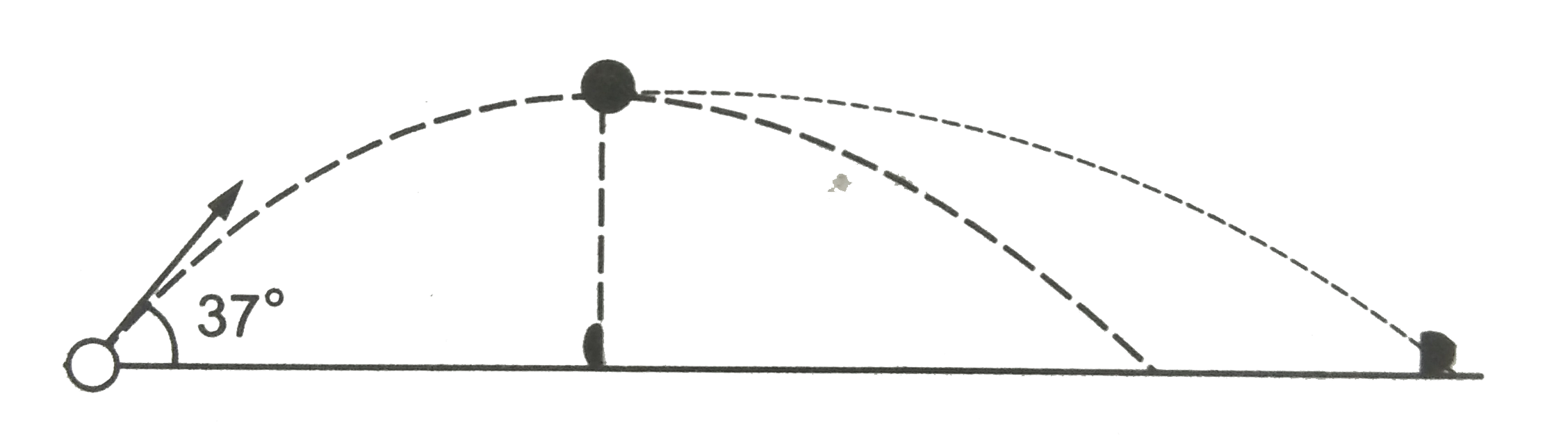
A projectile is fired at a spedd of 100 m/s at an angel of `37^0` above the horizontal. At the highest point, the projectile breaks into two parts of mass ratio 1:3 the smaller coming to rest. Findthe distance from the launching point to the where the heavier piece lands.

Text Solution

Verified by Experts

See ure. At the highest point, the projectrile has horizontal velocity. The lighter part comes to rest. Hence the heavier part willl move with inceased horizontal velocity. In vertical direction both parts have zero velocity and undergo same acceleration, hence they willl cover equal vertical displacements in a given time. Thus both will hit the ground together As interN/Al forces do not affect the motion of teh centre of mass, the centre of mass hits the ground at teh positin where the origiN/Al projectile would have landed. Te range of the origiN/Al projectile is
`x_(CM)=(2u^2sinthetacostheta)/g=(2xx10^4xx3/5xx4/5)/10m`
=960m.
The centre of mass will hit the grouond at this position. As the smaller block comes to rest after breaking. It falls down vertically and hits the ground at half othe range i.e., at `x=480m`. If the heavier block hits the ground at `x_2` then
`x_(CM)=(m_1x_1+m_2x_2)/(m_2+m_2)`
`960m=(M/4xx480m+(3M)/4xxx_2)`
or,
`x_2=1120m`
Promotional Banner

Similar Questions

Explore conceptually related problems

An object of mass 5 kg is projecte with a velocity of 20ms^(-1) at an angle of 60^(@) to the horizontal. At the highest point of its path , the projectile explodes and breaks up into two fragments of masses 1kg and 4 kg. The fragments separate horizontally after the explosion, which releases internal energy such that K.E. of the system at the highest point is doubled. Calculate the separation betweent the two fragments when they reach the ground.

A shell is fired from a cannon with a velocity v (m//sec.) at an angle theta with the horizontal direction. At the highest point in its path it explodes into two pieces of equal mass. One of the pieces retraces its path to the cannon and the speed (in m//sec. ) of the other piece immediately after the explosion is

A projectile takes off with an initial velocity of 50m//s at an angle of 37^(@) with horizontal, It is just able to clear two hurdles of height 25m each, separated from each other by a distance d Calculate d .

A bullet of mass M is fired with a velocity 50m//s at an angle with the horizontal. At the highest point of its trajectory, it collides head-on with a bob of mass 3M suspended by a massless string of length 10//3 metres and gets embeded in the bob. After the collision, the string moves through an angle of 120^@ . Find (i) the angle theta , (ii) the vertical and horizontal coordinates of the initial position of the bob with respect to the point of firing of the bullet. Take g=10 m//s^2

Two solid spherical planets of equal radii R having masses 4M and 9M their centre are separated by a distance 6R. A projectile of mass m is sent from theplanet of mass 4 M towards the heavier planet. What is the distance r of the point from the lighter planet where the gravitational force on the projectille is zero ?

A projectile of mass 1kg is projected with a velocity of sqrt(20)m//s such that it strikes on the same level as the point of projection at a distance of sqrt(3)m . Which of the following options are incorrect:

A particle is projected from a point P (2,0,0)m with a velocity 10(m)/(s) making an angle 45^@ with the horizontal. The plane of projectile motion passes through a horizontal line PQ which makes an angle of 37^@ with positive x-axis, xy plane is horizontal. The coordinates of the point where the particle will strike the line PQ is

A cannon of mass 5m (including a shell of mass m) is at rest on a smooth horizontal ground, fires the shell with its barrel at an angle theta with the horizontal at a velocity u relative to cannon. Find the horizontal distance of the point where shell strikes the ground from the initial position of the cannon :-

A piece of wire is bent in the shape of a parabola y=kx^(2) (y-axis vertical) with a bead of mass m on it. The bead can slide on the wire without friction. It stays at the lowest point of the parabola when the wire is at rest. The wire is now accelerated parallel to the x-axis with a constant acceleration a. The distance of the new equilibrium position of the bead, where the bead can stay at rest with respect to the wire, from the y-axis is:

A projectile is thrown with speed u making angle theta with horizontal at t =0 . It just crosses two points of equal height at time t = 1 s and t = 3 s respectively. Calculate the maximum height attained by it ? (g = 10 m//s^(2) )
