Home
Class 11
PHYSICS
The two balls shwonin figure are indenti...

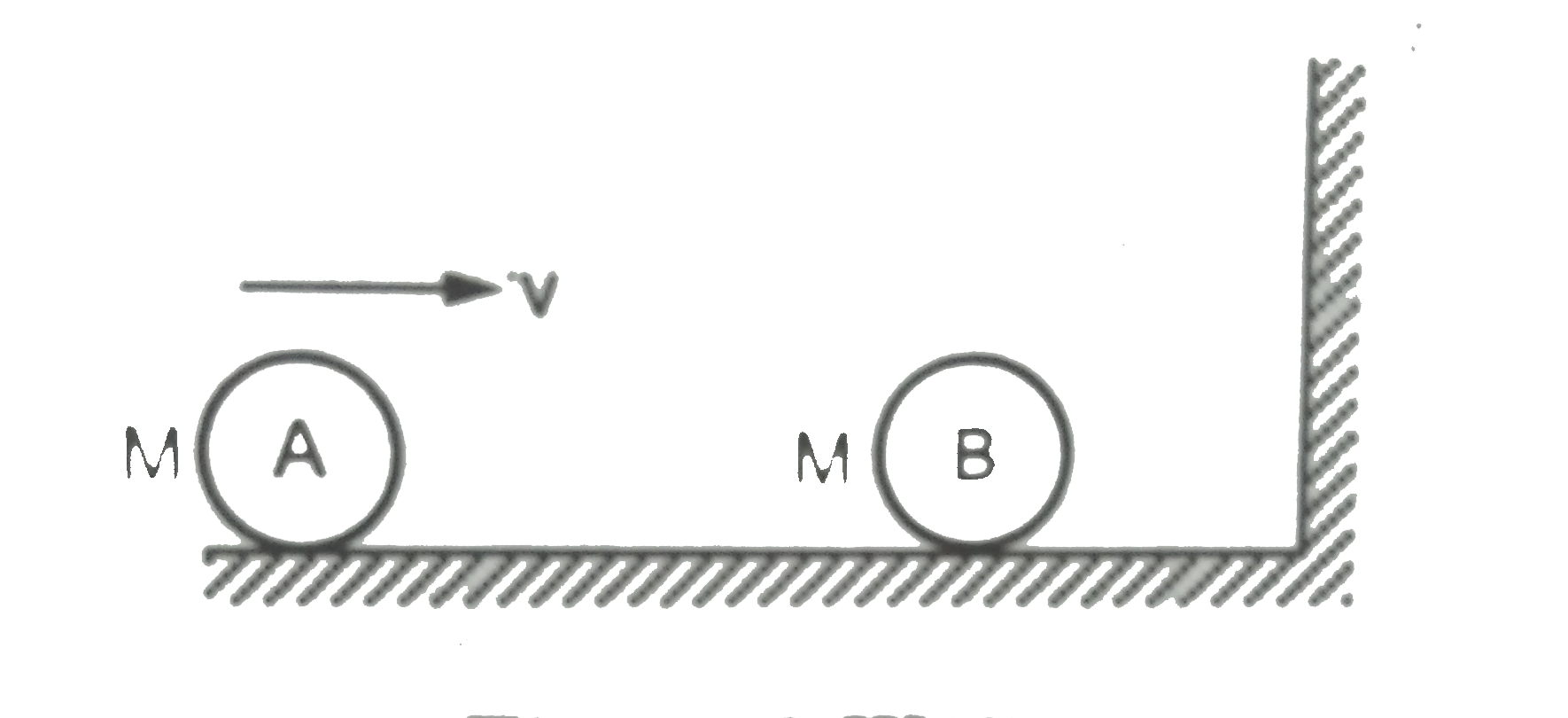
The two balls shwonin figure are indentical the first moving at a speed v towards right and the second staying at rest. The wall at the extreme right is fixed. Assume all collisions to be elastic. Show that the speeds of the balls remain unchanged after all the collisions have taken place.

Text Solution

Verified by Experts

1st collision: As the balls have equal mass and make elastic collision, the velocities are interchanged.
Hence, after the first collision the ball A comes to rest andk the ball B moves towards right at a speed v.
2nd collision: The ball B moving with speed v collides with teh wall and rebounds. As teh wall is rigit and may be taken to be of infinite mass, momentum conservative gives no useful result. Velocity of seperation should be equal to the velocity of approach. Hence, teh ball rebounds at teh same speed v towards left.
3rd collision: The ball B moving towards let at the speed v again collides with the ball A kept at rest. As the masses are equal and teh collision is elastic, the velocities are interchanged. Thus, the ball B comes to rest and the ball A moves towrds let at a speed v. No further collision takes place. Thus, the speeds ofthe balls remain the same as their initial values.
Promotional Banner

Similar Questions

Explore conceptually related problems

A ball moving with a velocity of 12ms^(-1) collides with another identical stationary ball . After the collision they move as shown in figure . Find the speed of the balls after the collision . Also , decide whether the condition is elastic or not .

Three particles with equal mass move with equal speed v along the medians of an equilateral triangle as shown. They all collide at the centroid simultaneously. After the collision. A comes to rest, B retraces it's path with same speed. What is speed of C after the collision?

A massive ball moving with speed v collieds with a tiny ball which is intially at rest having a mass very much smaller than the mass of the first ball. The collision is elastic, then immediately after the impact, the second ball will move with a speed approximately equal to :-

A neutron moving with a speed v makes a head-on collision with a hydrogen in ground state kept at rest which inelastic collision will be take place is (assume that mass of photon is nearly equal to the mass of neutron)

Two identical ball bearings in contact with each other and resting on a frictionless table are hit head - on by another ball bearing of the same mass moving initially with a speed V. If the collision is elastic , which of the following fgures is a possible result after collision ?

An object is moving though air at a speed v. If the area of the object normal to the direction of velocity is A and assuming elastic collision with air molecules, then the resistive force on the object is propotional to-(assume that molecules striking the object were initially at rest)

The Fig. shows a string of equally placed beads of mass m , separated by distance d . The beads are free to slide without friction on a thin wire. A constant force F act on the first bead initially at rest till it makes collision with the second bead. The second bead then collides with the third and so on. Supposed that all collisions are elastic,

The Fig. showns a string of equally placed beads of mass m, separated by distance. The beads are free to slide without friction on a thin wire. A constant force F act on the first bead initially at rest till it makes collision with the second bead. The second bead then collides with the third and so on. Supposed that all collisions are elastic,

Three blocks A, B and C each of mass m are placed on a surface as shown in the figure. Blocks B and C are initialyy at rest. Block A is moving to the right with speed v. It collides with block B and stricks to it. The A-B combination collides elastically with block C. Which of the following statement is (are) true about the velocity, of block B and C.
