Home
Class 11
PHYSICS
A circular plate of diameter d is kept i...

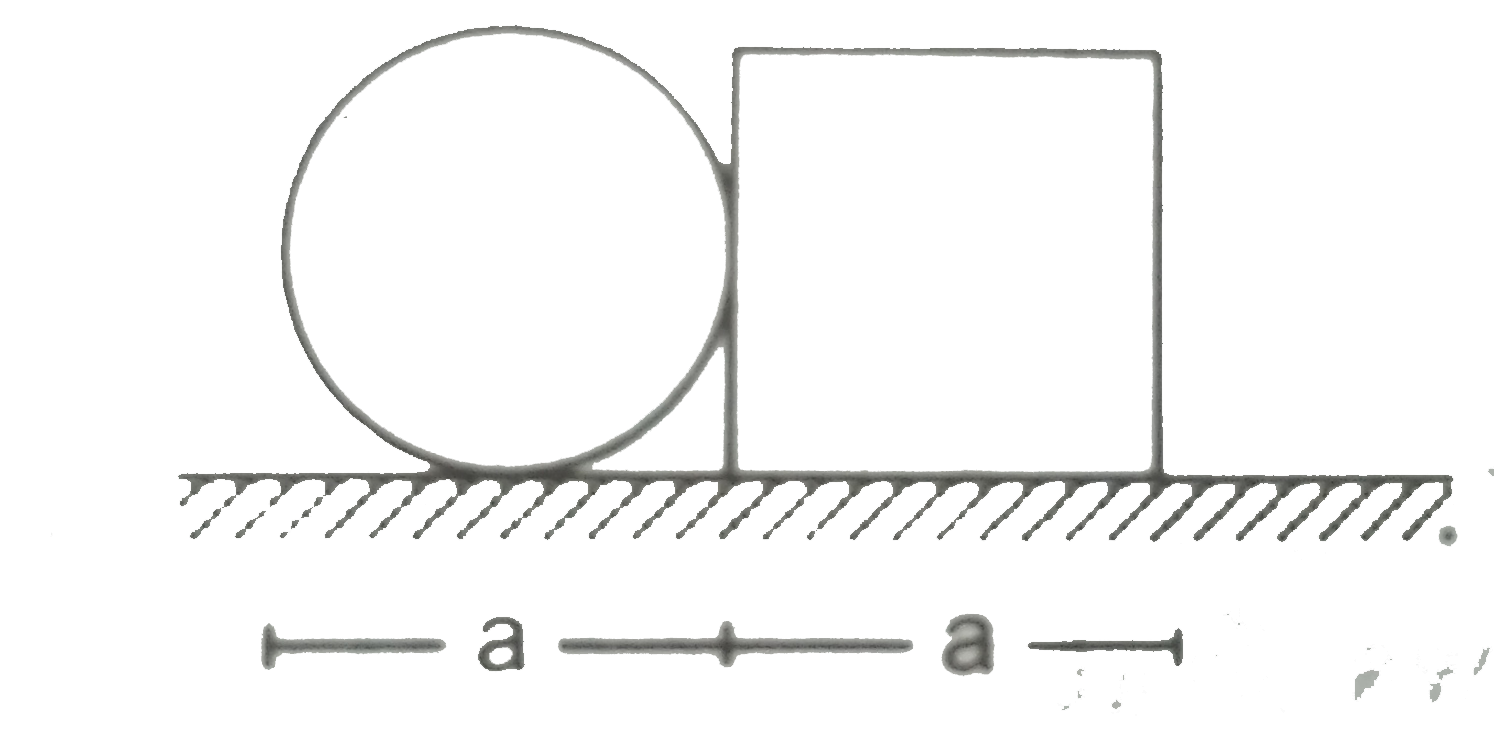
A circular plate of diameter d is kept in contact with a square plate of edge d as shown in figure. The densit of the material and the thickness are same
. Everywhere. The centre of mass of the composite system will be

A

inside the circular plate

B

inside the squre platee

C

at the point of contact

D

outside the system

Text Solution

Verified by Experts

The correct Answer is:

B
Promotional Banner

Similar Questions

Explore conceptually related problems

Three rods of the same mass are placed as shown in the figure. Calculate the coordinates of the centre of mass of the system.

An arrow sign is made by cutting and rejoining a quarter part of a square plate of side 'L' as shown. The distance OC, where C is the centre of mass of the arrow, is

A circular plate of uniform thickness has a diameter fo 56cm. A circular portion of diameter 42 cm is removed from one edge of the plate as shown in figure. Find the position of the centre of mass of the remaining portion.

A uniform solid right circular cone of base radius R is joined to a uniform solid hemisphere of radius R and of the same density, as shown. The centre of mass of the composite solid lies at the centre of base of the cone. The height of the cone is

A piece of paper (shown in figure 1) is in form of a square. Two corners of this square are folded to make it appear like figure2. Both corners are put together at centre of square 'O'. If O is taken to be (0, 0), the centre of mass of new system will be at

Three rods made of the same material and having the same cross-section have been joined as shown in the figure. Each rod is of the same length. The left and right ends are kept at 0^@C and 90^@C , respectively. The temperature of junction of the three rods will be (a) 45^@C (b) 60^@C (c) 30^@C (d) 20^@C .

Five uniform circular plates, each of diameter b and mass m are laid out in a pattern shown. Using the origin shown, find the y co-ordinate of the centre of mass of the five-plate system. .

Two very large thin conducting plates having same cross sectional area are placed as shown in figure. They are carrying chaerges Q and 3Q , respectivley. The variation of electric field as as function at x(for x=0 to x=3d ) will be best represented as by

A uniform thin cylindrical disk of mass M and radius R is attaached to two identical massless springs of spring constatn k which are fixed to the wall as shown in the figure. The springs are attached to the axle of the disk symmetrically on either side at a distance d from its centre. The axle is massless and both the springs and the axle are in horizontal plane. the unstretched length of each spring is L. The disk is initially at its equilibrium position with its centre of mass (CM) at a distance L from the wall. The disk rolls without slipping with velocity vecV_0 = vacV_0hati. The coefficinet of friction is mu. The centre of mass of the disk undergoes simple harmonic motion with angular frequency omega equal to -

A uniform thin cylindrical disk of mass M and radius R is attaached to two identical massless springs of spring constatn k which are fixed to the wall as shown in the figure. The springs are attached to the axle of the disk symmetrically on either side at a distance d from its centre. The axle is massless and both the springs and the axle are in horizontal plane. the unstretched length of each spring is L. The disk is initially at its equilibrium position with its centre of mass (CM) at a distance L from the wall. The disk rolls without slipping with velocity vecV_0 = vacV_0hati. The coefficinet of friction is mu. The maximum value of V_0 for whic the disk will roll without slipping is-
