Home
Class 11
PHYSICS
What is the result when î + 14ĵ is multi...

What is the result when î + 14ĵ is multiplied by √49?
a) 7î + 98ĵ
b) 98î + 14ĵ
c) 7î + 98ĵ
d) (î + 7ĵ)*√49

Text Solution

Verified by Experts
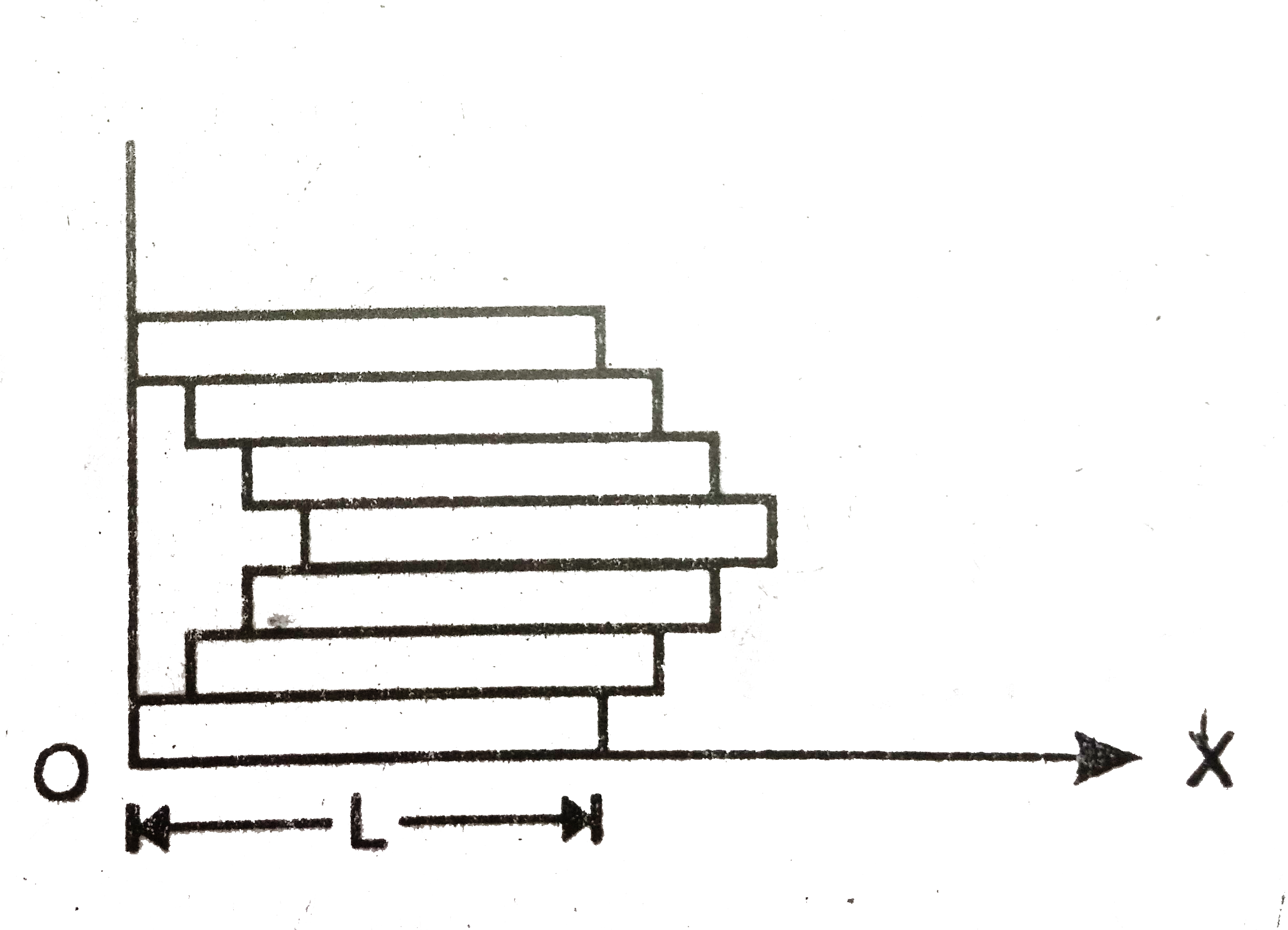
Let `0(0,0) be the orign of the system. Each brick is of mass M and length L, Each brick is displaced w.r.t one in contact by `L/10`.

`:. The X coordiN/Ate of the centre of mas `X_(cm)`
=1/{7mL/10)^((mL)/2+m(L/2+L/10)+.......+m(L/2)}`/(7mL/10)`
`X_(cm)=(L/2+L/2+L/10+L/5+L/2+(3L)/10+L/2+L/5+L/2+L/10+L/2)/7`
`=(7L/2+5L/10+2L/5)/7=(22L)/35`
Promotional Banner

Similar Questions

Explore conceptually related problems

What is the height and weight of twelve weeks old human embryo? (A) 7.5 cm, 14 gram (B) 7.5 cm, 650 gram (C) 42 cm, 1800 gram (D) 32 cm, 650 gram

The value of the lambda , if the lines (2x + 3y + 4) + lambda( 6 x - y + 14) =0 are {:("Column- I","Column - II"),("(i) Parallel to Y -axis is","(a)" lambda = (-3)/(4) ),("(ii) Perpendicular to" 7x + y -4 =0 "is" , "(b)" lambda = (-1)/( 3) ),("(iii) Passes through (1, 2) is","(c)" lambda = (-17)/( 41) ),("(iv) parallel to X -axis is","(d)" lambda = 3):}

Separation of Motion of a system of particles into motion of the centre of mass and motion about the centre of mass : (a) Show p=p_(i).+m_(i)V where p_(i) is the momentum of the ith particle (of mass m_(i) ) and p_(i).=m_(i)v_(i). . Note v_(i). is the velocity of the i^(th) particle relative to the centre of mass Also, prove using the definition of the centre of mass Sigmap_(i).=0 (b) Show K=K.+(1)/(2)MV^(2) where K is the total kinetic energy of the system of particles, K. is the total kinetic energy of the system when the particle velocities are taken with respect to the centre of mass and (1)/(2)MV^(2) is the kinetic energy of the translation of the system as a whole (i.e. of the centre of mass motion of the system). The result has been used in Sec. 7.14). (c ) Show vecL=vecL.+vecRxxvec(MV) where vecL.=Sigmavec(r_(i)).xxvec(p_(i)). is the angular momentum of the system about the centre of mass with velocities taken relative to the centre of mass. Remember vec(r._(i))=vec(r_(i))-vecR , rest of the notation is the velcities taken relative to the centre of mass. Remember vec(r._(i))=vec(r_(i))-vecR rest of the notation is the standard notation used in the chapter. Note vecL , and vec(MR)xxvecV can be said to be angular momenta, respectively, about and of the centre of mass of the system of particles. (d) Show vec(dL.)/(dt)=sumvec(r_(i).)xxvec(dp.)/(dt) Further, show that vec(dL.)/(dt)=tau._(ext) where tau._(ext) is the sum of all external torques acting on the system about the centre of mass. (Hint : Use the definition of centre of mass and Newton.s Thrid Law. Assume the internal forces between any two particles act along the line joining the particles.)

A charged metallic sphere A is suspended by a nylon thread another charged metallic sphere b held by an insulating centers is 10 cm as shown in Fig. 1.7(a). The resulting repulsion of A is noted (for example, by shining a beam of light and measuring the deflection of its shadow on a screen). Spheres A and B are touched by uncharged spheres C and D respectively, as shown in Fig. 1.7(b). C and D are then removed and B is brought closer to A to a distance of 5.0 cm between their centers, as shown in Fig. 1.7(c). What is the expected repulsion of A on the basis of Coulomb’s law? Spheres A and C and spheres B and D have identical sizes. ignore the sizes of a and b in comparison to the separation between their centers

Suppose, you are to take the measurements of the mass of a 50.0-gram standard sample with a weighing balance. You get values of 47.5, 47.6, 47.5 and 47.7 grams with weighing machine-1 and 49.8, 50.5, 51.0, 49.6 with machine-2, then (A) Machine 1 is more accurate and less precise (B) Machine 2 is more assurate and less precise (C) Machine 1 is less accurate and more precise (D) Machine 2 is less accurate and more percise Select correct alternative.

An alkyl bromide A has molecular formula C_(8)H_(17)Br and four different structures can be drawn for it, all optically active. A on refluxing with ethanolic KOH solution yields only one elimination product B(C_(8)H_(16)) which it still enantiomeric. B on treatment with H_(2)//Pt yields C(C_(8)H_(18)) which does not rotate the plane polarized light, B on ozonolysis followed by work-up with H_(2)O_(2) yields D(C_(7)H_(14)O) as one product which it still resolvable. Deduce structures of A to D.

The line (x+6)/5=(y+10)/3=(z+14)/8 is the hypotenuse of an isosceles right-angled triangle whose opposite vertex is (7,2,4)dot Then which of the following in not the side of the triangle? a. (x-7)/2=(y-2)/(-3)=(z-4)/6 b. (x-7)/3=(y-2)/6=(z-4)/2 c. (x-7)/3=(y-2)/5=(z-4)/(-1) d. none of these

