Home
Class 11
PHYSICS
Two persns each of mass m are standing a...

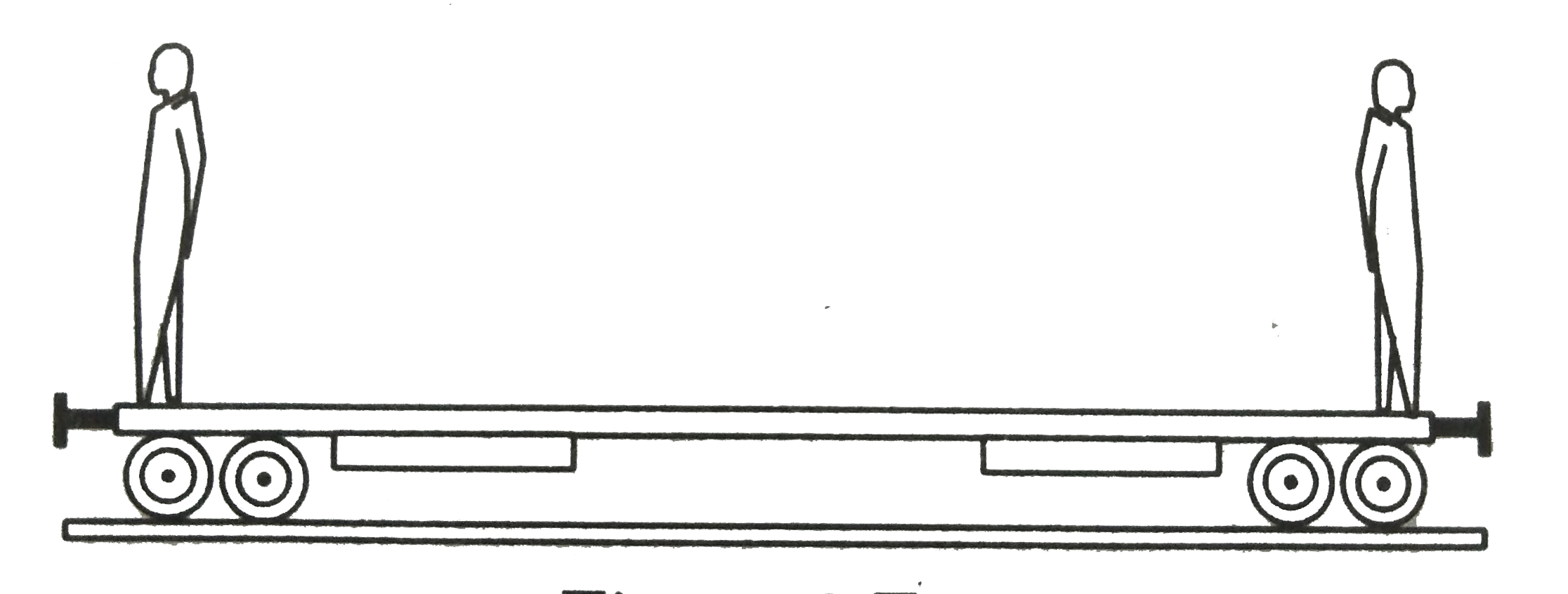
Two persns each of mass m are standing at the two extremes of a railroad car of mas M resting on a smooth track figure. The person on left jumps to the left with a horizontal speed u with respect to the state f the cr before the jump. Threafter, the other person jumps to the right, again with the same horizontl speed u with respect to teg state of the car before his jump. Find the vellcity of the car after both the person hae jumped off.

Text Solution

Verified by Experts

Two persons each of mass m are standing at the two extremes of a railroad car of mass M resting on smooth track.
Case I
Let the velocity of the railroad can w.r.t the earth is V when the jump of left man.
`:. O=-mu+(M+m)V`
`rarr V=((mu)/(M+m))` towards right
Case II
When the mann the right jumps the velocity of it w.r.t the car is u.
`O=mu-MV^1`
`rarr V^1=(mu)/M`
V is the change in velocity of the platform when platform itself is taken as reference assuming the car to be at rest.
`:.` So not velocity towards left (i.e. the velocity of the car w.r.t the earth)
`(mu)/M-(mu)/(M+m)`
`=(mMu+m^2u-Mmu)/(M(M+m)`
`(m^2u)/(M(M+m))`
Promotional Banner

Similar Questions

Explore conceptually related problems

A particle of mass m is projected with speed u at an angle theta with the horizontal. Find the torque of the weight of the particle about the point of projection when the particle is at the highest point.

A person of mass 60 kg is standing on a raft of mass 40 kg in a lake. The distance of the person from the bank is 30 m. If the person starts running towards the bank with velocity 15 m/s, then what will his distance be from the bank after two second

A strange cat with a mass m_(c ) is sitting at rest on the left sled of a pair of identical sleds. The sleds hace mass m_(s) and sit on frictionless ice. Suddenly, the cat leaps to the right sled, traveling with a horizontal speed v_(cg) measured with respect ot the groun. The instant the cat reaches the right sled, it turns around and leaps back to the left sled. The horizontal component of the cat's speed is again v_(cg) measured with respect to the ground. The final speed of right sled in terms of the masses of the cat and sleds and the cat's leaping speed is (The cat remains on the left sled after its return) :-

The Atwood machine in figure has a third mass attached to it by a limp string. After being released, the 2m mass falls a distance x before the limp string becomes laut. Thereafter both the mass on the left rise at the same speed. What is the final speed ? Assume that pulley is ideal.

A man of mass m stands at the left end of a uniform plank of length L and mass M, which lies on a frictionaless surface of ice. If the man walks to the other end of the plank, then by what distance does the plank slide on the ice?

A body of mass m is projected with intial speed u at an angle theta with the horizontal. The change in momentum of body after time t is :-

Can we get out of smooth surface by taking jump on it ?

Suppose the weight of a man on the planet A is half than that on the earth. If he can jump 0.4 m high on earth's surface, then how high he can jump on the planet A?

A cannon of mass 5m (including a shell of mass m) is at rest on a smooth horizontal ground, fires the shell with its barrel at an angle theta with the horizontal at a velocity u relative to cannon. Find the horizontal distance of the point where shell strikes the ground from the initial position of the cannon :-
