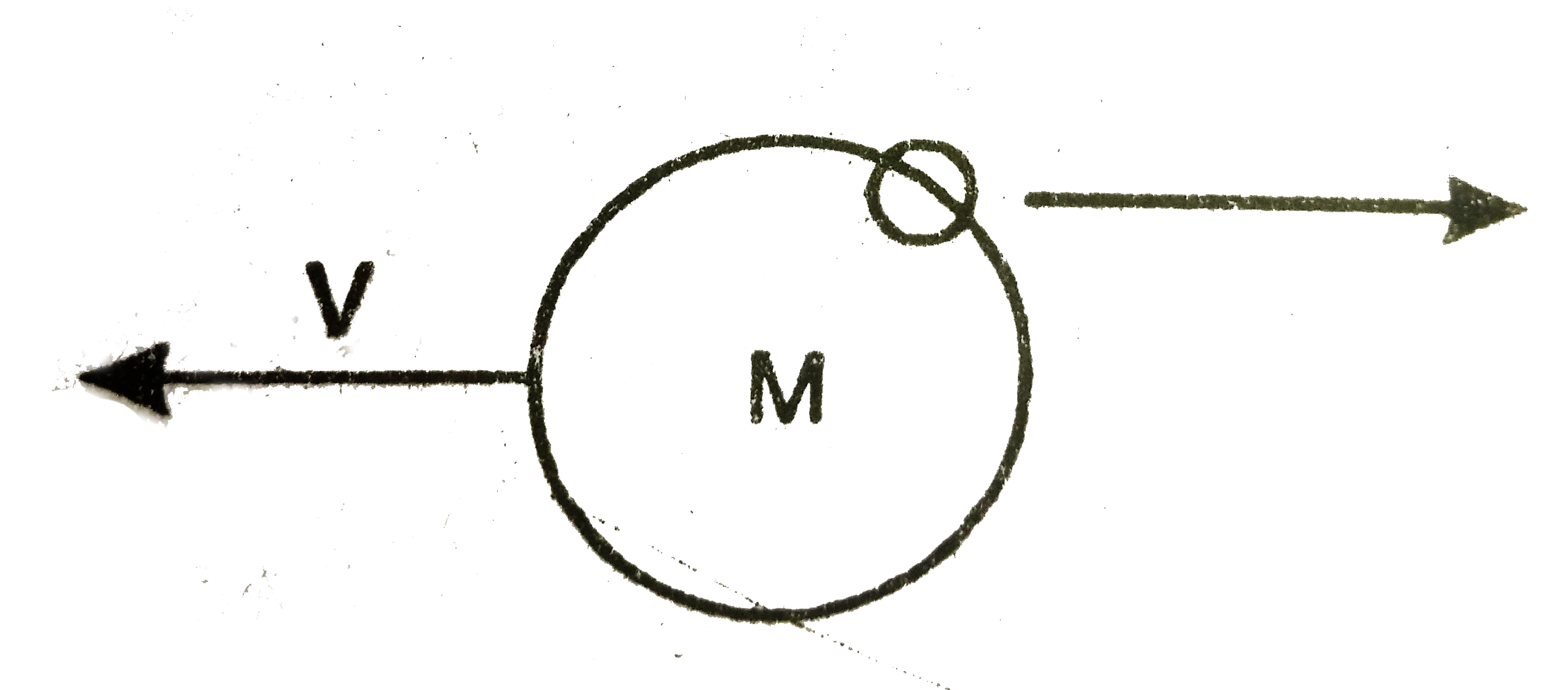
In a gamma decay fprcess, the internal energy of a nucleus of mass M deceses, a gamma photon of energy E and linear momentum E/c is emitted and the nucleus recoils. Find the decrease in internal energy.
In a gamma decay fprcess, the internal energy of a nucleus of mass M deceses, a gamma photon of energy E and linear momentum E/c is emitted and the nucleus recoils. Find the decrease in internal energy.
Text Solution
Verified by Experts
K.E. of Nucleus `=(1/2)mv^2`
`=(1/2)m(E/mc)^2=E^2/(2mc^2)`
Energy emitted by Gamma photon=E
`Decrease in interN/Al energy `=E+E^2/(2mc^2)`
`=(1/2)m(E/mc)^2=E^2/(2mc^2)`
Energy emitted by Gamma photon=E
`Decrease in interN/Al energy `=E+E^2/(2mc^2)`



Similar Questions
Explore conceptually related problems
An ideal diatomic gas (gamma=7/5) undergoes a process in which its internal energy relates to the volume as U=alphasqrtV , where alpha is a constant. (a) Find the work performed by the gas to increase its internal energy by 100J. (b) Find the molar specific heat of the gas.
If E and p are the energy and momentum of a photon respectively then on decreasing in the wavelength of photon.
In an alpha -decay, the kinetic energy of alpha -particles is 48 MeV and Q value of the reaction is 50 MeV . The mass number of the mother nucleus is (assume that daughter nucleus is in ground state)
A star like the sun has several bodies moving around it at different distances. Consider that all of them are moving in circular orbits. Letr be the distance of the body from the centre of the star and let its linear velocity be v, angular velocity , omega kinetic energy K, gravitational potential energy U, total energy E and angular momentum I. As the radius r of the orbit increases, determine which of the above quantities increase and which ones decrease. As shown in figure, where a body of mass m is revolving around a star of mass M. Linear velocity of the body,
In the given figure an ideal gas changes its state from A to state C by two paths ABC and AC . (i) Find the path along which work done is the least. (ii) The internal energy of gas at A is 10J and amount of heat supplied to change its state to C through the path AC is 200J . Calculate the internal energy at C . (iii) How much is the heat involved in the process ABC and ADC ?
A weightless piston divides a thermally insulated cylinder into two parts of volumes V and 3V. 2 moles of an ideal gas at pressure P = 2 atmosphere are confined to the part with volume V =1 litre. The remainder of the cylinder is evacuated. The piston is now released and the gas expands to fill the entire space of the cylinder. The piston is then pressed back to the initial position. Find the increase of internal energy in the process and final temperature of the gas. The ratio of the specific heats of the gas, gamma =1.5 .
A radio nuclide with disintegration constant lambda is produced in a reactor at a constant rate alpha nuclei per second. During each decay energy E_0 is released. 20% of this energy is utilized in increasing the temperature of water. Find the increase in temperature of m mass of water in time t . Specific heat of water is s . Assume that there is no loss of energy through water surface.
When a particle is restricted to move aong x axis between x =0 and x = a , where a is of nanometer dimension. Its energy can take only certain specific values. The allowed energies of the particle moving in such a restricted region, correspond to the formation of standing waves with nodes at its ends x = 0 and x = a . The wavelength of this standing wave is realated to the linear momentum p of the particle according to the de Breogile relation. The energy of the particl e of mass m is reelated to its linear momentum as E = (p^(2))/(2m) . Thus, the energy of the particle can be denoted by a quantum number 'n' taking values 1,2,3,"......." ( n=1 , called the ground state) corresponding to the number of loop in the standing wave. Use the model decribed above to answer the following three questions for a particle moving in the line x = 0 to x =a . Take h = 6.6 xx 10^(-34) J s and e = 1.6 xx 10^(-19) C . If the mass of the particle is m = 1.0 xx 10^(-30) kg and a = 6.6 nm , the energy of the particle in its ground state is closet to
When a particle is restricted to move aong x axis between x =0 and x = a , where a is of nanometer dimension. Its energy can take only certain specific values. The allowed energies of the particle moving in such a restricted region, correspond to the formation of standing waves with nodes at its ends x = 0 and x = a . The wavelength of this standing wave is realated to the linear momentum p of the particle according to the de Breogile relation. The energy of the particl e of mass m is reelated to its linear momentum as E = (p^(2))/(2m) . Thus, the energy of the particle can be denoted by a quantum number 'n' taking values 1,2,3,"......." ( n=1 , called the ground state) corresponding to the number of loop in the standing wave. Use the model decribed above to answer the following three questions for a particle moving in the line x = 0 to x =a . Take h = 6.6 xx 10^(-34) J s and e = 1.6 xx 10^(-19) C . The allowed energy for the particle for a particular value of n is proportional to
When a particle is restricted to move aong x axis between x =0 and x = a , where a is of nanometer dimension. Its energy can take only certain specific values. The allowed energies of the particle moving in such a restricted region, correspond to the formation of standing waves with nodes at its ends x = 0 and x = a . The wavelength of this standing wave is realated to the linear momentum p of the particle according to the de Breogile relation. The energy of the particl e of mass m is reelated to its linear momentum as E = (p^(2))/(2m) . Thus, the energy of the particle can be denoted by a quantum number 'n' taking values 1,2,3,"......." ( n=1 , called the ground state) corresponding to the number of loop in the standing wave. Use the model decribed above to answer the following three questions for a particle moving in the line x = 0 to x =a . Take h = 6.6 xx 10^(-34) J s and e = 1.6 xx 10^(-19) C . The speed of the particle, that can take disrete values, is proportional to
Recommended Questions
- In a gamma decay fprcess, the internal energy of a nucleus of mass M d...
Text Solution
|
- In a gamma decay fprcess, the internal energy of a nucleus of mass M d...
Text Solution
|
- An excited nucleus emits a gamma-ray photon with energy of 2.45 MeV. (...
Text Solution
|
- A stationary nucleus of mass 24 amu emits a gamma photon. The energy o...
Text Solution
|
- A radioactive nucleus of mass M emits a photon of frequency v and the ...
Text Solution
|
- A stationary Pb^(200) nucleus emits an alpha-particle with kinetic ene...
Text Solution
|
- A free sationary Ir^(191) nucleus with excitation energy E=129 keV pas...
Text Solution
|
- A free nucleus of mass 24 amu emits a gamma photon (when initially at ...
Text Solution
|
- A radioactive nucleus of mass M emits a photon of frequency v and the ...
Text Solution
|