Home
Class 11
PHYSICS
If cos x=0 then x = a) nπ b) (2n+1) ...

If cos x=0 then x = ________
a) nπ
b) (2n+1) π/2
c) (n+1) π
d) nπ/2

Text Solution

Verified by Experts
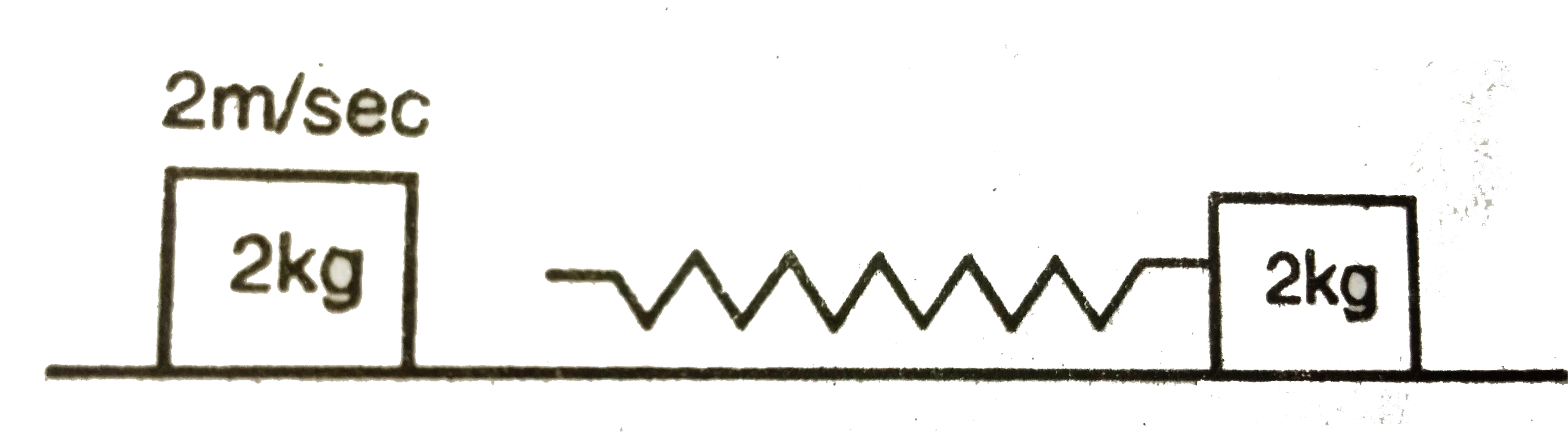
Mass of each block `M_B=2kg`
Initial velocity of the 1st block
`v=1m/sec`
`V_a=1m/sec`
`V_b=0m/sec`
Spring constantof the spring =100N/m

The block A strikes the spring with a velocity 1m/sec.
After teh colision, its velocilty deceases continuously adn at an instant the whole system(Block A+the compound spring +Block B) moves together wilth a common velocity.
Let teh velocity be V.
Using conservation of energy,.
`(1/2)M_AV_A^2+(1/2)M_bV_B^2`
`=(1/2)M_AV^2+(1/2)M_BV^2+(1/2)kx^2`
`(1/2)xx2(1)^2+0`
`=(1/2)+(1/2)xv^2+(1/2)x^2xx100`
`(when x=maximum compresion of spring)
`rarr `1-2v^2=50x^2`..........i
`As there is no exterN/Al force in the horizontal direction, the momentum should be conserved.
`rarr M_AV_A+M_BV_B=(M_A+M_B)V`
`rarr 2xx1=4xxV`
`rarr V=(1/2)m/sec` .....ii
putting in equationn i
`1=2xx(1/4)+50x^2`
`rarr (1/4)=50x^2`
`rarr (1/4)=50x^2`
`rarr x^2=1/100m^2`
`rarr x=(1/10)m`
`=0.1m=10cm`
Promotional Banner

Similar Questions

Explore conceptually related problems

Discuss the continuity of the cosine, cosecant, secant and cotangent functions: f(x)= sec x =(1)/(cos x), x in R- {(2n+1) (pi)/(2), n in I}

Statement -1: If 2"sin"2x - "cos" 2x=1, x ne (2n+1) (pi)/(2), n in Z, "then sin" 2x + "cos" 2x = 5 Statement-2: "sin"2x + "cos"2x = (1+2"tan" x - "tan"^(2)x)/(1+"tan"^(2)x)

f(x)= cosec^(-1)[1+sin^(2)x] , where [*] denotes the greatest integer function.Then f(x) equal to (a){ π/2 ​ ,cosec^ (−1) 2}(b) π/2 (c)cosec^(-1) 2 (d)none of these

Satement-1 : If secx + cos x =2 then (sec x)^(n)+(cos x)^(n)=2 . because Statement-2 : If A+B=2 and AB=1 then A=B=1 .

If f(x) = {{:(b([x]^(2)+[x])+1",","for",x gt -1),(sin(pi(x + a))",","for",x lt -1):} , where [x] denotes the integral part of x, then for what values of a, b, the function is continuous at x = - 1? (a) a = 2n + (3)/(2), b in R, n in I ,(b) a = 4n + 2, b in R, n in I

If y= a sin x + b cos x then, y^(2) + (y_(1))^(2) = ……. (a^(2) + b^(2) ne 0)

Let f(x)=cos(a_1+x)+1/2cos(a_2+x)+1/(2^2)cos(a_3+x)++1/(2^(n-1))cos(a_n+x) where a)1,a_2 a_n in Rdot If f(x_1)=f(x_2)=0,t h e n|x_2-x_1| may be equal to pi (b) 2pi (c) 3pi (d) pi/2

Discuss the continuity of the function f(x) = lim_(n rarr oo) (log (2 + x)-x^(2n) sin x)/(1+x^(2n))"at x" = 1

Differentiate, tan^(-1) ((a cos x- b sin x)/(b cos x + a sin x)), (-pi)/(2) lt x lt (pi)/(2) and (a)/(b) tan x gt -1

