Home
Class 11
PHYSICS
The second law of motion, in mathematica...

The second law of motion, in mathematical form can be written as ____
a) F = dp/dt
b) F = ma
c) F = v(dm/dt)
d) F = mv

Text Solution

Verified by Experts

The correct Answer is:
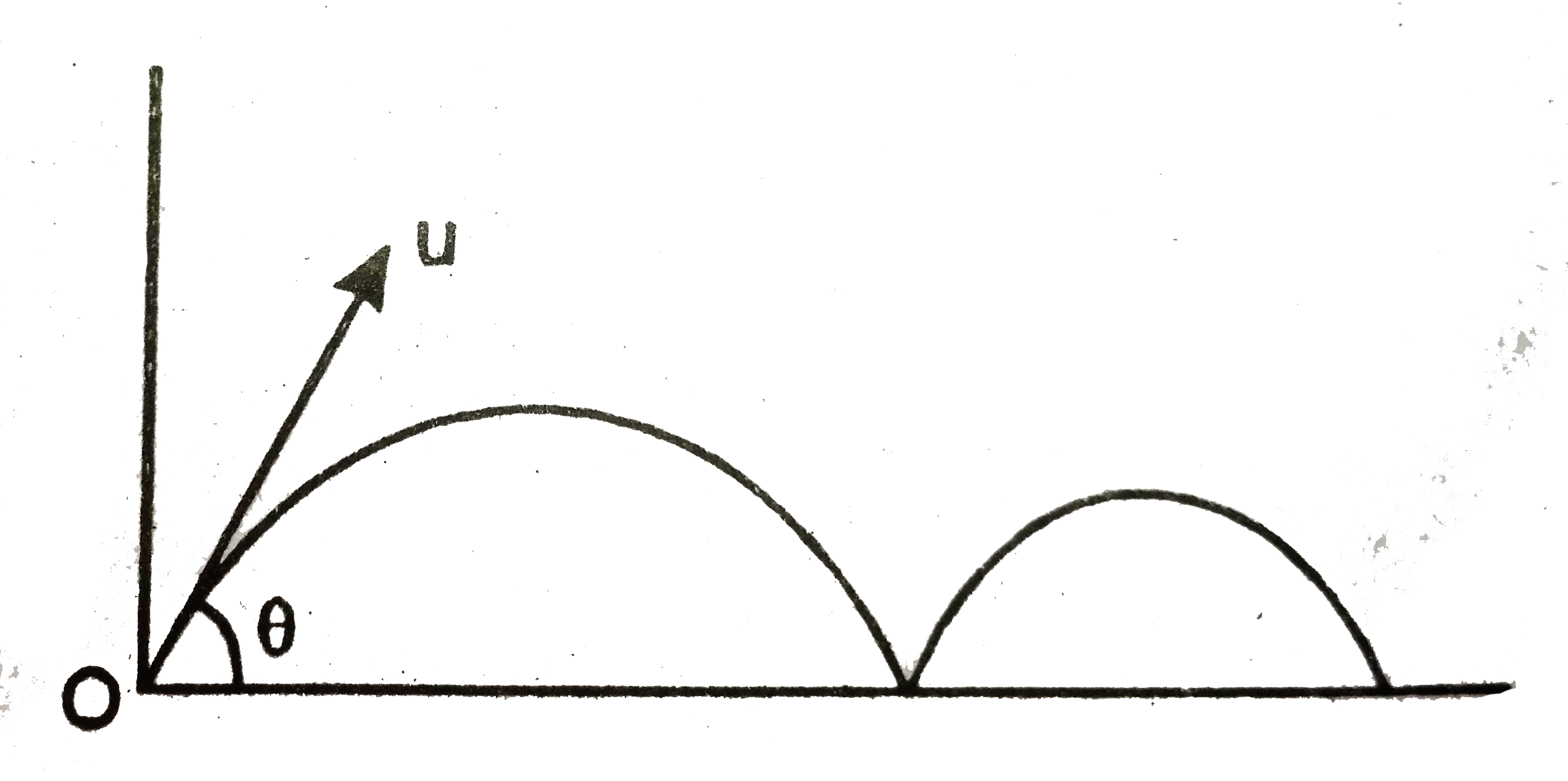
A, B

The projected velocity =u
The angle of prjection `=theta`
Whentehprojectilehits the ground for the 1st time,
The velocity would be the same i.e u
Here the component of velocity paralel to ground
`u costheta` should remain constant
But teh verticla component of the projectile under goes.

`rarr v=eusintheta`
Now for the 2nd projectile motion.
`u=velocity of projection
`=sqrt((ucostheta)^2+(eusintheta)^2)`
and Angle of projection
`=alpha=tan^I-1((eusintheta)/(ucostheta))`
`=tan^-1 (etantheta)`
`or taN/Alpha=etantheta`..............2
Because `y=xtaN/Alphatan^-1(gx^2sec^2alpha)/(2u^2)`............e
`Here y=0, taN/Alpha`
`=etantheta`
`sec^2alha=1+e^2tan^2theta`
and `u^2=u^2cos^2theta+e^2u^2sin^2theta`
putting the above values in the equation 3
`xetantheta=(gxx^2(1+e^2tan^2theta))/(2u^2(cos^2theta+e^2sintheta))`
or x=(2eu^2tantheta(cos^2theta+e^2sin^2theta))/(g(1+e^2tan^2theta))`
`=(2eu^2tantheta.cos^2theta)/g`
`(eu^2sin2theta)/g`
`rarr So, from the starting point O it will fasll at a distance
`(u^2sin2theta)/g+(eu^2.sin2theta)/g`
`(u^2sin2theta)/g(1+e)`
Promotional Banner

Similar Questions

Explore conceptually related problems

Derive the mathematical formulation of Newton's second law of motion F = ma.

If force F is reprsented in different, ways then which of the following is correct and which are not correct ? M= mass, a = acceleration r= radius, v= velocity d= distance t=time. (a) F=(mv^(2))/(r), (b) F=ma, (c) F=(ma)/(d) (d) F=ma+(1mv^(2))/(r) (e) F=(md^(2))/(t^(2))

How many maximum electron can be filled in d and f orbitals ?

Expression of only one of the parental characters in the FI and expression of both in the F2, can be explained by (A) Law of dominance (B) Punnett square (C) Law of segregation (D) Multiple alleles

A cylindrical tube, open at both ends, has a fundamental frequency f in air . The tube is dipped vertically in water so that half of its length is in water. The fundamental frequency of the air column is now (a) f // 2 (b) 3 f // 4 (C ) f (d) 2f

Rank in order, from largest to smallest, the sizes of the friction forces vec(f)_(a) to vec(f)_(c) in these 5 different situation. The box and the floor are made of the same materials in all situations. (a) (b) (c) (d) (e)

The momentum of a moving particle given by p=tl nt . Net force acting on this particle is defined by equation F=(dp)/(dt) . The net force acting on the particle is zero at time

From the following in which pair of orbitlas have more attraction with nucleus (i) 4f and 5d (ii) 4d and 5 s (iii) 7s and 5 f , (ii) 7p and 5p ( v) 3d and 3f

Force on a particle in one-dimensional motion is given by F=Av+Bt+(Cx)/(At+D) , where F= force, v= speed, t= time, x= position and A, B, C and D are constants. Dimension of C will be-

f and h are function from A rarr B, where A = {a, b, c, d} and B = {s, t, u} defined as follows f(a) = t, f (b) = s, f(c ) = s f(d) = u, h(a) = s, h(b) = t h(c ) = s, h(a) = u, h(d) = u Which one of the following statement is true?

