Home
Class 11
PHYSICS
If sin x=0 then x = a) nπ b) (2n+1) ...

If sin x=0 then x = ________
a) nπ
b) (2n+1) π/2
c) (n+1) π
d) nπ/2

Text Solution

Verified by Experts
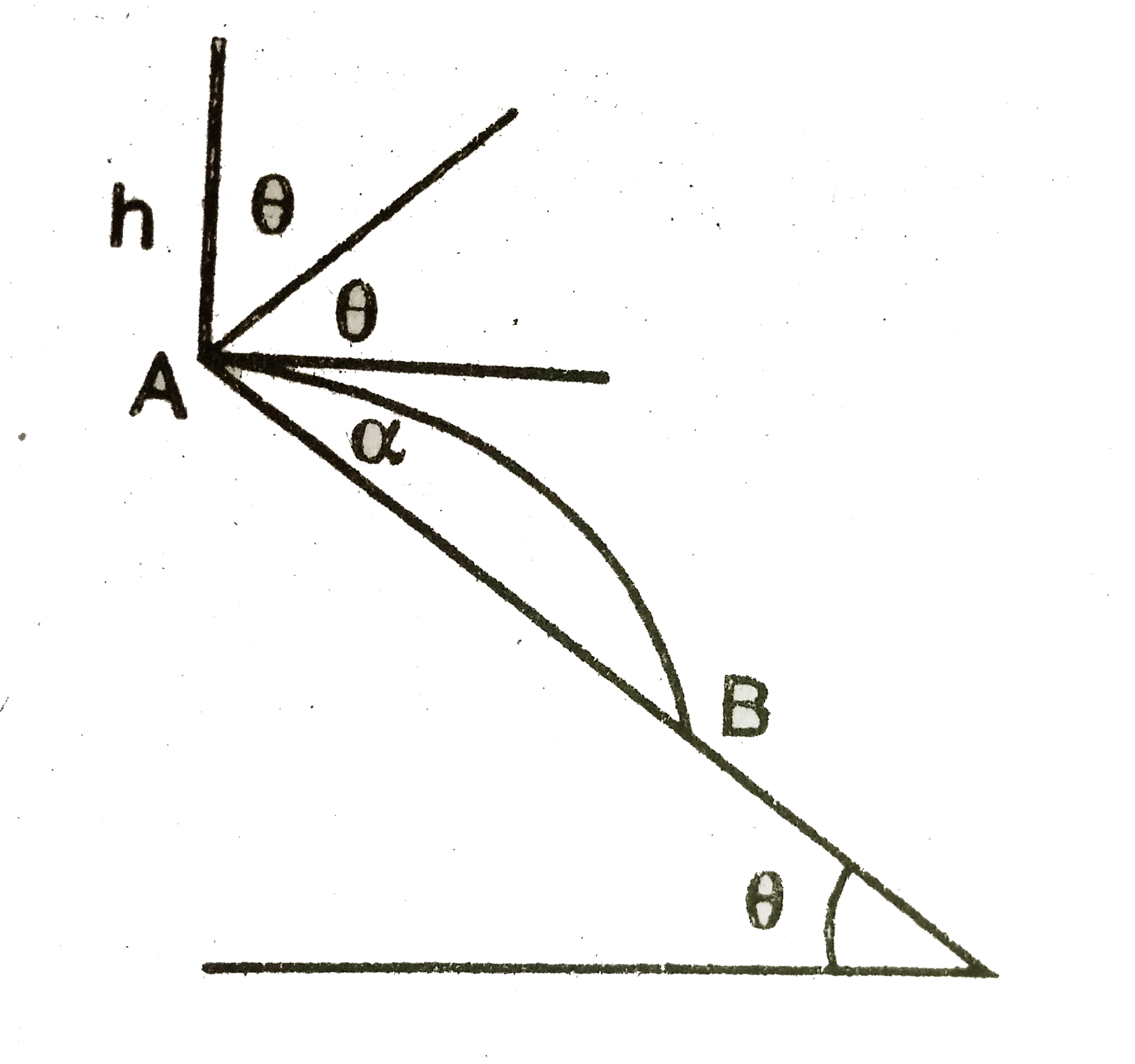
`h=5m `
`theta=45^0`
e=(3/4)`
here thevelocity with which it wold strike
`=v=sqt(2gxx5)=10m/sec`
After colision let ilt makes an angle `beta` with horizontal. The horizontal components of velocity ` 10 cos45^0` will remain unchanged and velocity in the perpendicular direction to the plane after wilisine
`v_1=exx10sin45^0`
`=(3/4xx10xx1/sqrt(2)`
`=(3.75)sqrt2m/sec`
similarly `v_2=5sqrt2`m/sec
`u=sqt(v_2^2+v_1^2)`
`=sqrt(50+28.125)`
`=sqrt(78.125)`
`=8.83m/sec`

Angle of relfection from the wall
`beta=tan^-1((3.75sqrt2))/(5sqrt2)`
`=tan^-1(3/4)=37^0
`rarr Angle of projection `alpha=90-(theta+beta)`
`90-(45+37^0)=8^0`
Let the distance where it falls =L
`rarr x=Lcostheta`
Angle of projection `(alpha)=-8^0`
`y=xtaN/Alpha-(gx^2sec^2alpha)/(2u^2)`
`rarr -Lsintheta=Lcosthetaxxtan8^0
` rarr -g/2 (L^2cos^2thetasec^28^0)/((8.83)^2)
solving the above equation we get
`L=18.5m
Promotional Banner

Similar Questions

Explore conceptually related problems

Statement -1: If 2"sin"2x - "cos" 2x=1, x ne (2n+1) (pi)/(2), n in Z, "then sin" 2x + "cos" 2x = 5 Statement-2: "sin"2x + "cos"2x = (1+2"tan" x - "tan"^(2)x)/(1+"tan"^(2)x)

f(x)= cosec^(-1)[1+sin^(2)x] , where [*] denotes the greatest integer function.Then f(x) equal to (a){ π/2 ​ ,cosec^ (−1) 2}(b) π/2 (c)cosec^(-1) 2 (d)none of these

If sin y= x sin (a+ y) and (dy)/(dx)= (A )/(1 + x^(2)-2x cos a) then the value of A is …… [a] 2 [b] CosA [c] SinA [d] 1/2

If y= a sin x + b cos x then, y^(2) + (y_(1))^(2) = ……. (a^(2) + b^(2) ne 0)

Differentiate, tan^(-1) ((a cos x- b sin x)/(b cos x + a sin x)), (-pi)/(2) lt x lt (pi)/(2) and (a)/(b) tan x gt -1

Let f(x)=cos(a_1+x)+1/2cos(a_2+x)+1/(2^2)cos(a_3+x)++1/(2^(n-1))cos(a_n+x) where a)1,a_2 a_n in Rdot If f(x_1)=f(x_2)=0,t h e n|x_2-x_1| may be equal to pi (b) 2pi (c) 3pi (d) pi/2

Discuss the continuity of the function f(x) = lim_(n rarr oo) (log (2 + x)-x^(2n) sin x)/(1+x^(2n))"at x" = 1

If f(x) = {{:(b([x]^(2)+[x])+1",","for",x gt -1),(sin(pi(x + a))",","for",x lt -1):} , where [x] denotes the integral part of x, then for what values of a, b, the function is continuous at x = - 1? (a) a = 2n + (3)/(2), b in R, n in I ,(b) a = 4n + 2, b in R, n in I

If sin^(-1)x+cot^(-1)(1/2)=pi/2,\ t h e n\ x is a. 0 b. 1/(sqrt(5)) c. 2/(sqrt(5)) d. (sqrt(3))/2

