Home
Class 11
PHYSICS
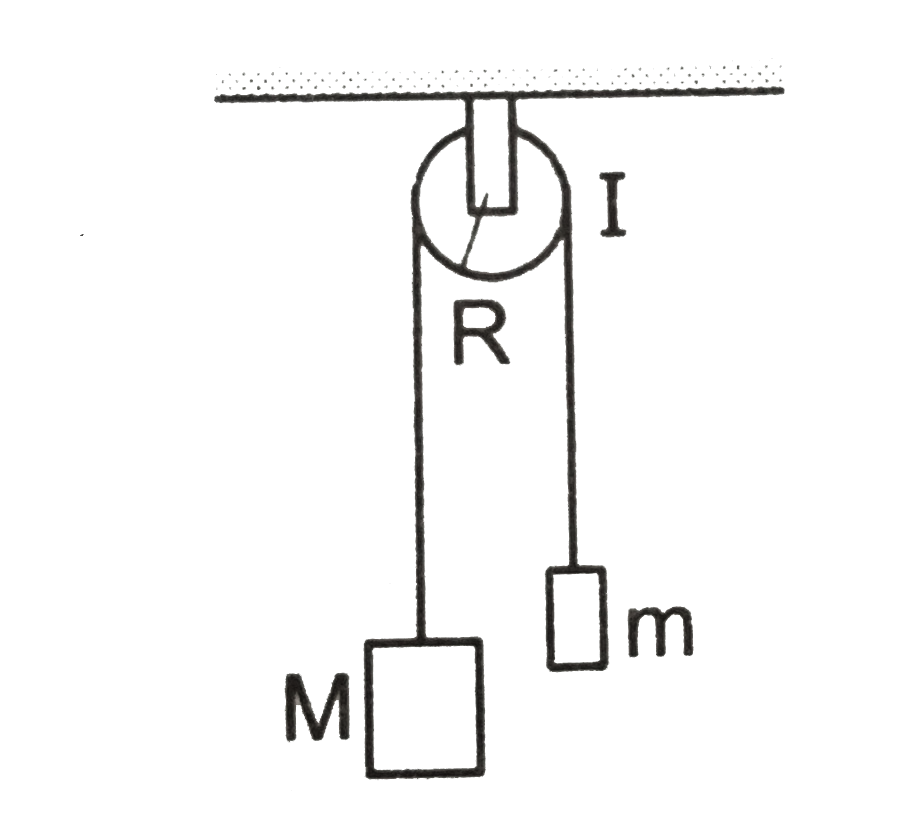
The pulley shown in figure has a moment ...

The pulley shown in figure has a moment of inertia I about it's axis and its radius is R. Find the magnitude of the acceleration of the two blocks. Assume that the string is light and does not slip on the pulley.

Text Solution

Verified by Experts

Suppose the tension in the sleft string is `T_1 and `that in the right string is `T_2`. Suppose the block of mas M goes down with an acceleration a and the other block moves up wit the same acceleration. This is also the tangential acceleration of the rim of the wheel as the string does not slip over the rim. the angular acceleration of the wheel is theerfore `alpha=a/R`. The equation of motiooin for the mass M the mass m and the pulley are as follows:
Mg-T_1=Ma`..........i
T_2-mg=ma`......ii
`T_1R-T_2R=Ialpha=Ia/R` ............iii
putting `T_1 and T_2` from i and ii and iii
`[M(g-a)-m(g+a)]RIa/R`
which gives `a=((M-m)gR^2)/(I+(M+m)R^2`
Promotional Banner

Similar Questions

Explore conceptually related problems

A solid sphere of mass M and radius R has a moment of inertia about an axis tangent to its surface is given by formula …………..

In the situation shown in figure, both the pulleys and the strings are light and all the surfaces are frictionless. The acceleration of mass M, tension in the string PQ and force exerted by the clamp on the pulley, will respectively be -

Prove that moment of inertia of uniform ring of mass M and radius R about its geometric axis is MR^(2)

A non-uniform rod of mass m , length l and radius r is having its centre of mass at a distance l//4 from the centre and lying on the axis of the cylinder. The cylinder is kept in a liquid of uniform density rho . The moment of inertia of the rod about the centre of mass is I . The angular acceleration of point A relative to point B just after the rod is released from the position as shown in the figure is

In the system shown, pulley and strings are ideal. The vertically upward pull F is being increased gradually, find magnitude F and acceleration of the 5 kg block at the moment the 10 kg block leves the floor.

A ring rotates about z axis as shown in figure. The plane of rotation is xy. At a certain instant the acceleration of a particle P (shown in figure) on the ring is (6hat(i)-8hat(j)) m//s^(2) . Find the angular acceleration of the ring & the abgular velocity at that instant. Radius of the ring is 2m.

A 1 kg block situated on a rough incline is connected to a spring constant 100 Nm^(-1) as shown in figure . The block is released from rest with the spring in the unstretched position . The block moves 10 cm down the incline before coming to rest . Find the coefficient of friction between the block and the incline .Assume that the spring has a negligible mass and the pulley is frictionless.

The system shown in the figure is initially in equilibrium. A is of mass 2 m and B,C D and E are of mass m Certain actions are performed on the system. Every action has been taken individually when the system is intact. Find the direction and magnitude of acceleration of the blocks after each action of the following actions has been taken {:((i)"Spting 1 is cut",(ii)"Spring 2 is cut"),((iii)"String between C and D is cut.",(iv)"String between B and C is cut."):}

Block A of mass m//2 is connected to one end of light rope which passes over a pulley as shown in fig. A man of mass m climbs the other end of rope with a relative acceleration of g//6 with respect to rope. Find the acceleration of block A and tension in the rope.

A fixed pulley of radius 20 cm and moment of inertia 0.32 kg. m^(2) about its axle has a massless cord wrapped around its rim. A mass M of 2 kg is attached to the end of the cord. The pulley can rotate about its axis without any friction. The acceleration of the mass M is :- (Assuming g=10m//s^(2) )
