Home
Class 11
PHYSICS
The ladder shown in figure has negligibl...

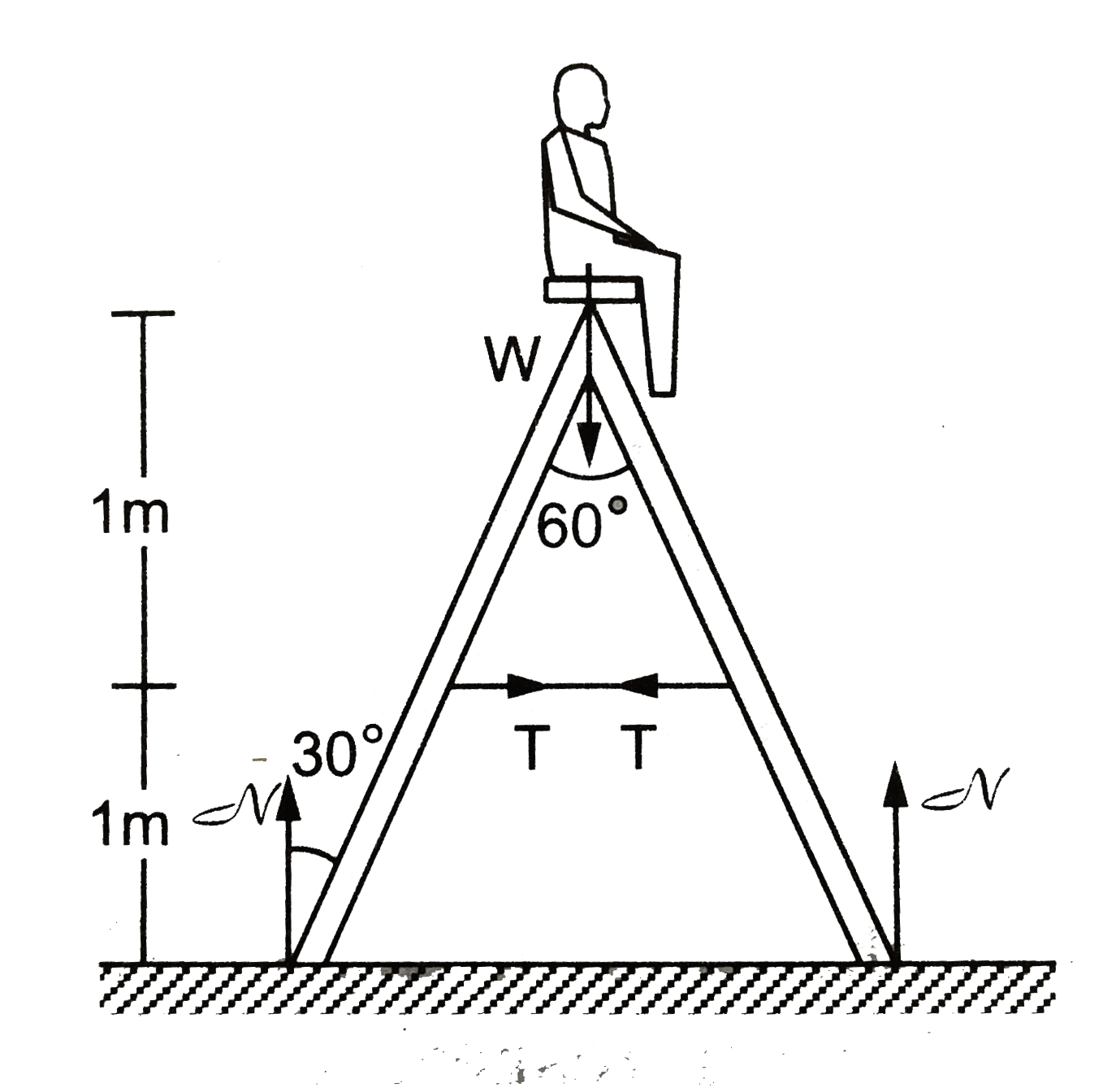
The ladder shown in figure has negligible mass and rests on a frictionless floor. The crossbar connects the two legs of the ladder at the middle. The angle between the two legs is `60^0`. The fat person sitting on the ladder has a mas of 80 kg. Find the contact force exerted by the floor on each leg and the tension in the cross bar.

Text Solution

Verified by Experts

The forces acting on different parts are shown in ure. Consider the verticle equilibrium of the ladder plus the person system. The forces acting on this system are its weight (80 kg)g and the contact force `N+N=2N` due to the floor. Thus,
`2N=(80 kg)g`
`or, N(40kg)(9.8m/s^2)=392N`
Next consider the equilibrium of the left leg of the ladder. Taking torques of the forces acting on it about the upeer end, ltbr. `N(2m)tan30^0=T(1m)`
`or T=N 2/sqrt3 =(392N)xx2/sqrt3=450N`.
Promotional Banner

Similar Questions

Explore conceptually related problems

A 3m long ladder weighing 20 kg leans on a frictionless wall. Its feet rest on the floor 1 m from the wall as shown in Fig.7.27. Find the reaction forces of the wall and the floor.

As shown in Fig.7.40, the two sides of a step ladder BA and CA are 1.6 m long and hinged at A. A rope DE, 0.5 m is tied half way up. A weight 40 kg is suspended from a point F, 1.2 m from B along the ladder BA. Assuming the floor to be frictionless and neglecting the weight of the ladder, find the tension in the rope and forces exerted by the floor on the ladder. (Take g = 9.8 m//s^(2) )

Two identical small discs each of mass m placed on a frictionless horizontal floor are connected with the help of a light spring of force constant k. The discs are also connected with two light rods each of length 2sqrt(2)m that are pivoted to a nail driven into the floor as shown as shown in the figure by a top view of the situation. If period of small oscillations of the system is 2pi sqrt((m//k)) , find relaxed length (in meters) of the spring.

Two blocks each of mass m, connected by an un-stretched spring are kept at rest on a frictionless horizontal surface. A constant force F is applied on one of the blocks pulling it away from the other as shown in figure. (a)Find accelaration of the mass center. (b) Find the displacement of the centre of mass as function of time t. (c) If the extension of the spring is X_(0) at an instant t, find the displacements of the two blocks relative to the ground at this instant.

Two blocks of masses 6 kg and 4 kg are connected with rope of mass 2 kg are resting on a frictionless floor as shown in the following figure: If a constant force of 60N is applied to 6 kg block then the tension in the rope at points A,B and C are respectively given by :

A 1 kg block situated on a rough incline is connected to a spring constant 100 Nm^(-1) as shown in figure . The block is released from rest with the spring in the unstretched position . The block moves 10 cm down the incline before coming to rest . Find the coefficient of friction between the block and the incline .Assume that the spring has a negligible mass and the pulley is frictionless.

Two bodies A and B of masses 5 kg and 10 kg in contact with each other rest on a table against a rigid wall as shown in figure. The coefficient of friction between the bodies and the table is 0.15. A force of 200 N is applied horizontally to A. What are (a) the reaction of the partition, (b) The action-reaction forces between A and B ? What happens when the wall is removed ? Does the answer to (b) change, when the bodies are in motion ? Ignore the difference between p_(s) and p_(k) .

Two blocks of masses M_(1)=4 kg and M_(2)=6kg are connected by a string of negligible mass passing over a frictionless pulley as shown in the figure below. The coefficient of friction between the block M_(1) and the horizontal surface is 0.4. when the system is released, the masses M_(1) and M_(2) start accelrating. What additional mass m should be placed over M_(1) so that the masses (M_(1)+m) slide with a uniform speed?

As shown, a big box of mass M is resting on a horziontal smooth florr. On the bottom of the box there is a small block of mass m. The block is given an intial speed v_(0) relative to the floor, and starts to bounce back and forth between the two walls of the box. Find the final speed of the box when the block has finally come to rest in the box :-

For the system shown in the figure the cylinder on the left at L has a mass of 600 kg and a cross sectional area of 800cm^(2) the piston on the right at S has cross sectional area 25cm^(2) and negligible weight if the apparatus is filled with oil (rho=0.75gm//cm^(3)) find thhe force F required to hold the system in equilibrium.
