Home
Class 11
PHYSICS
Two particles of mass m each are attache...

Two particles of mass m each are attached to a light rod of length d, one at its centre and the other at a free end, The rod is fixed at the other end is rotated in a plane at an angular speed `omega`. Calculate the angular momentum of the particle at the end with respect to the particle at the centre

Text Solution

Verified by Experts
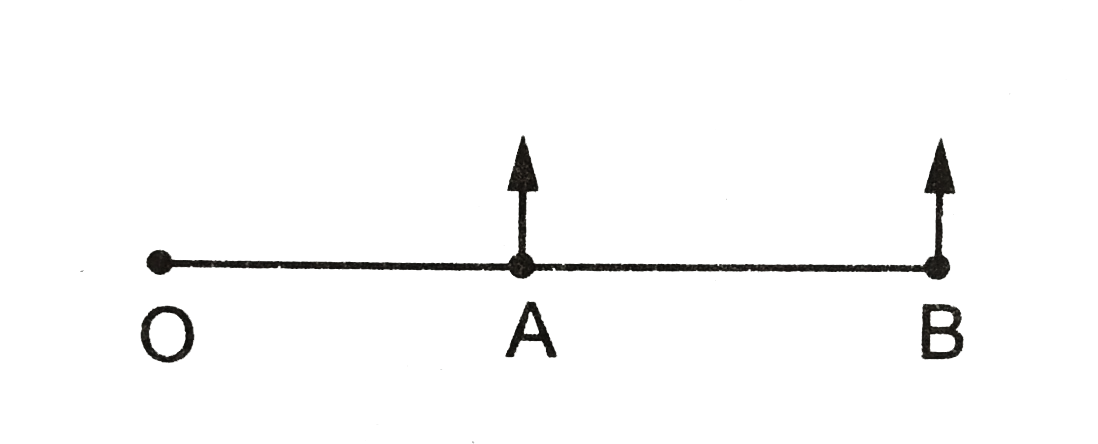


The situation is shown in ure. The velocity of the particle with respect to the fixed end O is `v_A=omega(d/2)` and that of B with respect to O is `v_B=omegad`. Hence the velocity of B with respect to A is `v_B-v_A=omega(d/2). `the angular momentum of B with respect to A is therefore
`L=mvr=momega(d/2)=1/4momegad^2`
along the directiion perpendicular to the plane of rotation.
Promotional Banner

Similar Questions

Explore conceptually related problems

A particle is rotating in circle with uniform speed . The angular momentum of the particle w.r.t. origin is :-

The thin rod shown below has mases M and length L. A force F acts at one end as shown and the rod is free to rotate about the other end in horizontal plane. Initial angular acceleration of the rod is :

A particle is moving along a straight line with increasing speed. Its angular momentum about a fixed point on this line :

Two particles A and B of mass 2m and m respectively are attached to the ends of a light inextensible string of length 4a which passes over a small smooth peg at a height 3a from an inelastic table. The system is released from rest with each particle at a height a from the table. Find - (i) The speed of B when A strikes the table (ii) The time that elapses begore A first hits the table. (iii) The time for which A is resting on the table after the first collision & begore it is first jerked off.

Consider two cylindrical rods of identical dimensions, one of rubber and the other of steel. Both the rods are fixed rigidly at one end to the roof. A mass M is attached to each of the free ends at the centre of the rods.

Three rods each of mass m and length l are joined together to form an equilateral triangle as shown in figure. Find the moment of inertial of the system about an axis passig through its centre of mass and perpendicular to the plane of the particle.

A particle of mass m is attached to one end of a mass-less spring of force constant k, lying on a frictionless horizontal plane. The other end of the spring is fixed. The particle starts moving horizontally from its equilibrium position at time t=0 with an initial velocity u_0 . when the speed of the particle is 0.5u_0 , it collides elastically with a rigid wall. After this collision

A pulley is attached to the celing of a lift moing upwards. Two particles are attached to the two ends of a stirng passing over the pulley. The masses of the particles are in the ration 2:1 if the acceleration of the particles is g/2, then the acceleration of the lift will be

Two particles each of mass m are connected by a light inextensible string and a particle of mass M is attached to the midpoint of the string. The system is at rest on a smooth horizontal table with string just taut and in a straight line. The particle M is given a velocity v along the table perpendicular to the string. Prove that when the two particles are about to collide : (i) The velocity of M is (Mv)/((M + 2m)) (ii) The speed of each of the other particles is ((sqrt2M (M + m))/((M + 2m)))v .

