Home
Class 11
PHYSICS
Find ∫(20x^3)/(1+x^4)dx. a) 5 log⁡(x^4...

Find ` ∫(20x^3)/(1+x^4)dx.`
`a) 5 log⁡(x^4)+C`
`b) -5 log⁡(1+x^4)+C`
`c) 5 log⁡(1+x^4)+C`
`d) log⁡(1+x^4)+C`

Text Solution

Verified by Experts
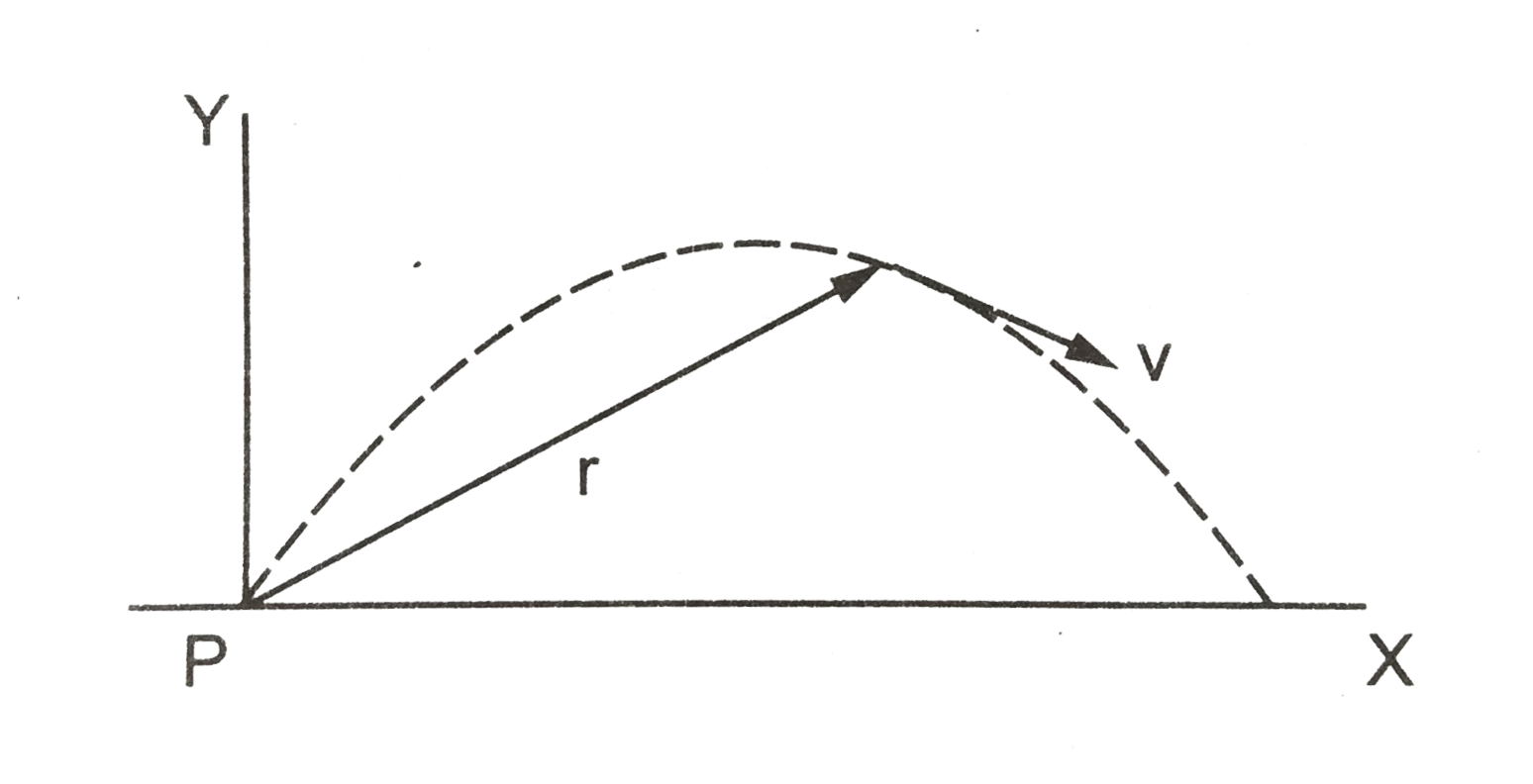
Let us take the origin at P, X-axis along the horizontal and Y-axis along the vertically upward direction as shown in ure. For horizontal motion during the time 0 to t`,

`v_x=v_0cos45^@=v_0/sqrt2`
and `x=v_xt=v_0/sqrt2.v_0/g=v_0^2/(sqrt2 g)`
for vertical motion, ltbr. `v_y=v_0sin45^@-gt=v_0/sqrt2-v_0=((1-sqrt2))/sqrt2v_0`
and `y=(v_0sin45^@)t-1/2gt^2`
`v_0^2(sqrt2g)-v_0^2/(2g)=v_0^2/(2g)(sqrt2-1)`
the angular momentum of the particle at time t about the origin is
`L=vecrxxvecp=mvecrxxvecv`
`=m(vecix+vecjy)xx(veciv_x+vecjv_y)`
`=m(veckxv_y-veckyv_x)`
`=mveck[(v_0^2/(sqrt2g)v_0/sqrt2(1-sqrt2)-v_0^2/(2g)(sqrt2-1)v_0/sqrt2]`
`-veck(mv_0^3)/(sqrt2 sg)`
Thus the angular momentum of the particle is `(mv_0^2)/(2sqrt2g)` in the negative Z direcrtion i.e. perpendicuar to the plane of motion going into the plane.
Promotional Banner

Similar Questions

Explore conceptually related problems

Find int((x^(4)-x)^(1/4))/(x^(5))dx

Given system of simultaneous equations 2^x\ . 5^y=1\ a n d\ 5^(x+1). 2^y=2. Then - (a) . x=(log)_(10)5\ a n d\ y=(log)_(10)2 (b) . x=(log)_(10)2\ a n d\ y=(log)_(10)5 (c) . x=(log)_(10)(1/5)\ a n d\ y=(log)_(10)2 (d) . x=(log)_(10)5\ a n d\ y=(log)_(10)(1/2)

If log_(4)5 = x and log_(5)6 = y then

If log_(sqrt(2)) sqrt(x) +log_(2)x + log_(4) (x^(2)) + log_(8)(x^(3)) + log_(16)(x^(4)) = 40 then x is equal to-

Which of the following when simplified reduces to an integer? a. (2log6)/(log12+log3) b. (log32)/(log4) c. ((log)_5 15-(log)_5 4)/((log)_5 128) d. (log)_(1//4)(1/(16))^2

find int ((x +1) (x + log x)^2)/(x)dx

log_(3/4)log_8(x^2+7)+log_(1/2)log_(1/4)(x^2+7)^(-1)=-2

Which pair of functions is identical? (a)sin^(-1)(sinx) ,sin(sin^(-1)x) (b) log_(e)e^(x),e^(log_(e)x) (c) log_(e)x^(2),2log_(e)x (d)None of the above

(d)/(dx). ((1)/(log|x|)) = …….

