Home
Class 11
PHYSICS
A square plate of mass 120g and edge 5.0...

A square plate of mass 120g and edge 5.00 cm rotates about one of the edges. If it has a unifrom angular acceleration of `0.2 rad/s^2`, what torque acts on the plate?

Text Solution

Verified by Experts

The correct Answer is:
A, B

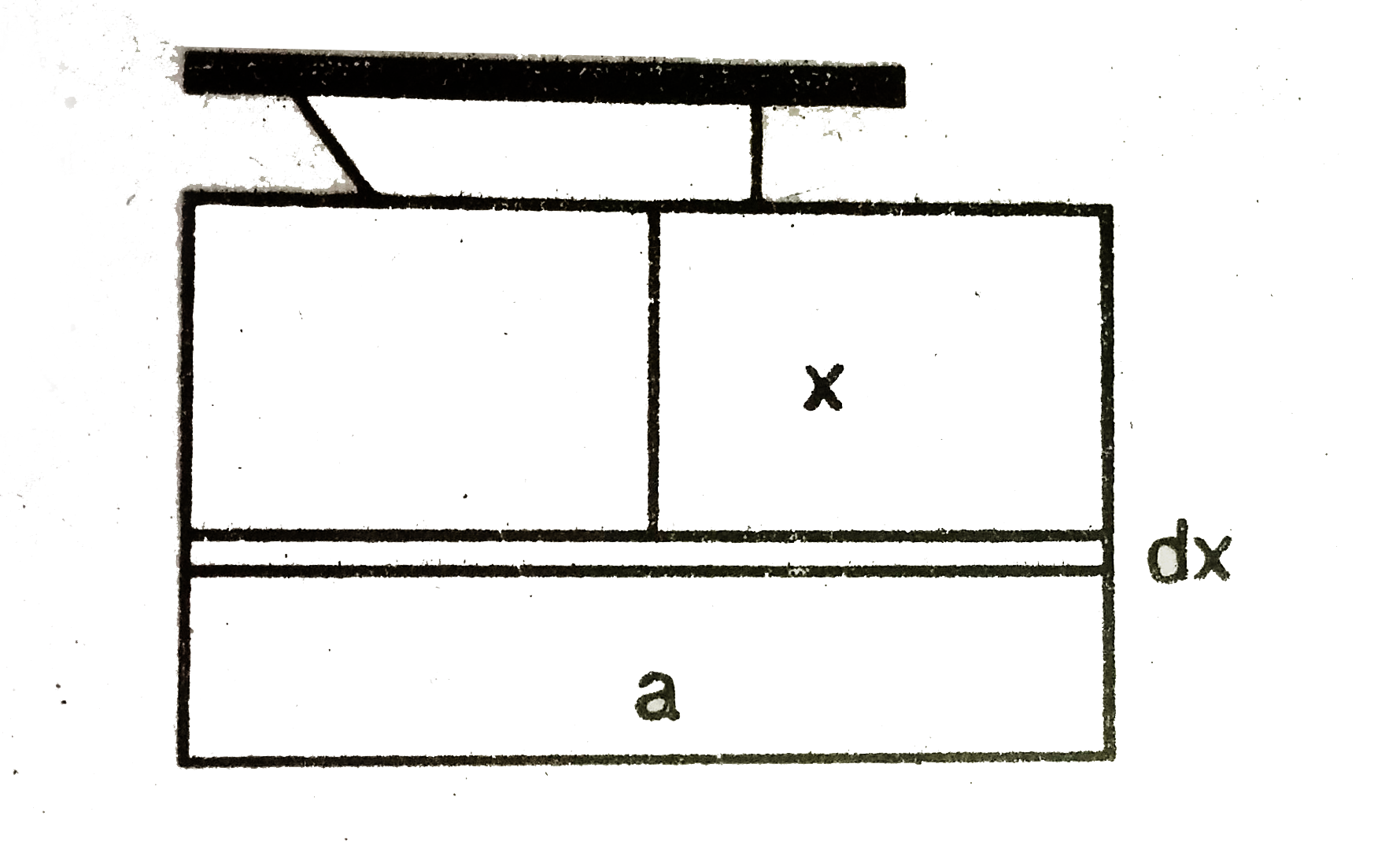
A square plate of mass 120gm and edge 5cm rotates about one of the edge.
Let take a small area of the square of width dx and length a which is at a distance from the axis of rotation.
Therefore, mass of that small area
`=m/a^2=adx`
(m=mass of the square , a=side of the plate)
`l=int_0^a9(m/a)^2xxax^2dx`
`=[(m/a)(x^3/e)]_0^a`
`=[(m/a)(x^3/3)]_)^a=(ma^3/3)`

Therefore torque produced
`=lxxa=((ma^2)/3)xxa`
`={((120xx10^-3xx52xx10^-4))/3.02}`
`=0.2xx10^-1`
`=0.2xx10^-1`
`=2xx10^-5 N-m`
Promotional Banner

Similar Questions

Explore conceptually related problems

The thin rod shown below has mases M and length L. A force F acts at one end as shown and the rod is free to rotate about the other end in horizontal plane. Initial angular acceleration of the rod is :

A particle starts from rest and moves on a curve with constant angular acceleration of 3.0 rad//s^(2) . An observer starts his stopwatch at a certain instant and recond that the particle covers an angular span of 120 rad at the end of 4^(th) second. How long the particle has moved when the observer started his stopwatch?

A particle of mass m and charge enters the region between the two charged plates initally moving along x axis with speed v_(x) the length of plate is l and an uniform vertical deflectio of the particle at the far edge of the plate is qEL^(2)//2mv_(x)^(2) compare this motion with motion of a projectile in gravitational field

A uniform circular disc of radius 50 cm at rest is free to turn about an axis which is perpendicular to its plane and passes through its centre it is subjected to a torque which produces a constant angular acceleration of 2.0 rad s^(-2) . Its net acceleration in ms^(-2) at the end of 2.0 s is approximately .............

A particle is moving on a circular path of radius 1.5 m at a constant angular acceleration of 2 rad//s^(2) . At the instant t=0 , angular speed is 60//pi rpm. What are its angular speed, angular displacement, linear velocity, tangential acceleration and normal acceleration and normal acceleration at the instant t=2 s .

A block of mass m = 20 kg is kept is a distance R = 1m from central axis of rotation of a round turn table (A table whose surface can rotate about central axis). Table starts from rest and rotates with constant angular acceleration, alpha = 3 rad//sec^(2) . The friction coefficient between block and table is mu = 0.5 . At time t = (x)/(30) from starting of motion (i.e. t =0) the block is just about to slip. Find the value of x (g = 10 m//s^(2))

A body rotates about a fixed axis with an angular acceleration of 5 rad//s^(2) The angle rotated by it during the time when its angular velocity increases frm 20 rad/s to 30 rad/s (in radian) is

A body rotates about a fixed axis with an angular acceleration of 5 rad//s^(2) The angle rotated by it during the time when its angular velocity increases frm 10 rad/s to 20 rad/s (in radian) is

A body rotates about a fixed axis with an angular acceleration of 3 rad//s^(2) The angle rotated by it during the time when its angular velocity increases frm 10 rad/s to 20 rad/s (in radian) is

A disc of mass 1 kg and radius 0.1 m is rotating with angular velocity 20 rad/s. What is angular velocity (in rad/s) if a mass of 0.5 kg is put on the circumference of the disc ?

