Home
Class 11
PHYSICS
Calculate the torque on the square plate...

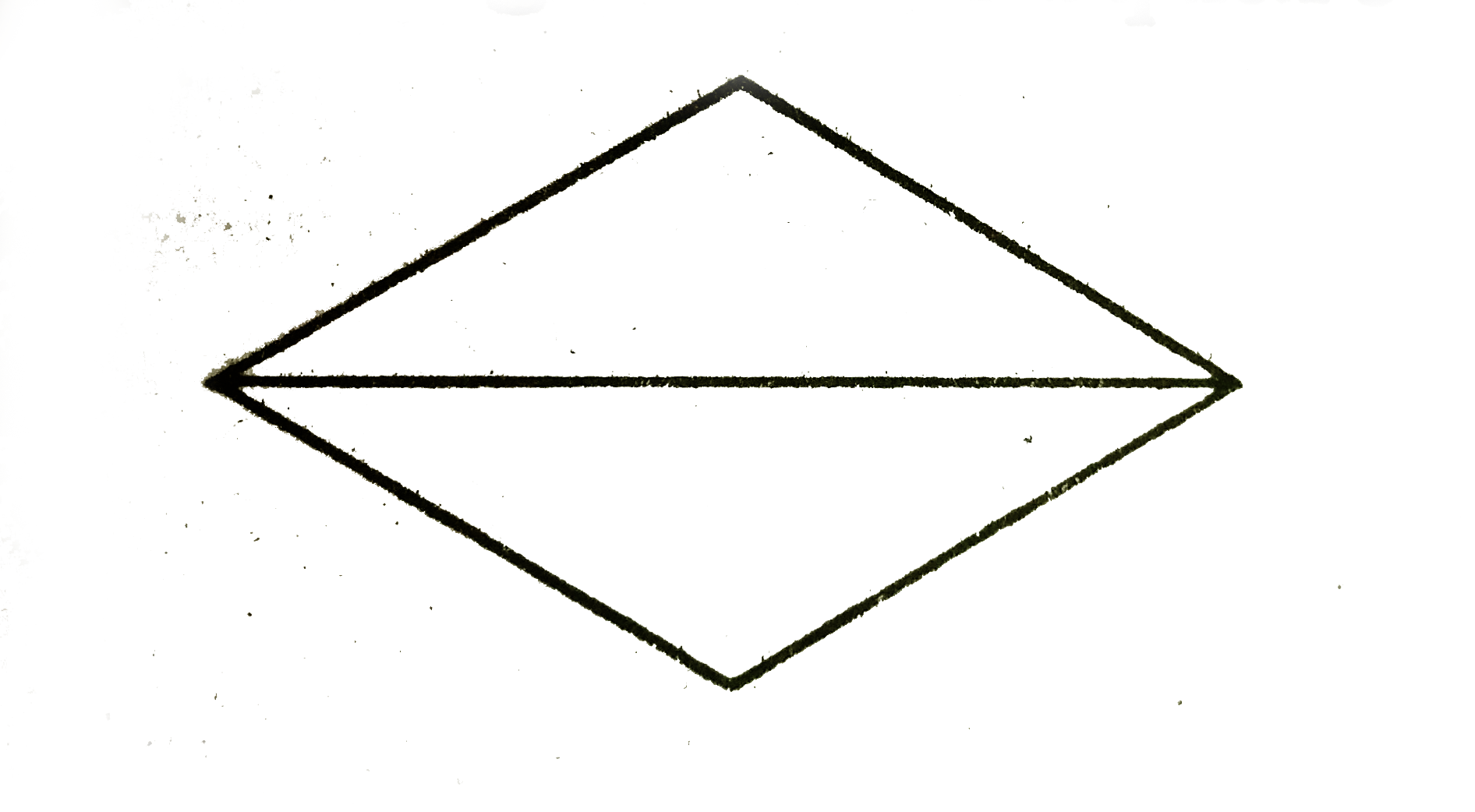
Calculate the torque on the square plate of the previous problem if it rorates about a diagonal with the same angular acceleration.

Text Solution

Verified by Experts

The correct Answer is:
A

Moment of inertial of a square plate about its diagoN/Al is `(ma^2)/12`
(m=mass o the square plate)
a=edges of the square

Therefore torque produced
`((ma^2)/12)xxl`
`({((120xx10^-3xx5.2xx10^-4))/(12 0.2)}`
`=10x25xx10^-7xx0.2`
`=0.5xx10^-5N-m`
Promotional Banner

Similar Questions

Explore conceptually related problems

The thin rod shown below has mases M and length L. A force F acts at one end as shown and the rod is free to rotate about the other end in horizontal plane. Initial angular acceleration of the rod is :

A long horizontal rod has a bead which can slide along its length and initially placed at a distance L from one end A of the rod. The rod is set in angular motion about A with constant angular acceleration alpha. if the coefficient of friction between the rod and the bead is mu , and gravity is neglected, then the time after which the bead starts slipping is

A block of mass m = 20 kg is kept is a distance R = 1m from central axis of rotation of a round turn table (A table whose surface can rotate about central axis). Table starts from rest and rotates with constant angular acceleration, alpha = 3 rad//sec^(2) . The friction coefficient between block and table is mu = 0.5 . At time t = (x)/(30) from starting of motion (i.e. t =0) the block is just about to slip. Find the value of x (g = 10 m//s^(2))

Calculate the distance from the surface of the earth at which acceleration due to gravity is the same as below and above the earth

If the magnitude of velocity in the previous question is decreasing with time, what is the direction of f angular acceleration (oversetrightarrow(alpha))?

Calculate the time period of a uniform square plate of side 'a' if it is suspended through a corner.

A uniform circular disc of radius 50 cm at rest is free to turn about an axis which is perpendicular to its plane and passes through its centre it is subjected to a torque which produces a constant angular acceleration of 2.0 rad s^(-2) . Its net acceleration in ms^(-2) at the end of 2.0 s is approximately .............

A solid sphere of mass m and radius R rotating about its diameter. A solid cylinder of the same mass and same radius is also rotating about its geometrical axis with an angular speed twice that of the sphere. The ratio of their kinetic energies of rotation ((E_("sphere"))/(E_("cylinder"))) will be = ..............

Two particles, each of mass m and speed v, travel in opposite directions along parallel lines separated by a distance d. Show that the angular momentum vector of the two particle system is the same whatever be the point about which the angular momentum is taken.

Two particles, each of mass m and speed v, travel in opposite directions along parallel lines separated by a distance d. Show that the vector angular momentum of the two particle system is the same whatever be the point about which the angular momentum is taken.

