Home
Class 11
PHYSICS
A flywheel of moment of inertia 5.0 kg m...

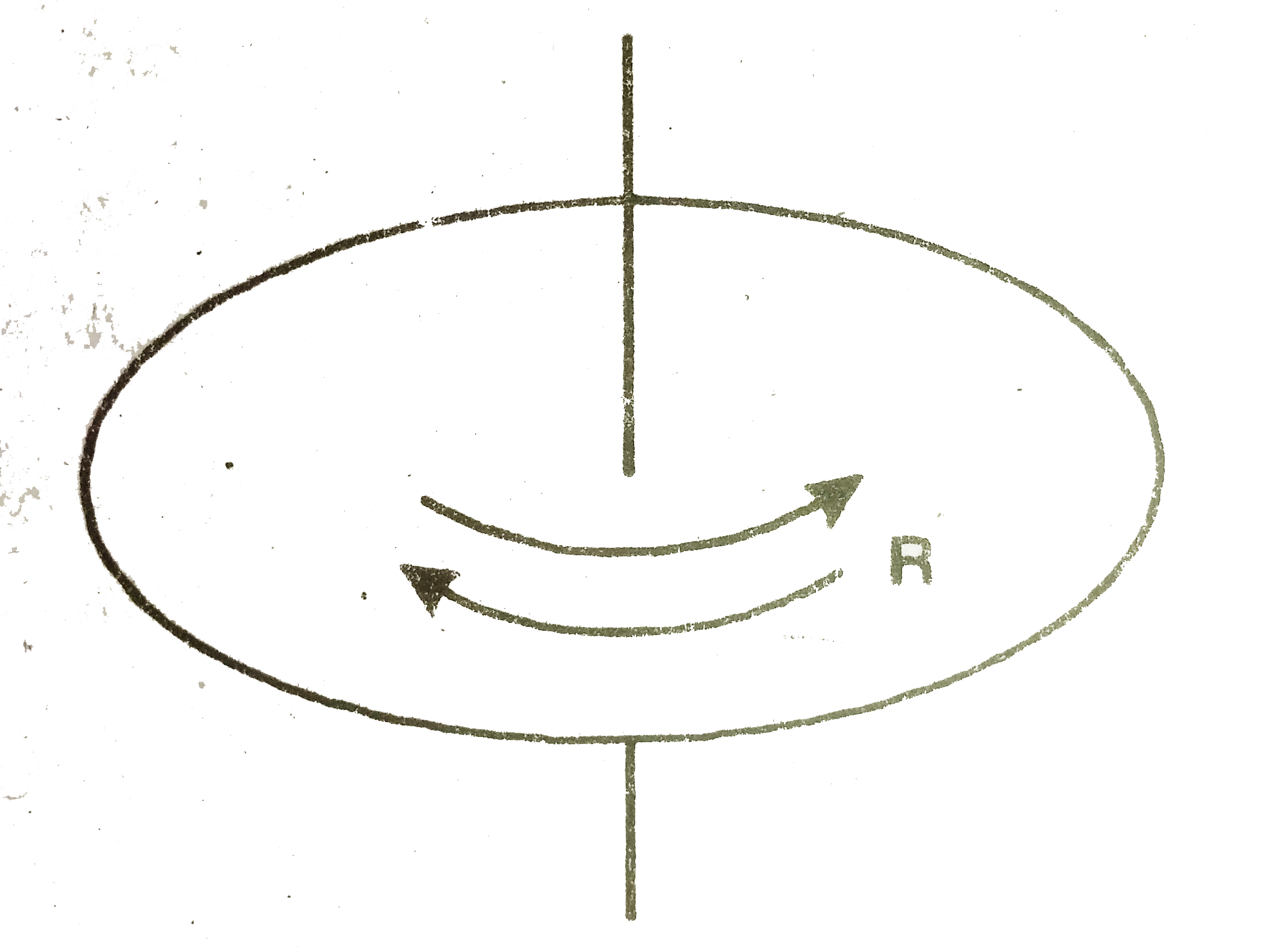
A flywheel of moment of inertia 5.0 kg m^2 is rotated at a speed of 60 rad/s. Because of the frictionat te axle, it comes to rest in 5.0 minutes. Find a. The average torque of the friction. B. the total work done by the friction and c. the angular momentum of the wheel 1 minute before it stops rotating.

Text Solution

Verified by Experts

The correct Answer is:
A, B, C

A fly wheel of moment of inertia 5 kg m is rotated at a speed of 60 rad/s. The fly wheel comes to rest due to the friction at the axis after 5 minutes.
therefore the angular deceleration poroduced due to friction force
`omega=omega_0+at`

`rarr omega_0=-at`
`rarr a=-(60/5xx60)`
`=-1/5rad/s^2`
a. therefore total work done in stopping the wheel by frictioN/Al force
`W=1/2 Iomega^2
`=1/2xx5xx(60xx60)`
`=1N-mopposite to the rotation of wheel
c. Angular velocity after 4 minutes
`rarr omega=omega_0+at`
`=60-240/5`
`60/5=12rad/s`
Therefore angular mometum abut the centre
`=Ixxomega`
`=5xx12=60kg-m^2/s`
Promotional Banner

Similar Questions

Explore conceptually related problems

A wheel having moment of inertia 4 kg m^(2) about its axis, rotates at rate of 240 rpm about it. The torque which can stop the rotation of the wheel in one minute is :-

A solid cylinder of mass 20 kg rotates about its axis with angular speed 100 rad s^(-1) . The radius of the cylinder is 0.25 m. What is the kinetic energy associated with the rotation of the cylinder? What is the magnitude of angular momentum of the cylinder about its axis?

A wheel having moment of inertia 2kgm^(2) about its vertical axis, rotates at the rate of 60 rpm about the axis. The torque which can stop the wheel.s rotation in one minute would be……………

A cord of negligible mass is wound round the rim of a fly wheel of mass 20 kg and radius 20 cm. A steady pull of 25 N is applied on the cord as shown in Fig. 7.35. The flywheel is mounted on a horizontal axle with frictionless bearings. (a) Compute the angular acceleration of the wheel. (b) Find the work done by the pull, when 2m of the cord is unwound. (c) Find also the kinetic energy of the wheel at this point. Assume that the wheel starts from rest. (d) Compare answers to parts (b) and (c).

A body of mass 2 kg initially kg intially at rest moves under the action of an applied horizontal force of 7 N on a table with coefficient of kinetic friction = 0.1 Compute the (a) work done by the applied force in 10 s. (b) work done by friction in 10 s . work done by the net force on the body in 10 s. (d) Change in kinetic energy of the body in 10 s and interpret your details .

A 100 turn closely wound circular coil of radius 10 cm carries a current of 3.2 A. (a) What is the field at the centre of the coil? (b) What is the magnetic moment of this coil? The coil is placed in a vertical plane and is free to rotate about a horizontal axis which coincides with its diameter. A uniform magnetic field of 2T in the horizontal direction exists such that initially the axis of the coil is in the direction of the field. The coil rotates through an angle of 90^@ under the influence of the magnetic field. (c) What are the magnitudes of the torques on the coil in the initial and final position? (d) What is the angular speed acquired by the coil when it has rotated by 90^@ ? The moment of inertia of the coil is 0.1 kg m^2 .

A fixed pulley of radius 20 cm and moment of inertia 0.32 kg. m^(2) about its axle has a massless cord wrapped around its rim. A mass M of 2 kg is attached to the end of the cord. The pulley can rotate about its axis without any friction. The acceleration of the mass M is :- (Assuming g=10m//s^(2) )

